Short answer: yes, South Korea is one of the easiest countries in Asia to backpack solo, even on a tight budget. The country is safe, transport is efficient, and there is enough English support that you will rarely feel stuck.
What makes it easy:
- Clear transport systems: Metro maps, intercity buses, and trains usually have English signage and announcements. Ticket machines often have an English option.
- High safety level: Violent crime against travelers is rare. You can walk around late, especially in busy areas, with normal street smarts.
- Reliable infrastructure: Fast Wi‑Fi almost everywhere, good 4G/5G coverage, and convenience stores on nearly every corner for cheap snacks and quick meals.
- Hostel scene: Seoul, Busan, and Jeju have plenty of hostels and guesthouses with social common areas, kitchens, and staff used to backpackers.
Challenges to be ready for:
- Language barrier outside big cities: In rural areas and small towns, English drops off fast. Offline translation apps and screenshots of key phrases help a lot.
- Cashless quirks: Korea is card-heavy, but some older guesthouses or countryside restaurants still prefer cash. ATMs that accept foreign cards are common in cities but less so in villages.
- Navigation apps: Google Maps is limited for navigation. Use Naver Map or KakaoMap; both have English interfaces but take a bit of getting used to.
If you are comfortable with basic planning, booking a few key stays ahead, and using apps for translation and maps, backpacking South Korea independently is very straightforward.
For a first-time backpacking trip, 10–14 days is the sweet spot if you want a mix of cities, culture, and a bit of hiking without sprinting. If you have less or more time, here is how to think about it:
5–7 days (quick hit):
- Focus: Seoul + 1 side trip.
- Example: 4–5 nights in Seoul, plus 1–2 nights in either Busan, Gyeongju, or Sokcho/Seoraksan.
- Good if you mainly want food, nightlife, and a taste of history.
10–14 days (ideal first trip):
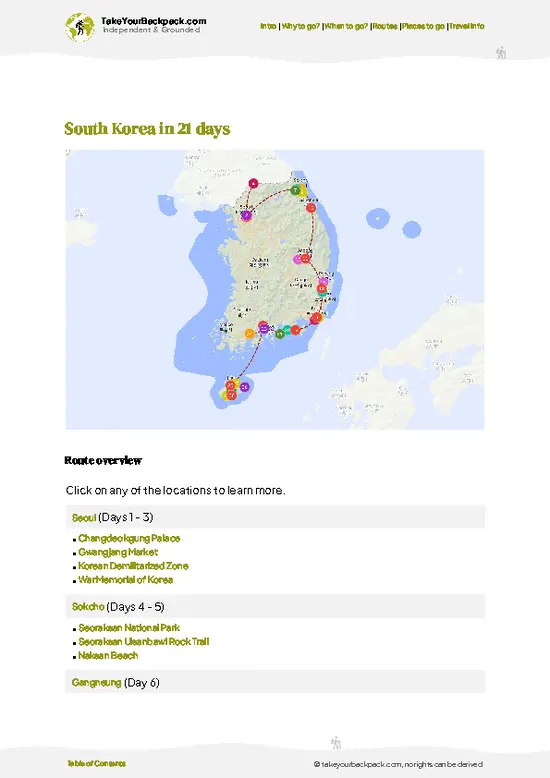
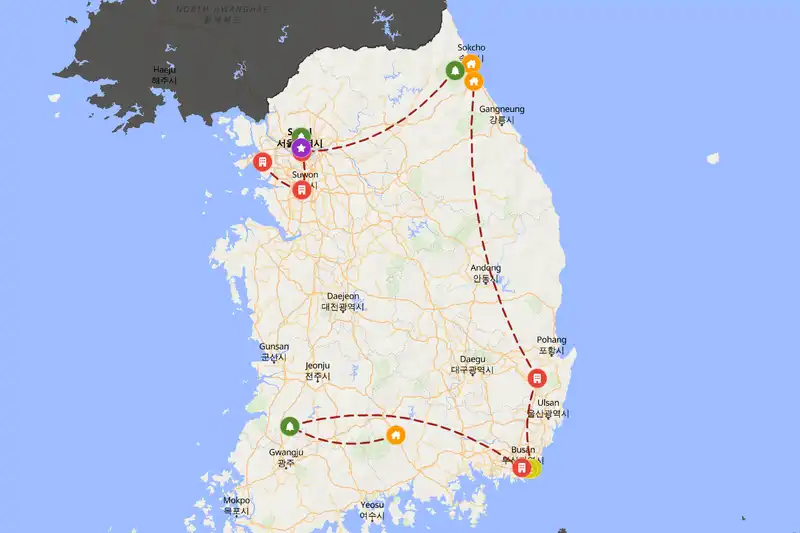
- Route idea: Seoul → Sokcho/Seoraksan → Gyeongju → Busan.
- This gives you: big-city energy, a national park hike, old capital history, and a coastal city.
- You can travel mostly by bus and train, with no need to rush.
3 weeks (slow and deep):
- Add: Jeju Island for coastal walks and volcanic landscapes, or smaller cities like Jeonju (traditional hanok houses and food) or Andong (folk village and Confucian heritage).
- You can build in rest days, repeat favorite food spots, and do more day hikes.
1 month+ (long backpacking loop):
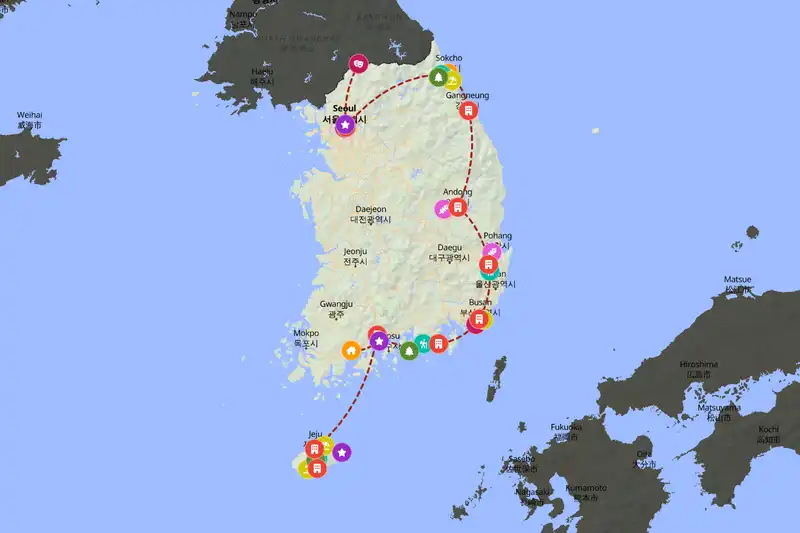
- You can circle the country, hit multiple national parks (Seoraksan, Jirisan, Hallasan on Jeju), and spend time in smaller towns.
- This is where you can chase festivals, seasonal activities (cherry blossoms, autumn foliage), and really lean into slow travel.
If you are on a tight budget, longer stays in fewer places usually save money because you can cook more, use weekly transit passes in cities, and avoid constant transport costs.
You can absolutely get around South Korea without a car; in fact, for most backpackers, not having a car is easier and cheaper.
Inside cities:
- Subways: Seoul, Busan, Daegu, and a few other cities have clean, frequent metro systems with English signage. A rechargeable T-money or Cashbee card works on most buses and subways nationwide.
- Buses: City buses fill in the gaps where the metro does not reach. They can feel chaotic at first, but stops are usually announced in English in big cities.
- Taxis: Affordable compared to many Western countries, and widely available. Use Kakao T app to avoid miscommunication and to see estimated fares.
Between cities:
- Express and intercity buses: The backbone of budget travel. They are frequent, comfortable, and reach more places than trains. Bus terminals are usually central and easy to navigate.
- Trains: KTX (high-speed) is fast but pricier; good for long hops like Seoul–Busan if you are short on time. Slower trains (ITX, Mugunghwa) are cheaper and still comfortable.
- Ferries: Useful for islands like Jeju or smaller offshore islands, though many travelers fly to Jeju because of frequent budget flights.
For national parks and rural areas:
- Buses usually connect nearby cities to park entrances (for example, Sokcho to Seoraksan). Schedules can be less frequent, so starting early in the day gives you more margin.
- Some trailheads are only reachable by infrequent local buses or short taxi rides from the nearest town, but you still do not need your own car.
If you stick to a typical backpacker route (Seoul, Busan, Gyeongju, Sokcho/Seoraksan, Jeonju, Jeju), public transport plus the occasional taxi is more than enough.
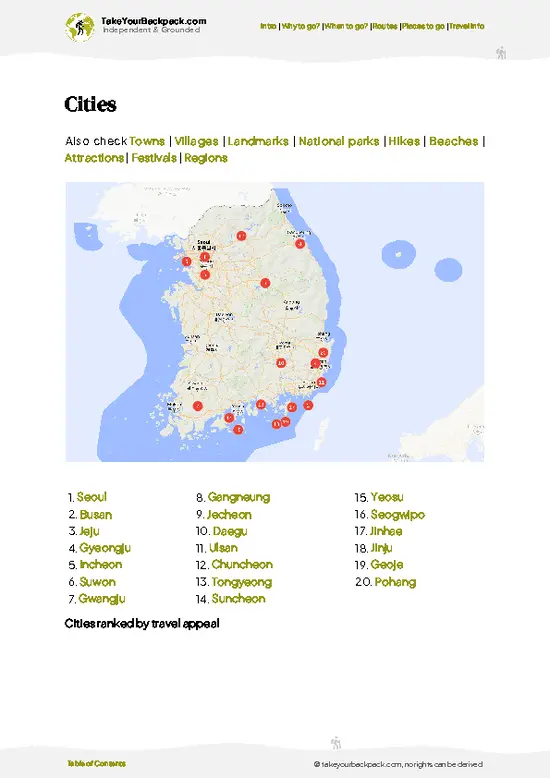
For a budget traveler or backpacker, the must-visits are the places that give you the most culture, food, and nature per won and per hour of transit.
Seoul (4–6 days total, possibly split at the start and end):
- Why it is worth it: Street food, nightlife, palaces, markets, and easy day trips.
- Key areas: Hongdae (youthful, live music, cheap eats), Itaewon (international food, bars), Insadong and Ikseon-dong (traditional meets trendy), Gangnam (modern, polished side of the city).
- Cheap highlights: Gyeongbokgung or Changdeokgung Palace, hiking up Inwangsan or Bukhansan for city views, wandering markets like Gwangjang for food.
Busan (2–3 days):
- Why: Coastal city with beaches, seafood, and a more relaxed vibe than Seoul.
- Cheap highlights: Haeundae and Gwangalli beaches, Gamcheon Culture Village (colorful hillside neighborhood), Jagalchi Fish Market, coastal walks around Taejongdae or Igidae.
Gyeongju (1–2 days):
- Why: Former Silla capital, often called a museum without walls.
- Cheap highlights: Tumuli Park burial mounds, Anapji (Donggung Palace and Wolji Pond), Bulguksa Temple, and night walks around the historic center.
Sokcho & Seoraksan National Park (2–3 days):
- Why: Some of the best hiking in the country, very accessible without a car.
- Cheap highlights: Day hikes like Ulsanbawi, cable car views if you want to splurge a bit, and Sokcho’s harbor and seafood.
Jeju Island (3–4 days, if you have time and can catch a cheap flight):
- Why: Volcanic landscapes, coastal trails, and a different pace from the mainland.
- Cheap highlights: Hallasan day hike (if you are fit), Olle walking trails, lava tubes, and free or low-cost coastal viewpoints.
If your time is tight, prioritize Seoul, one coastal city (Busan or Sokcho), and one historic stop (Gyeongju). That combination gives you a strong sense of modern Korea, old Korea, and outdoor Korea.
If you are short on time or money, skip anything that eats up hours of transit without adding a new side of the country. Here is what is easiest to cut:
Overdoing palaces and museums in Seoul:
- Visiting one or two major palaces (like Gyeongbokgung and Changdeokgung) is enough for most travelers. After that, they start to blur together.
- Same with museums: pick either the National Museum of Korea or the War Memorial, not every museum in town.
Theme parks (Lotte World, Everland):
- They are fun but expensive and time-consuming, and you can find similar parks elsewhere in the world.
- If you are on a backpacker budget, that money usually goes further on food, hikes, or an extra night in a new city.
Too many similar cities:
- Daegu, Daejeon, and some mid-sized inland cities are pleasant but not essential if you are rushing. They feel more like everyday Korea than must-see destinations.
- If you have already done Seoul and Busan, you can safely skip another big city and head to a national park or historic town instead.
Jeju Island on a very short trip:
- Jeju is great, but it costs extra time and money to reach. If you have less than 10 days in Korea, flying there can compress your schedule too much.
- You can get excellent hiking and coastal scenery on the mainland (Seoraksan, Tongyeong, or coastal walks near Busan) without the extra flight.
Overhyped shopping districts:
- Areas like Myeongdong used to be legendary for shopping, but if you are not into cosmetics or brand-name shopping, you can do a quick walk-through and move on.
- Focus instead on markets (Gwangjang, Namdaemun) and neighborhoods with character (Hongdae, Ikseon-dong), which are better for people-watching and cheap eats.
If you are forced to cut hard, keep: Seoul, one historic stop (Gyeongju or a day trip like Suwon), and one nature stop (Seoraksan or Busan’s coastal trails). Everything else is optional layering, not the core experience.