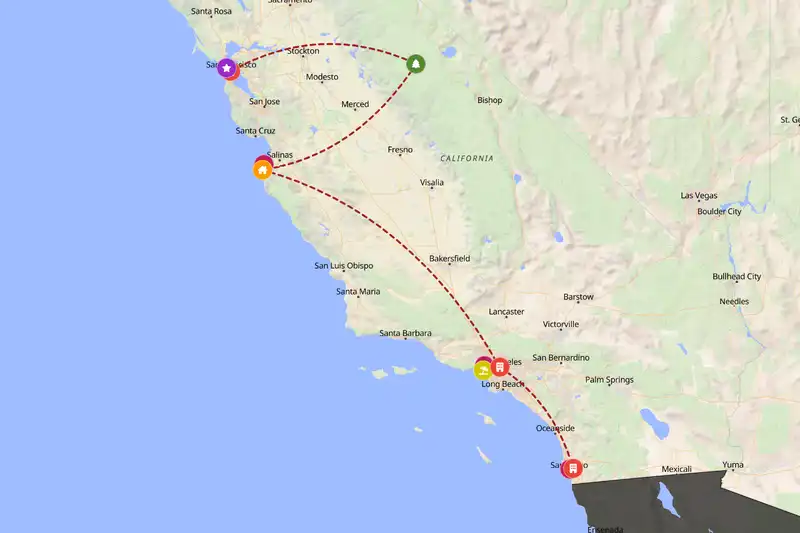
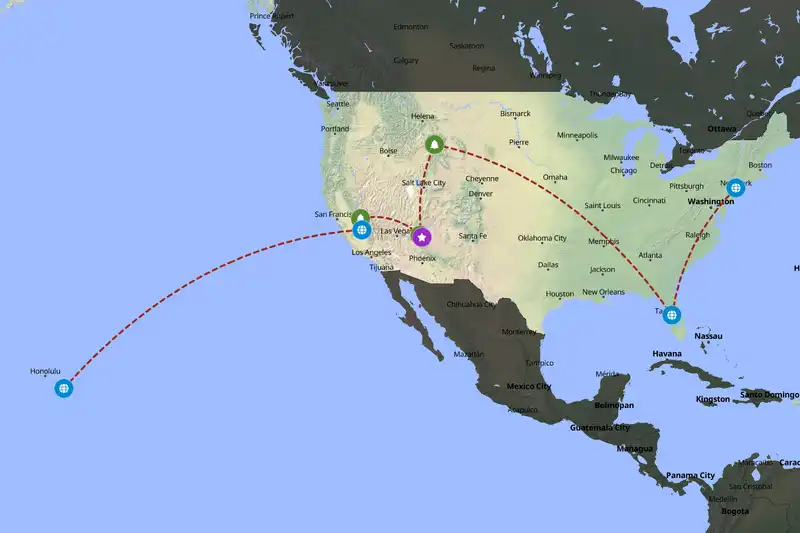
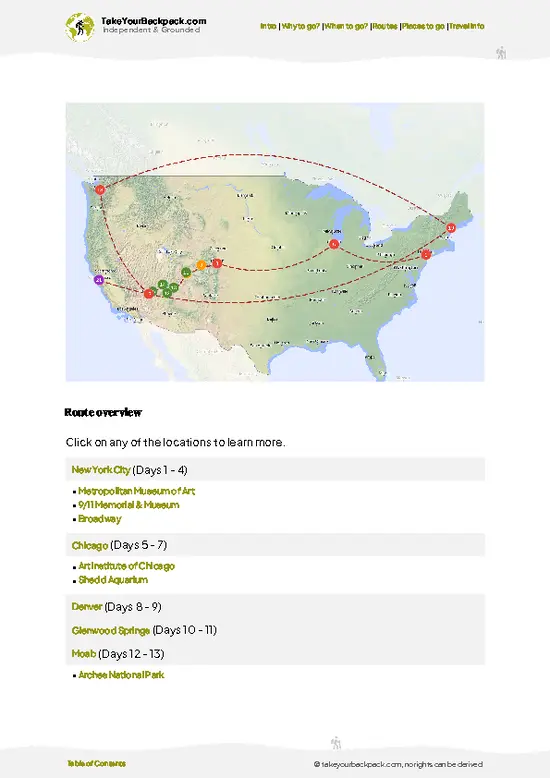
This month-long route suits travelers who want the United States at full scale: the two great inland and Atlantic cities, an overnight train across the plains, the red-rock canyon country, and a slow finish in the Pacific Northwest and San Francisco. The pace is moderate, with three or four nights in the cities and two in each park. You will use domestic flights, Amtrak’s California Zephyr and Cascades trains, city subways and light rail, park shuttles, and one rental car for about a week through Utah and Arizona, the only stretch where public transport cannot do the job.
Days 1-4: New York City
Open in
New York City because it has the most international flights and the deepest bench of things to do on day one. Give one full day to the
Metropolitan Museum of Art, where the Egyptian Temple of Dendur sits in a glass-walled hall facing Central Park (entry around US$30 for visitors from outside New York State). Spend a quieter morning at
The National September 11 Memorial & Museum: the two pools …
read more 👉This month-long route suits travelers who want the United States at full scale: the two great inland and Atlantic cities, an overnight train across the plains, the red-rock canyon country, and a slow finish in the Pacific Northwest and San Francisco. The pace is moderate, with three or four nights in the cities and two in each park. You will use domestic flights, Amtrak’s California Zephyr and Cascades trains, city subways and light rail, park shuttles, and one rental car for about a week through Utah and Arizona, the only stretch where public transport cannot do the job.
Days 1-4: New York City
Open in New York City because it has the most international flights and the deepest bench of things to do on day one. Give one full day to the Metropolitan Museum of Art, where the Egyptian Temple of Dendur sits in a glass-walled hall facing Central Park (entry around US$30 for visitors from outside New York State). Spend a quieter morning at The National September 11 Memorial & Museum: the two pools fill the footprints of the towers and cost nothing to visit, while the museum underneath runs about US$33 to 36 and needs two to three hours. Evenings belong to the Broadway Theaters. The TKTS booth in Times Square sells same-day seats at a discount, so you can decide that afternoon.Days 5-7: Chicago
A 2 to 2.5 hour flight takes you to Chicago, a city most visitors underrate until they stand on the river and look up. Take the architecture boat tour, then walk to the Art Institute of Chicago, home to Hopper’s Nighthawks, Seurat’s La Grande Jatte and Grant Wood’s American Gothic. The Shedd Aquarium sits on the lakefront Museum Campus, so pair it with a walk along Lake Michigan. The L train runs from both airports straight into the Loop, so you can skip taxis entirely.Days 8-10: The California Zephyr to Denver
Board the California Zephyr at Union Station in the early afternoon and wake up the next morning in Denver, roughly 18 to 19 hours later. The overnight across Iowa and Nebraska is flat but restful, and it saves a hotel night. Two nights in Denver are enough to recover, walk the murals of the RiNo district and adjust to 1,600 meters of altitude before the mountains.Days 11-12: Glenwood Springs
This is the most scenic train day of the trip: about 6 hours on the Zephyr from Denver, climbing through the 10-kilometer Moffat Tunnel and then threading the Colorado River gorges of Gore Canyon and Glenwood Canyon. The station drops you in walking distance of everything in Glenwood Springs, including the block-long Glenwood Hot Springs Pool. After a week of cities, two nights of soaking and short canyon walks reset your legs for the desert.Days 13-14: Moab and Arches National Park
Ride the Zephyr another 2 hours west to Grand Junction, pick up your rental car, and drive about 2 hours to Moab. Base yourself here for Arches National Park, 10 minutes north of town. Between April and October you need a timed-entry reservation, so book it when you book the car. The 4.8-kilometer round trip to Delicate Arch climbs about 150 meters over open slickrock; go in the last two hours of daylight when the sandstone turns orange and the heat breaks.Days 15-16: Grand Canyon National Park
The drive south to Grand Canyon National Park takes 5 to 5.5 hours through Monument Valley, so make it the day’s only plan. Sleep at the South Rim, either in Mather Campground or in Tusayan just outside the gate, and spend the full second day walking the Rim Trail and dropping a short way down the Bright Angel or South Kaibab trails. Vehicle entry is US$35 and valid for seven days, and visitors who are not US residents pay an extra US$100 per person. Turn back by midday on the descent; the climb out is always harder than it looks from the top.Days 17-18: Lower Antelope Canyon and Zion National Park
Head east and north to Page, about 2.5 hours, for a guided tour of Lower Antelope Canyon, a narrow slot of carved sandstone that you can only enter with Navajo-operated tours booked in advance. Continue around 2 hours to Springdale, the gateway to Zion National Park. Leave the car parked: the free canyon shuttle runs most of the year and is the only way up the main road in peak season. If you won the permit lottery, hike Angels Landing early, when the chain section along the ridge is less crowded; if not, wade the first few kilometers of the Narrows.Days 19-20: Valley of Fire and Las Vegas
On the 2.5 to 3 hour drive to Las Vegas, add an hour-long detour through Valley of Fire State Park, where the red sandstone and petroglyphs on Mouse’s Tank trail are a short walk from the road. Drop the car at the airport and spend two nights in Las Vegas. Midweek rooms on the Strip can drop to US$40 to 80 before resort fees, and Fremont Street downtown has the old neon and cheaper drinks.Days 21-23: Seattle
Fly about 2.5 hours north to Seattle, where the Link light rail runs from the airport to downtown in roughly 40 minutes. Walk Pike Place Market in the morning before the crowds, then take the walk-on ferry to Bainbridge Island (about 35 minutes each way, around US$10) for the best view back at the skyline and, on clear days, Mount Rainier.Days 24-25: Portland
The Amtrak Cascades covers Seattle to Portland in about 3.5 hours. Portland is the most relaxed stop on the route: eat from the food cart pods, lose an afternoon in Powell’s City of Books, which fills an entire city block, and walk the trails of Forest Park without leaving city limits.Days 26-30: San Francisco
A short flight of 1.5 to 2 hours brings you to San Francisco for a slow, four-night finish. Book the Alcatraz ferry several weeks out, spend a day cycling Golden Gate Park to Ocean Beach, and walk the Lands End trail for the view of the Golden Gate Bridge framed by cypress trees and sea cliffs. Four nights here means you fly home rested rather than wrecked.
If a friend asked me for one extra stop, I would send them 50 minutes from Moab to Dead Horse Point State Park for sunset over the Colorado River’s gooseneck bend, and I would tell them to bring a headlamp and a warm layer for the drive back.
 Best Backpacking