×
Chad🇹🇩 | 21 days itinerary

Your 21-Day Chad Itinerary

By Johan Kruseman 🇳🇱 | Updated May 8, 2026
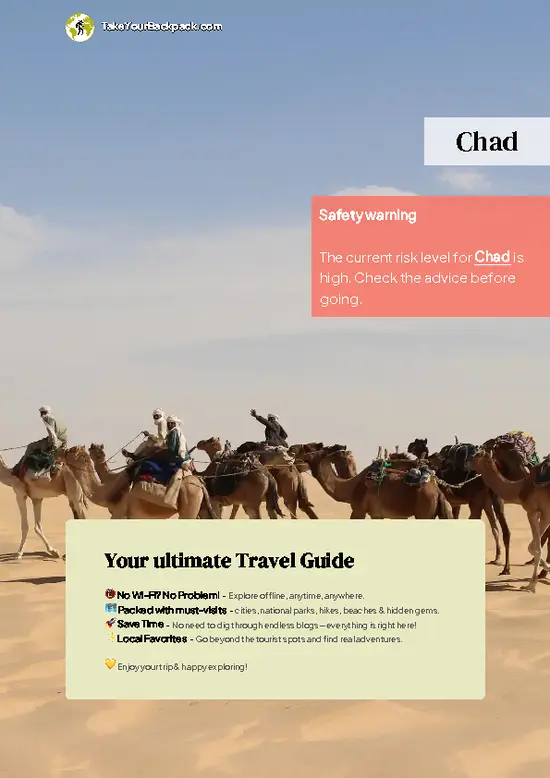
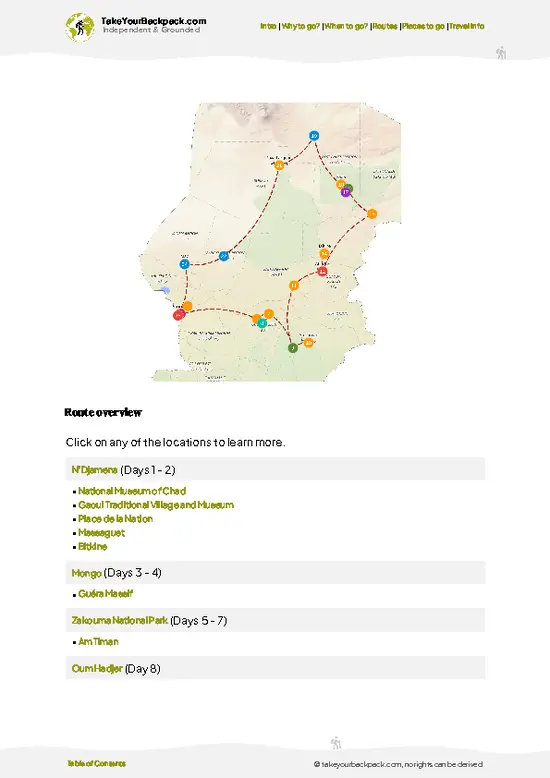
This 21-day route is for travelers who want to go all in on Chad: desert plateaus, rock arches, remote oases, classic Sahel towns, and a serious safari, with enough time to breathe between big moves. You’ll need a well-prepared 4x4 with driver for most of the journey, plus occasional local taxis in towns; the pace is adventurous but not punishing, with rest days built in after long hauls.

Days 1-3: N’Djamena - Capital crash course

Begin in N’Djamena to get your cultural and logistical footing before heading into the deep field. Spend time at the National Museum of Chad to understand the layers of history that run from prehistoric Sahara to modern politics, then work your way through the N’Djamena Central Market and Crafts Market of N’Djamena to see how those layers show up in everyday goods and handicrafts. Visit the Grand Mosque of N’Djamena and Chad’s Grand Mosque as key spiritual and architectural anchors, then ease into the rhythm of the city with evenings on Avenue Charles de Gaulle read more 👉
This 21-day route is for travelers who want to go all in on Chad: desert plateaus, rock arches, remote oases, classic Sahel towns, and a serious safari, with enough time to breathe between big moves. You’ll need a well-prepared 4x4 with driver for most of the journey, plus occasional local taxis in towns; the pace is adventurous but not punishing, with rest days built in after long hauls.

Days 1-3: N’Djamena - Capital crash course

Begin in N’Djamena to get your cultural and logistical footing before heading into the deep field. Spend time at the National Museum of Chad to understand the layers of history that run from prehistoric Sahara to modern politics, then work your way through the N’Djamena Central Market and Crafts Market of N’Djamena to see how those layers show up in everyday goods and handicrafts. Visit the Grand Mosque of N’Djamena and Chad’s Grand Mosque as key spiritual and architectural anchors, then ease into the rhythm of the city with evenings on Avenue Charles de Gaulle nightlife strip, where you can meet drivers, fixers, and fellow travelers who know the road ahead.

Days 4-8: Borkou, Faya-Largeau, and the Ennedi - Desert gateways and rock cathedrals

Head north into the Borkou region, using Moussoro as a first Sahel staging town before pushing on to Faya-Largeau, the classic desert hub where fuel, supplies, and local knowledge come together. From here, continue toward the Ennedi Plateau and the broader Ennedi Massif, where sandstone cliffs, canyons, and rock arches turn the desert into a natural sculpture park. Hike sections of the Fada Arch Trail to stand under vast stone spans and explore side canyons, then make time for the legendary Guelta d’Archei, where sheer rock walls and a permanent water source create an improbable refuge for wildlife and camel caravans. Nights under the stars out here are as much a highlight as the daytime hikes, so don’t rush this phase.

Days 9-11: Lakes of Ounianga and the far north

Continue deeper into the Sahara toward the Lakes of Ounianga region and the Ounianga Lakes themselves, a chain of surreal, multi-colored lakes ringed by dunes and cliffs that feel like a mirage made real. Use a full day to walk along the shores and viewpoints, watching how the light changes the water and the surrounding sand, and another to explore nearby villages and learn how people have adapted to life around these improbable water sources. This is one of those rare places where you want to move slowly, letting the silence and scale of the desert sink in rather than treating it as a quick photo stop.

Days 12-14: Guera Massif and central highlands

Begin your journey back south, angling toward the central highlands and the Guera Massif. Base yourself in Mongo, a town that gives you access to the surrounding hills and a very different feel from both the capital and the deep desert. Spend your days hiking around the massif, exploring rock outcrops and small villages, and enjoying cooler evenings that make it easier to recover from the long drives you’ve just done. This phase is about rebalancing: still adventurous, but with shorter day trips and more time to sit with tea and watch daily life.

Days 15-18: Salamat, Am Timan, and Zakouma - Wildlife and wild savanna

Push southeast into the Salamat region, using Am Timan as your main base for supplies and local contacts. From here, dedicate your prime days to Zakouma National Park, where you can switch from desert and rock to grasslands, rivers, and dense wildlife. Plan at least two full days of game drives to maximize your chances of seeing elephants, antelope, and serious birdlife, and use the quieter midday hours to rest, journal, or talk with rangers about the park’s conservation story. The contrast with the empty expanses of the north is dramatic, and it’s this shift that makes the long route feel like a complete portrait of the country.

Days 19-21: Southern towns and the road back

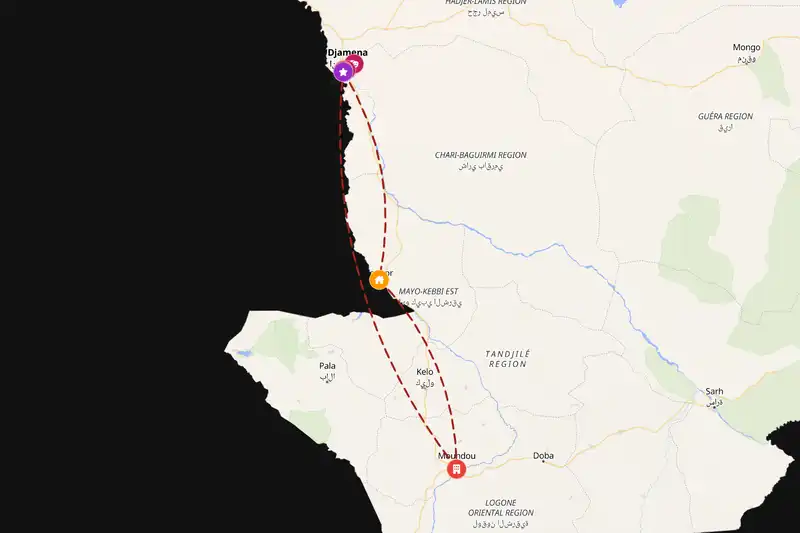
On your way back toward the capital, swing through Koumra to get a taste of a southern town that rarely sees international visitors, then continue to Moundou, one of Chad’s key cities in the south. Here you can enjoy a more relaxed urban vibe, with time to wander markets and sample regional food that differs from what you had in N’Djamena and the north. Finish by returning to N’Djamena for a last pass through the N’Djamena Central Market and a final evening on Avenue Charles de Gaulle nightlife strip, where the noise and lights feel almost gentle after the silence of the desert and the calls of Zakouma’s wildlife.


As a bonus, those who can’t stop chasing remote horizons can daydream about a future expedition to the windswept plateaus around Yebbibou, where ancient rock art and lonely tracks hint at stories few outsiders ever hear.
Loading the map 🌍
film
0
0
0a
N’Djamena Central Market
film
1
1
1a
Crafts Market of N’Djamena
film
2
2
2a
Grand Mosque of N’Djamena
film
3
3
3a
Ennedi Massif

🛏️ Where to stay?Where You'll Go

✈️ The backpacker research shortcutChad Travel Guide

An offline-friendly backpacking guide with optimized travel routes, ranked highlights, transport advice, and the best areas to stay.
example page 0 from our offline Travel Guide for Chadexample page 1 from our offline Travel Guide for Chadexample page 2 from our offline Travel Guide for Chadexample page 3 from our offline Travel Guide for Chadexample page 4 from our offline Travel Guide for Chadexample page 5 from our offline Travel Guide for Chad
The digital guide (257 pages) contains:
69 highlights, ranked by travel appeal
Optimized 7, 14 & 21-day travel routes
Best neighborhoods to stay
How to get around
Offline-friendly for travel without Wi-Fi
👉 See all 30+ guide features

📅 Plan smarter in minutes, not weeks
Month by month travel advice
Festivals & national holidays
Budget expectations

🗺️ Go to the right places, skip the overrated ones
Honest pros & cons of destinations
Top hikes, parks & viewpoints
Lesser-known places most travelers miss
Clear “worth it vs skip it” guidance

🛏️ Travel smoothly without rookie mistakes
Best areas to stay
Transport systems explained simply
Common scams & safety advice
SIM cards, money & practical tips

🌍 Understand the country, not just visit it
Culture & traditions
52 Essential phrases & customs
Festivals worth planning around
Traveler-friendly historical context
Insights that make places more meaningful

📱 Built for real travel conditions
Fully downloadable PDF
Works completely offline
Optimized for phone use
Useful in remote areas & buses
Everything in one place
Save weeks of stressful planning
Get instant access to the full guide directly. 30-day money-back guarantee.


Sent to your inbox immediately after payment • 100% Secure Checkout
Best Backpacking Travel Advisor 2025 tourism awardBest Backpacking
Travel Advisor
2025
What others say about Take Your Backpack Guides:
⭐⭐⭐⭐⭐
Fantastic, amazing amount of information!
⭐⭐⭐⭐⭐
My goodness this is amazing, it's what I've been looking for hats off too you!
⭐⭐⭐⭐⭐
I think this is absolutely BRILLIANT
⭐⭐⭐⭐
Very complete and informative. It's still missing places, but I gotta to commend you
⭐⭐⭐⭐⭐
This is truly amazing, thank you, can't wait to explore it with my kids!
⭐⭐⭐⭐⭐
Awesome resource, thank you!
⭐⭐⭐⭐⭐
This is amazing! Can't wait to explore the ones I haven't seen
⭐⭐⭐⭐
I love this! Well done, great idea.
⭐⭐⭐⭐⭐
Thanks for taking the time to make this gem!
⭐⭐⭐⭐⭐
This might be the best website I've ever seen.
⭐⭐⭐⭐⭐
Congratulations, and thank you so much for your work; it's incredibly valuable.
⭐⭐⭐⭐
In all seriousness I think you did a great job pointing out the important spots
⭐⭐⭐⭐⭐
10/10 very good
⭐⭐⭐⭐⭐
As someone who's only just starting to visit regularly this is awesome, thank you.
⭐⭐⭐⭐
Thank you very much! I'm going to visit my dad, it's going to be very useful!
⭐⭐⭐⭐⭐
This is really cool! We'll be travelling for the first time and this definitely come in handy.
⭐⭐⭐⭐⭐
You are now our minister of culture, congratulations 👨‍💼
⭐⭐⭐⭐⭐
Just wanted to tell you that this is a pearl! Going to follow your recommendations.
⭐⭐⭐⭐⭐
This is so cool. I'll definitely be using the resource for my travels soon.
⭐⭐⭐⭐⭐
This is very impressive! Good work.
⭐⭐⭐⭐⭐
This is an amazing and informative site. Very well done!

🧭 RouteAdjust Your Pace

Travel Chad your way — from a quick highlights trip to a slow-paced adventure.

🙋 FAQTraveler FAQ

Short answer: no, Chad is not an easy independent backpacking country, especially compared with West or East Africa, but a determined, experienced traveler can do it with planning and flexibility.

Security is the main constraint. Large areas have travel advisories due to banditry, rebel activity, and landmines, especially near borders (Libya, Sudan, CAR, parts of Lake Chad). That doesn’t mean the whole country is off-limits, but it does mean you should stick to relatively stable corridors and get up-to-date local advice in N’Djamena before moving on.

Costs are another surprise. Chad is poor but not cheap. Fuel, imported food, and accommodation for foreigners are expensive, and there’s almost no backpacker infrastructure. You won’t find a chain of $5 hostels and easy public buses like in Southeast Asia. Think basic guesthouses, NGO-style hotels, and shared taxis, with prices that feel more like a mid-range African capital than a budget hub.

Language matters. Outside N’Djamena, French and local languages dominate. English is rare. If you don’t have at least survival French, independent travel becomes much harder: negotiating rides, permits, and rooms will be slow and frustrating.

Permits and bureaucracy can be a headache. Photography of government buildings, bridges, and military is sensitive. Police checkpoints are frequent; you need multiple passport copies and a calm, patient attitude. Sometimes you’ll be asked for a “contribution.” Staying polite, never confrontational, and having your paperwork in order is crucial.

For first-time backpackers to Africa, Chad is a tough starting point. For someone who has already handled places like Mauritania, DRC, or remote Ethiopia, Chad is doable if you:
- Keep your route conservative and avoid border zones.
- Accept that you’ll pay more than in classic backpacker countries.
- Use local contacts, guesthouse owners, and trusted drivers for intel.
- Stay flexible: plans may change due to security, fuel, or weather.

If you want a low-stress, social hostel scene, Chad will frustrate you. If you’re chasing raw, off-grid adventure and you’re comfortable with risk management, it can be one of the most intense trips you ever do.
For a meaningful backpacking trip, 2 weeks is the bare minimum, 3–4 weeks is ideal, and anything less than 10 days is basically a rushed sampler of N’Djamena plus one region.

Under 10 days: You can realistically do N’Djamena and a short excursion:
- City + culture: 2–3 days in N’Djamena to get your bearings, sort permits, and recover from travel.
- Nearby trips: A quick visit to Gaoui village (traditional architecture), maybe a short Sahel excursion if you find a reliable driver.
This is fine if you’re already in Central Africa and just passing through, but not worth a dedicated long-haul flight.

2 weeks: This is the minimum to justify the effort and cost.
- N’Djamena: 2–3 days for admin, markets, and logistics.
- One major region: Either Ennedi (desert rock formations, canyons, and rock art) or Zakouma National Park (wildlife), but not both unless you fly or move very fast.
- Travel days: Overland distances are huge, roads can be rough, and breakdowns or delays are normal. You’ll lose several days just moving between places.

3 weeks: This is the sweet spot for most backpackers.
- N’Djamena: 2–3 days.
- Ennedi: 7–10 days including transit, exploring arches, canyons, and oases.
- Extra region: Either a shorter Zakouma visit (if seasonally open) or a Sahel/central region loop.
You get enough time to absorb the pace of the country instead of just bouncing between vehicles.

4+ weeks: Best for slow travelers and overlanders.
- You can combine Ennedi, Zakouma, and a more exploratory route through central or southern Chad.
- You’ll have time to wait out delays, fix vehicle issues if overlanding, and build relationships with local contacts.

Season matters more than exact trip length. Zakouma is mainly a dry-season destination (roughly December–April) when roads are passable and wildlife viewing is at its peak. The rains can turn some routes into mud traps and cut off remote areas. If you only have a short window, align it with the dry season and focus on one region done well rather than trying to cover the whole map.
You can technically move around parts of Chad without your own car, but for most backpackers it’s only practical in limited corridors, and for serious exploration you’ll almost certainly need to hire a vehicle with a driver or join an expedition.

Inside N’Djamena:
- Shared taxis and moto-taxis are common and cheap by local standards. They’re fine for getting around the city if you negotiate prices in French and keep your valuables low-key.
- Walking is possible in central areas during the day, but heat and dust are real factors.

Between major towns:
- There are long-distance shared taxis, minibuses, and trucks that carry passengers. They’re crowded, slow, and not always safe, but they’re the backbone of local travel.
- Schedules are fluid: vehicles leave when full, not at fixed times. You may wait hours at a station.
- Comfort is minimal: expect cramped seats, livestock, and loud music. It’s cheap but exhausting.

For remote regions (Ennedi, Zakouma, desert and Sahel zones):
- Public transport is either nonexistent or so irregular that it’s not realistic for a tight itinerary.
- Roads can be sand tracks, rocky pistes, or seasonal mud. A high-clearance 4x4 with an experienced driver is standard, not a luxury.
- Fuel availability is patchy; drivers often carry jerrycans. Trying to hitch or rely on random trucks in these areas is risky and can leave you stranded.

Domestic flights:
- There are occasional internal flights linking N’Djamena with some regional centers or Zakouma (often via charter or arranged through operators). They’re expensive but can save days of overland travel.

For a budget traveler, the realistic compromise is:
- Use shared taxis/minibuses for short hops and to keep costs down on main routes.
- Pool with other travelers (if you find them) to hire a 4x4 and driver for big-ticket regions like Ennedi or Zakouma.
- Accept that transport will eat both time and money, and build in buffer days for delays.

Trying to see the country purely by public transport is possible in theory but will limit you to a few corridors and leave out the most spectacular desert and wildlife areas.
For a budget-minded backpacker willing to rough it, these are the places that justify the effort and cost of coming to Chad:

1. Ennedi Plateau (Ennedi Massif)
This is the headline act. Think towering sandstone arches, slot canyons, rock pillars, and hidden gueltas (waterholes) in the middle of the Sahara. It feels like walking through a natural sculpture park built on a planetary scale.
- Why it’s worth it: The combination of desert landscapes, rock art, and remote camps under absurdly clear night skies is rare even by global standards.
- Backpacker angle: It’s not cheap because you’ll need a 4x4, fuel, and a guide/driver, but if you split costs with others, it becomes one of those “worth-the-splurge” trips that actually earns the price tag.

2. Zakouma National Park (in season)
One of Africa’s most remarkable conservation comeback stories. Huge herds of buffalo, elephants that have slowly relaxed after years of poaching, lions, and a ridiculous density of birds.
- Why it’s worth it: If you’ve done East or Southern Africa, Zakouma still feels different: wilder, less polished, and with far fewer visitors.
- Backpacker angle: Park fees and lodges are expensive, but if you’re going to blow your budget anywhere in Chad, do it here during the dry season when wildlife viewing is at its peak.

3. N’Djamena (as a functional base, not a destination in itself)
You won’t fly to Chad just for the capital, but it’s your staging ground.
- Why it’s worth a couple of days: Markets, riverside scenes along the Chari River, and a look at everyday urban life in a Sahelian capital. It’s also where you sort permits, cash, and contacts.
- Backpacker angle: Use it to get your logistics straight, meet potential travel partners, and adjust to the climate and pace.

4. Gaoui and nearby Sahel villages (day or short trip from N’Djamena)
Traditional architecture, mud-brick compounds, and a slower rural rhythm.
- Why it’s worth it: It gives you a feel for village life without committing to a long, complex overland detour.
- Backpacker angle: Low-cost, easy to arrange from the capital, and a good way to see more than just city streets.

If you have more time and budget, adding a deeper Sahel or central Chad loop can be rewarding, but for most backpackers, Ennedi + Zakouma (in the right season) + a short taste of N’Djamena and nearby villages is the core that makes Chad feel special rather than just difficult.
If you’re short on time or money, you need to be ruthless. Chad is huge, logistics are slow, and not every region gives you a good return on effort.

1. Trying to cover both Ennedi and Zakouma in a very short trip
If you have less than about 2 weeks, pick one flagship region. Doing both means you’ll spend most of your time in transit or airports instead of actually being in the desert or watching wildlife.

2. Long, unspecific Sahel or central loops without a clear goal
Wandering through random mid-sized towns and villages in central Chad can be interesting, but it’s a slow burn. If you only have a short trip, skip the “let’s just see what we find” overland loops and focus on one or two high-impact areas.

3. Border regions with security concerns
Areas near the borders with Libya, Sudan, and CAR often have security issues and limited infrastructure. They’re logistically heavy, sometimes require special permissions, and don’t add enough unique value for a short, budget trip compared with Ennedi or Zakouma.

4. Over-investing in N’Djamena sightseeing
Use N’Djamena as a base, not the main event. A couple of days for markets, river views, and admin is enough. Don’t burn half your trip sitting in the capital just because it’s easy; the real payoff is out in the desert and the parks.

5. Chasing “off-the-map” desert for its own sake if you’re already doing Ennedi
If you’re going to Ennedi, you’re already getting world-class Sahara landscapes. Adding extra remote desert routes just to say you went deeper usually means more fuel, more risk, and more cost for marginal gains. Save that energy for a future overland expedition when you have more time and a dedicated vehicle.

For a short, budget-conscious itinerary, the smart move is: a quick N’Djamena + Gaoui intro, then either Ennedi (desert and culture focus) or Zakouma (wildlife focus), and skip everything that doesn’t clearly support one of those anchors.

🇹🇩 ChadSee More of Chad

Ready to build a truly unique trip? Predefined routes are perfect for first-time visitors, but there is so much more to discover. Whether you are chasing a city trip, pristine national parks, local food scenes, or quiet beaches, pick a category to design your own path.