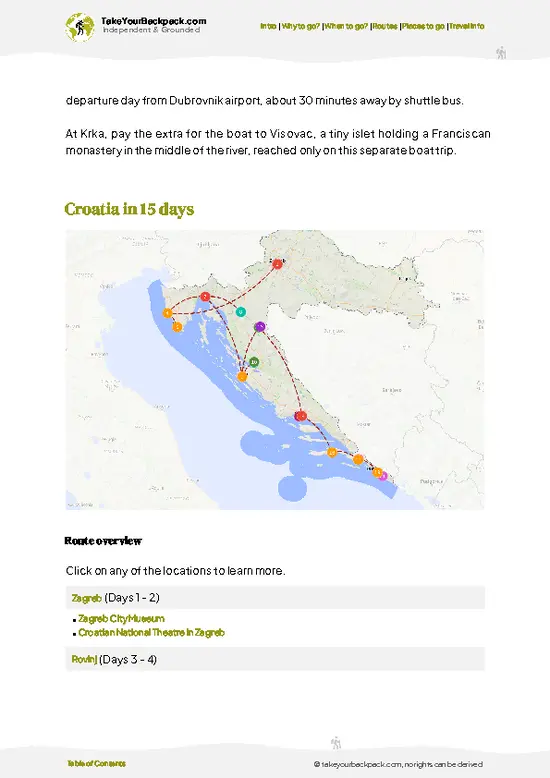
This fifteen-day route runs the full length of Croatia, from Zagreb’s Austro-Hungarian streets through Istria and the Kvarner coast down to Dubrovnik’s walls. It suits travelers with two weeks who want the famous postcards plus the quieter places between them: a Roman amphitheater, a limestone canyon, a seaside promenade locals actually use. The pace is steady but relaxed, with no two long travel days back to back and most stops getting two nights. You can do all of it on intercity buses, two local buses and one coastal catamaran or ferry, with no car needed.
Days 1-2: Zagreb
Starting in
Zagreb lets you meet the country before the coast takes over. Spend your first afternoon in the Upper Town, where the
Zagreb City Museum fills a former convent of the Poor Clares and walks you through the city’s growth from two rival hilltop settlements, Gradec and Kaptol. It is the best primer you will find on why the capital looks the way it does.
On your second evening, book a performance at the
Croatian …
read more 👉This fifteen-day route runs the full length of Croatia, from Zagreb’s Austro-Hungarian streets through Istria and the Kvarner coast down to Dubrovnik’s walls. It suits travelers with two weeks who want the famous postcards plus the quieter places between them: a Roman amphitheater, a limestone canyon, a seaside promenade locals actually use. The pace is steady but relaxed, with no two long travel days back to back and most stops getting two nights. You can do all of it on intercity buses, two local buses and one coastal catamaran or ferry, with no car needed.
Days 1-2: Zagreb
Starting in Zagreb lets you meet the country before the coast takes over. Spend your first afternoon in the Upper Town, where the Zagreb City Museum fills a former convent of the Poor Clares and walks you through the city’s growth from two rival hilltop settlements, Gradec and Kaptol. It is the best primer you will find on why the capital looks the way it does.
On your second evening, book a performance at the Croatian National Theatre in Zagreb, the mustard-yellow building on Republic of Croatia Square. Opera and ballet here are taken seriously, the audience dresses up a little, and the upper-tier seats cost far less than an equivalent night in Vienna. Morning of Day 2 is free for Dolac market and a coffee on Tkalčićeva street.Days 3-5: Rovinj, Pula and the Kvarner Coast
Take the bus west to Rovinj (4 to 5 hours), the longest single leg of the first week, and arrive in time to climb the cobbled lanes to the Church of St Euphemia for sunset over the harbor. Rovinj is the prettiest town in Istria and worth two nights, partly because the old town empties after the day-trippers leave.
Day 4 is a day trip to Pula, 40 to 50 minutes by bus. The reason to go is the Pula Arena, a first-century Roman amphitheater with its outer wall nearly complete. Walk the underground galleries, where olive presses and amphorae are displayed, then eat in the market hall before heading back to Rovinj.
On Day 5, ride the bus to Rijeka (about 2 hours), a working port city with almost no tourist gloss. Drop your bag and take city bus 32 to Opatija for an afternoon on the Lungomare coastal promenade, a 12-kilometer path cut along the shore past Habsburg-era villas and small swimming ladders, running from Volosko toward Lovran. Rijeka is a one-night stop, chosen because it breaks the trip south into two manageable halves.Days 6-7: Zadar and Paklenica
The coastal bus from Rijeka to Zadar takes 4.5 to 5 hours along the Velebit shoreline, one of the most dramatic road rides in the country, with bare mountains on your left dropping straight into the sea on your right. Sit on the right side heading south for the water views. Arrive by late afternoon and head to the Riva for the Sea Organ, whose pipes under the marble steps play notes pushed by the waves.
Day 7 is for hiking. Catch a morning bus to Starigrad (about 1 hour), the gateway to Paklenica National Park, and walk the Paklenica to Velika Paklenica Trail up the main canyon. Climbers hang off the 400-meter walls of Anića kuk above you, and the path climbs through pine forest toward the Manita peć cave and the mountain hut beyond. Start early in summer; the canyon floor gets hot by noon. Return to Zadar for dinner.Days 8-9: Plitvice Lakes
Zadar to Plitvice Lakes is a 2 to 3 hour bus ride inland, a short leg that leaves you the afternoon for the lower lakes. Sleeping in one of the villages by the park is what makes this stop work: you can be at the gate when it opens and walk the boardwalks above the upper lakes before the tour buses arrive at around 9 a.m.
The Plitvice Waterfalls are the main event, sixteen terraced lakes connected by cascades, with Veliki slap dropping 78 meters at the lower end. Summer tickets cost around €40 and must be booked for a time slot, so reserve online. After a morning in the park, take the afternoon bus to Split (4.5 to 6 hours).Days 10-11: Split
With a full day in Split, start under the city in the Diocletian’s Palace Substructures, the cellars beneath the Roman emperor’s retirement complex. Their floor plan mirrors the halls that once stood above, and walking them first makes the rest of the old town make sense. Then climb the cathedral bell tower and spend the late afternoon on Marjan hill, the forested headland at the end of the Riva, before swimming at its western coves.Days 11-13: Korčula
The catamaran from Split to Korčula takes 2.5 to 3 hours, often stopping at Hvar along the way. Korčula town is a fortified peninsula laid out in a herringbone pattern so that the streets break the wind. Two nights give you time to rent a bike for the vineyards inland or take a water taxi to the small islets across the channel.
On Day 13, take the bus toward Dubrovnik. It crosses to the Pelješac peninsula by ferry from Dominče to Orebić, then runs through vineyards to Ston, where you can step off for two or three hours. Walk a section of the medieval walls that climb the hill above the saltpans, eat oysters in neighboring Mali Ston, and catch a later bus for the final hour to Dubrovnik.Days 13-15: Dubrovnik
Dubrovnik is the finale, and you should treat it with discipline. Walk the Dubrovnik City Walls and Fortresses at opening time on Day 14, before the cruise crowds and the midday heat; the full 2-kilometer circuit takes about 2 hours, and tickets run around €35 to 40. Spend the afternoon in Cavtat, a quieter harbor town 30 minutes south by city bus 10 or a little longer by boat from the Old Port, where you can swim from the rocks on the Rat peninsula. Fly out on Day 15 from Dubrovnik airport, which sits just beyond Cavtat.
On Korčula, I would send a friend to Lumbarda, a short bus or bike ride from town, for its rare sandy coves and a glass of the local Grk white, which you will struggle to find anywhere else in the world.v2.webp)




 Best Backpacking