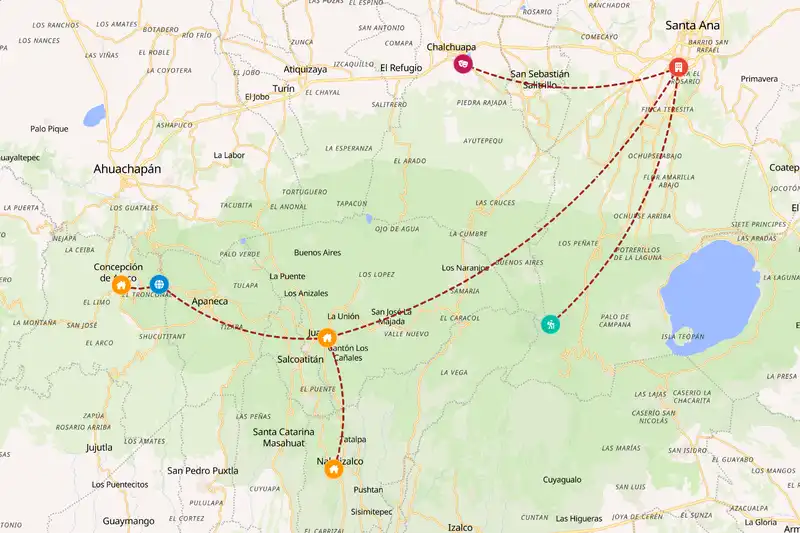
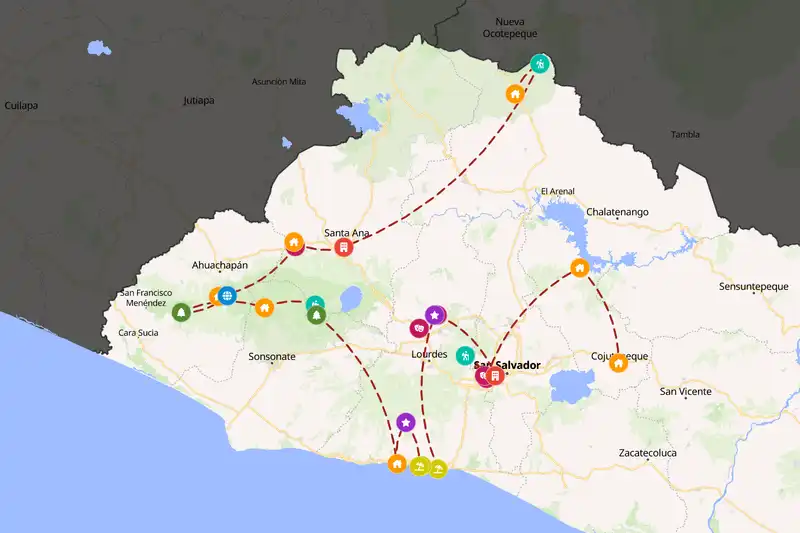
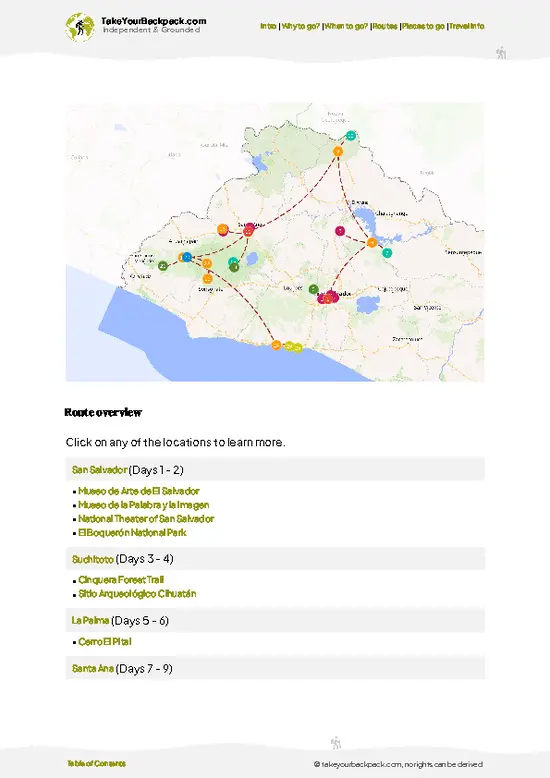
This fifteen-day loop is for travelers who want the whole western half of El Salvador at an unhurried pace: Maya ruins, a colonial lake town, the country’s highest summit, two volcano hikes, a coffee-and-mural highland and a surf coast to finish. Most legs run on numbered intercity buses and local “chicken buses,” with a pickup or a guided 4x4 for the cloud forest and El Imposible. Travel days are kept apart, and only one of them runs longer than about 3 hours.
Days 1-2: San Salvador
Start in
San Salvador and use it for the art and history you won’t find anywhere else in the country. The
Museo de Arte de El Salvador (MARTE) in San Benito gives you a clear walk through Salvadoran painting, and the small
Museo de la Palabra y la Imagen holds the civil war archive, including material from the rebel station Radio Venceremos. That is the context you need before the north. Downtown, step inside the
National Theater of San Salvador for its gilded French-style interior, then spend a morning on the …
read more 👉This fifteen-day loop is for travelers who want the whole western half of El Salvador at an unhurried pace: Maya ruins, a colonial lake town, the country’s highest summit, two volcano hikes, a coffee-and-mural highland and a surf coast to finish. Most legs run on numbered intercity buses and local “chicken buses,” with a pickup or a guided 4x4 for the cloud forest and El Imposible. Travel days are kept apart, and only one of them runs longer than about 3 hours.
Days 1-2: San Salvador
Start in San Salvador and use it for the art and history you won’t find anywhere else in the country. The Museo de Arte de El Salvador (MARTE) in San Benito gives you a clear walk through Salvadoran painting, and the small Museo de la Palabra y la Imagen holds the civil war archive, including material from the rebel station Radio Venceremos. That is the context you need before the north. Downtown, step inside the National Theater of San Salvador for its gilded French-style interior, then spend a morning on the second day at El Boquerón National Park, where a short rim trail circles a crater roughly 1.5 km wide and more than 500 m deep. Go early, before the clouds settle on the summit.Days 3-4: Suchitoto and Cinquera
Bus 129 takes about 1.5 hours to Suchitoto, a cobbled colonial town above Lake Suchitlán with whitewashed Santa Lucía church on the plaza and indigo workshops where you can dye your own scarf. On day 4, ride out to the Cinquera Forest Trail, a regrowing forest that former guerrilla fighters now guide through, with old camp sites and a river pool along the way. It pairs well with the war history from the capital and sees few foreign visitors.Days 5-6: Cihuatán and La Palma
Take the bus from Suchitoto to Aguilares (about 1 hour), then hop off on the Troncal del Norte at Sitio Arqueológico Cihuatán, a large Postclassic city with ballcourts and pyramid mounds and very few visitors. Continue north the same afternoon to La Palma, the town painted head to toe in the naïve style of artist Fernando Llort. Day 6 is for Cerro El Pital, at 2,730 m the highest point in El Salvador: a pickup from San Ignacio gets you near the top, and a short climb through pine and cloud forest leads to views into Honduras. Pack a fleece, because nights up here get properly cold.Days 7-9: Santa Ana and Chalchuapa
The ride to Santa Ana is the long day of the trip: 5 to 6 hours with a change in San Salvador. Your reward is three nights in the most handsome city in the country. The neo-Gothic cathedral faces the restored Teatro Nacional de Santa Ana across the main plaza, and the small Museo Regional de Occidente nearby covers the history of the western coffee region. Day 8 is the hike up Santa Ana Volcano, starting inside Cerro Verde National Park: about 2 hours of guided climbing to a rim above a sulfur-green crater lake. On day 9, ride 30 minutes to Chalchuapa for Tazumal Archaeological Site, the tallest Maya structure in the country, and the quieter Parque Arqueológico Casa Blanca a few blocks away, where an indigo workshop runs alongside the mounds.Days 10-12: Concepción de Ataco and El Imposible
Ride via Ahuachapán to Concepción de Ataco, the best base on the Ruta de Las Flores, with mural-covered walls and coffee you can drink a few steps from where it grows. Day 11 is a full day in El Imposible National Park with a guide from nearby Tacuba, swimming in river pools inside the largest protected forest in El Salvador. Day 12 is slow: bus 249 along the route to Juayúa for the weekend food fair and to Nahuizalco, where the Nahuat-speaking community weaves tule and wicker furniture and runs a candlelit night market.Days 13-15: El Zonte and Punta Roca
Head down to the coast through Sonsonate (3 to 4 hours) and settle in El Zonte, a small surf village on a black-sand cove. Spend the last two days in the water. Experienced surfers should paddle out at Punta Roca in La Libertad, a long right-hand point break over rock, while everyone else can take lessons or hop over to El Tunco for sunset drinks by the rock that gives the town its name. The airport is about an hour from El Zonte, so you can surf the morning you fly.
If you have one spare afternoon in Santa Ana, take a bus out to Lago de Coatepeque, a deep blue caldera lake where you can swim off a wooden dock below the crater walls.v2.webp)

 Best Backpacking