×

France🇫🇷 | best villagesThe 11 Top villages in France

France has roughly 35,000 communes, and most of them are villages, so the label tells you almost nothing until you know the region. The Dordogne, Provence and the Luberon are the famous stone-village belts: beautiful, easy by car, and crowded and pricey from June to August. Alsace has half-timbered wine villages on a cycle-friendly flat plain, with good trains from Strasbourg and Colmar. Brittany and Normandy give you granite harbors and cider country at lower prices. The Alps and Pyrenees offer real mountain life, cheaper rooms and fewer tour buses, but buses are thin. Independent travelers should know that public transport stops at the village edge in much of rural France, often with one or two buses a day. Skip the villages that exist only as souvenir streets. Back the ones with a working market, a bakery and a church bell that still rings.

By Johan Kruseman 🇳🇱 | Updated October 18, 2026
Explore the best landmarks in France

Why go?What Makes Them Special

France suits villages better than almost any country in Europe, and the reasons are structural. The Revolution of 1789 turned parishes into communes, so even settlements of a few hundred people have a mairie, a church, a bakery or a bar, and a market day. Centuries of stone building were tied to local geology, so ochre Provençal walls, gray Breton granite and pale Dordogne limestone look different from region to region within a few hours of travel. Strong heritage protection and the national “Plus Beaux Villages de France” label (about 170 members, selected by strict criteria) keep modern sprawl out of the old centers.

There is a cost to that. Rural depopulation has closed many village shops, and some perfectly pretty places have no open restaurant on Monday or Tuesday. The label villages … read more 👉
France suits villages better than almost any country in Europe, and the reasons are structural. The Revolution of 1789 turned parishes into communes, so even settlements of a few hundred people have a mairie, a church, a bakery or a bar, and a market day. Centuries of stone building were tied to local geology, so ochre Provençal walls, gray Breton granite and pale Dordogne limestone look different from region to region within a few hours of travel. Strong heritage protection and the national “Plus Beaux Villages de France” label (about 170 members, selected by strict criteria) keep modern sprawl out of the old centers.

There is a cost to that. Rural depopulation has closed many village shops, and some perfectly pretty places have no open restaurant on Monday or Tuesday. The label villages also draw the heaviest day-trip traffic, so midday in July can mean paid parking, queues and shuttered doors at lunch from 2 p.m. Do not choose France expecting to rely on trains. The rail network is excellent between cities, but villages are often 5 to 30 kilometers from the nearest station, and a car or a bicycle is the practical answer in most regions. Alsace, the Loire valley and parts of Brittany are the easier exceptions.

Also know that the rhythm of French life shapes your days. Lunch runs about noon to 2 p.m., many shops close Sunday afternoon and Monday, and August brings local holidays. Greet people with “bonjour” before asking anything. Villages worth your time are the ones that still function as places to live, not as open-air museums.
How the List Was Created
The list of best villages in France is created based on authenticity, scenic beauty, community spirit, traditions, and overall character. If you feel a village is missing in this list, please let us know.

When to go?Optimal Periods for Travel

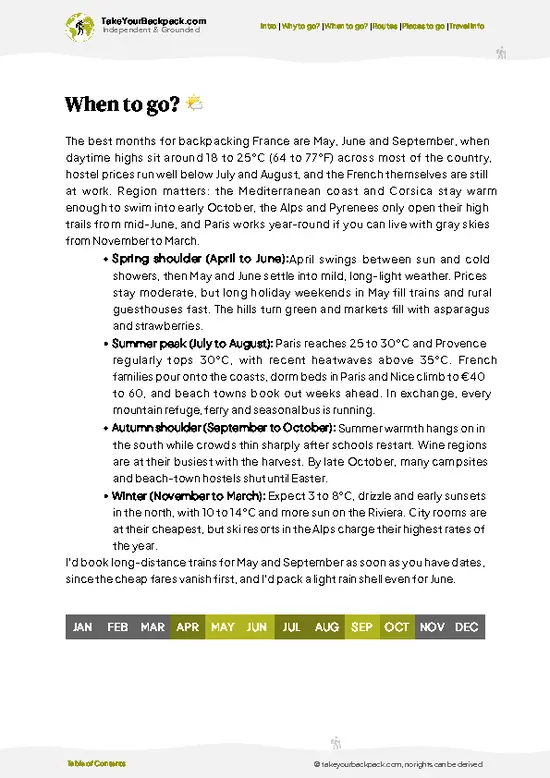
Best months: The best months for French villages are May, June and September, when daytime highs sit around 18 to 26°C, nearly everything is open, and you avoid the July and August crush. May is green and flowering but can be showery, with 50 to 70 mm of rain in many regions. September is warm, settled and harvest season in wine areas such as Alsace and the Dordogne.

Peak summer: July and August are worth avoiding in the famous belts of Provence, the Luberon and the Dordogne. Highs reach 30 to 38°C inland, parking fills by mid-morning, and rooms can cost 30 to 60 percent more than in spring or autumn. The whole country also takes holiday in August, so small village restaurants may shut for two to three weeks. Coastal Brittany and Normandy are more comfortable in summer, at 20 to 24°C, but … read more 👉
Best months: The best months for French villages are May, June and September, when daytime highs sit around 18 to 26°C, nearly everything is open, and you avoid the July and August crush. May is green and flowering but can be showery, with 50 to 70 mm of rain in many regions. September is warm, settled and harvest season in wine areas such as Alsace and the Dordogne.

Peak summer: July and August are worth avoiding in the famous belts of Provence, the Luberon and the Dordogne. Highs reach 30 to 38°C inland, parking fills by mid-morning, and rooms can cost 30 to 60 percent more than in spring or autumn. The whole country also takes holiday in August, so small village restaurants may shut for two to three weeks. Coastal Brittany and Normandy are more comfortable in summer, at 20 to 24°C, but beach villages are packed.

Shoulder and winter: April and October are good value, with cheaper beds and thinner crowds, but some seasonal hotels, campsites and attractions are closed until April or after the end of October. Expect 10 to 17°C and frequent rain in the north and west. November to March is mostly poor for village hopping in lowland France: short days, many closures and gray weather. Alsace is the exception, as its Christmas markets run from late November to Christmas, with higher prices and big weekend crowds.

Mountain regions: The Alps and Pyrenees follow a different calendar. Hiking villages are best from late June to mid-September, when lifts and huts operate. Mid-October to early December and mid-April to early June are quiet and often partly shut. Ski season, roughly December to March, is the expensive period.

village hoppingOptimizing Your Multi-Stop Itinerary

How long to allow: A trip combining several French villages needs 7 to 14 days, and 10 days is comfortable for two regions. Fewer than a week pushes you into driving more than looking. Allow half a day to one day per village: two to four hours is enough for the smallest, while a village with a market, a hike or a vineyard visit deserves a night.

Regions that pair well: Pair neighbors. Provence and the Luberon link easily with the Côte d’Azur hinterland, about 2 to 3 hours apart. The Dordogne and Lot run together, with 30 to 90 minutes between stops. Alsace pairs with the Vosges or Lorraine, and Brittany with Normandy, roughly 2 to 3 hours between them. Combining Alsace with Provence is a mistake on a short trip: it is a day of 6 to 7 hours on the road, or a TGV to Lyon and a hire car.

Direction … read more 👉
How long to allow: A trip combining several French villages needs 7 to 14 days, and 10 days is comfortable for two regions. Fewer than a week pushes you into driving more than looking. Allow half a day to one day per village: two to four hours is enough for the smallest, while a village with a market, a hike or a vineyard visit deserves a night.

Regions that pair well: Pair neighbors. Provence and the Luberon link easily with the Côte d’Azur hinterland, about 2 to 3 hours apart. The Dordogne and Lot run together, with 30 to 90 minutes between stops. Alsace pairs with the Vosges or Lorraine, and Brittany with Normandy, roughly 2 to 3 hours between them. Combining Alsace with Provence is a mistake on a short trip: it is a day of 6 to 7 hours on the road, or a TGV to Lyon and a hire car.

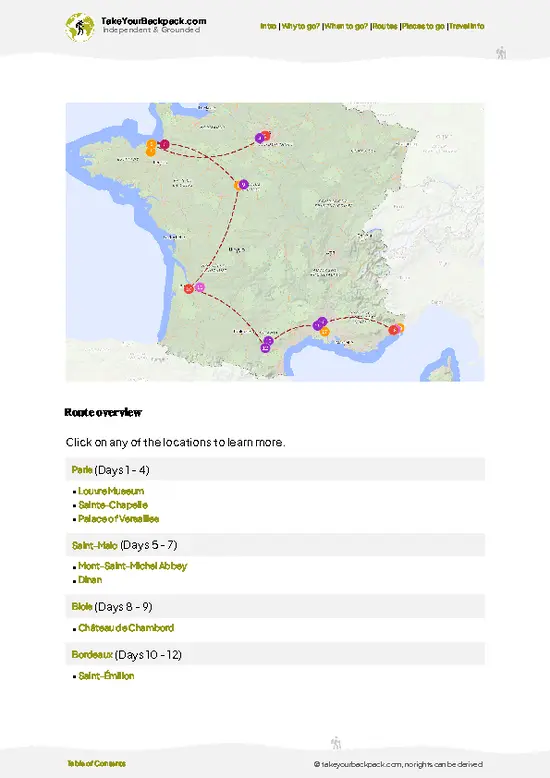
Direction and transport: Travel in one sweep and avoid backtracking. A sensible shape is arriving in Paris, going west to Normandy and Brittany, then south via the Loire, or flying into Lyon or Marseille and ending in Paris. Use TGV trains for long legs (Paris to Strasbourg about 1 hour 50 minutes, Paris to Avignon about 2 hours 40 minutes), then pick up a rental car at the station. Rural buses often run once or twice a day and rarely on Sundays, so do not plan village hops around them.

Planning mistakes: The commonest error is stacking four villages in a day, which leaves you with parking lots and photos. Do two at most and finish by late afternoon. Another is ignoring closing days: Sunday afternoon, Monday and August can shut shops and restaurants, so book lodging and a dinner spot ahead. Drive on small roads only after allowing about 40 percent more time than the map suggests.

The ListMust-Visit villages in France

1 Mont-Saint-Michel

tidal island, abbey spire, causeway approach

Time your arrival with the tides, climb winding steps to the abbey, and watch the landscape transform between land and sea.

2 Saint-Émilion

underground cellars, limestone facades, Grand Cru estates

Sample world-renowned wines among ancient monoliths and explore subterranean passages beneath a town built for oenophiles.

france-city-saint-emilion
© Google |

3 Gordes

dry-stone houses, Luberon plateau, Provençal market

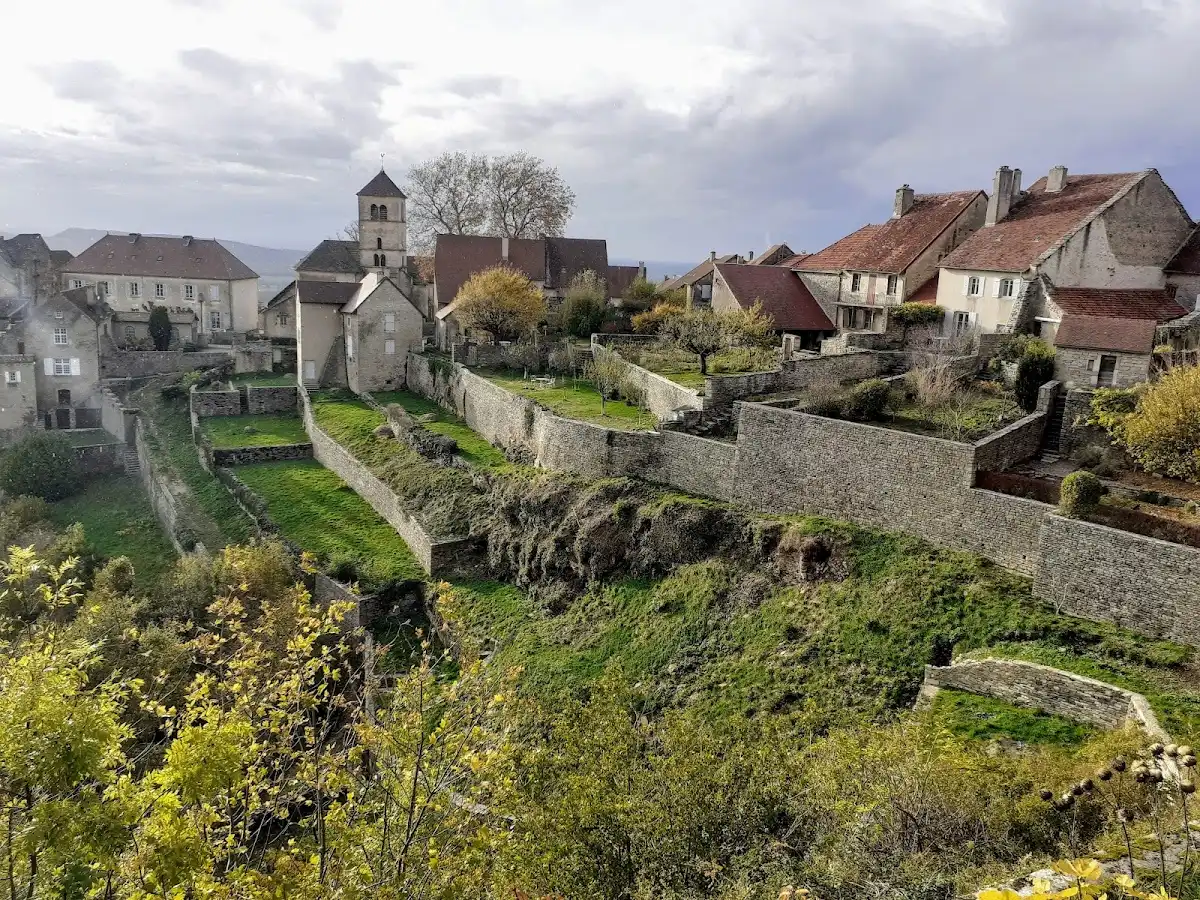
Experience a village built into limestone hills, where weekly markets and layered terraces reveal the rhythms of rural Provence.

france-city-gordes
© Google | Luis Vidilla

4 Moustiers-Sainte-Marie

ceramic workshops, rocky gorge, chapel on the cliff

Follow the sound of water through a village famed for faïence pottery, nestled beneath cliffs and a star-topped chapel.

france-city-moustiers-sainte-marie
© Google | Sophia Lin

5 Èze

hilltop gardens, Mediterranean panoramas, stone archways

Climb winding paths through sculpted gardens and gaze over the Côte d’Azur from a village suspended between sea and sky.

france-city-eze
© Google | Ion Sandu

6 Saint-Cirq-Lapopie

clifftop lanes, medieval stonework, Lot River views

Wander narrow alleys perched above the Lot, where centuries-old houses and panoramic river bends shape a distinct sense of place.

france-city-saint-cirq-lapopie
© Google | Sylviane M80

7 Roussillon

ochre cliffs, pastel facades, artists’ trails

Walk among vivid earth tones and creative studios, where mineral-rich soils and colorful houses set a striking visual tone.

france-city-roussillon
© Google | Poco Loco

8 Vézelay

pilgrimage hill, Romanesque basilica, Burgundy vineyards

Ascend a storied ridge to experience spiritual architecture, hillside vistas, and the quiet rhythm of a wine-producing village.

france-city-vezelay
© Google | Nick Van Bennekom

9 Baume-les-Messieurs

limestone cliffs, abbey, waterfall gorge

Descend into a secluded valley, explore monastic ruins, and follow trails that lead to caves and cascading streams.

france-city-baume-les-messieurs
© Google |

10 Château-Chalon

Jura escarpment, vin jaune, terraced slopes

Survey steep vineyards clinging to cliffs and taste unique yellow wine in a village shaped by its dramatic natural setting.

france-city-chateau-chalon
© Google |

11 Luz-Saint-Sauveur

Pyrenean spa, fortified church, mountain gateway

Rest in a valley town known for thermal baths and as a base for exploring high passes and remote Pyrenean landscapes.

france-city-luz-saint-sauveur
© Google |
Loading the map 🌍

Expert viewTips and Advice from Travelers

How many villages: Plan on 6 to 10 villages for a trip of one to two weeks, and not more. Each one needs at least half a day to be worth the stop: a morning market, a walk to the edge of the stone, a long lunch. Beyond about one village a day, you are collecting ticks, and the famous label villages blur together fast. Skip the extras and spend the saved time in one place overnight, when day-trippers leave and evenings go quiet.

Which kind to prioritize: Choose by travel style. Hikers should favor Alps and Pyrenees villages, where trails start at the edge of town and rooms are cheaper. Food and wine travelers get the most from Alsace, Burgundy and the Dordogne, where markets and producers matter more than monuments. Cyclists do best in Alsace, the Loire and Brittany, with signed routes and … read more 👉
How many villages: Plan on 6 to 10 villages for a trip of one to two weeks, and not more. Each one needs at least half a day to be worth the stop: a morning market, a walk to the edge of the stone, a long lunch. Beyond about one village a day, you are collecting ticks, and the famous label villages blur together fast. Skip the extras and spend the saved time in one place overnight, when day-trippers leave and evenings go quiet.

Which kind to prioritize: Choose by travel style. Hikers should favor Alps and Pyrenees villages, where trails start at the edge of town and rooms are cheaper. Food and wine travelers get the most from Alsace, Burgundy and the Dordogne, where markets and producers matter more than monuments. Cyclists do best in Alsace, the Loire and Brittany, with signed routes and flat stretches. Photographers and first-timers will want the Provençal and Luberon stone villages, but visit early in the morning or at dusk. The heavily marketed, souvenir-lined label villages are not worth a long detour unless the setting is exceptional. A working village with a Tuesday market and one decent café is the better bet.

What it costs: A realistic backpacker budget is US$55 to 90 a day (roughly €50 to 85) outside peak summer, higher in Provence in July and August. A dorm bed or basic chambre d’hôte room runs about €25 to 60, a campsite pitch €12 to 25, a fixed-price lunch menu €14 to 22, and a bakery lunch of baguette, cheese and fruit about €6 to 9. Most villages are free to walk. Churches, castles and gardens charge about €4 to 12, and guided village tours, where offered, cost €8 to 15. Cars are the big line: a rental runs €35 to 70 a day plus fuel, and tolls on autoroutes add €10 to 30 on long legs. Parking at popular villages often costs €3 to 8 a day. Local bus fares are usually €2 to 5 a ride, but the services are thin.

Safety and manners: Villages are very safe. Violent crime is rare, and the main risk is car break-ins at hiking trailheads and remote parking areas, so leave nothing visible. Mountain villages bring altitude weather, so check conditions before any walk. In summer, wildfire risk in the south can close forest trails and access roads, and local rules ban fires and smoking in woods.

Culturally, always open with “bonjour” in shops and cafés, and say “merci, au revoir” when leaving. Skipping the greeting is the quickest way to cold service. Keep voices low in the evening, since many houses are lived in and not rentals. Do not photograph residents or private courtyards without asking. Tipping is optional because service is included, though rounding up a euro or two is appreciated. Lunch is the main meal, so a restaurant arriving after 2 p.m. may refuse you. Carry cash for small markets and bakeries, since some villages have no ATM.

What not to bother with: Skip paid “village experience” add-ons, miniature trains and souvenir-heavy lanes. Spend instead on a market morning, a local producer tasting for €5 to 15, and a night in the village itself.

✈️ The backpacker research shortcutFrance Travel Guide

An offline-friendly backpacking guide with optimized travel routes, ranked highlights, transport advice, and the best areas to stay.
example page 0 from our offline Travel Guide for France
example page 1 from our offline Travel Guide for France
example page 2 from our offline Travel Guide for France
example page 3 from our offline Travel Guide for France
example page 4 from our offline Travel Guide for France
example page 5 from our offline Travel Guide for France
example page 6 from our offline Travel Guide for France
example page 7 from our offline Travel Guide for France
The digital guide (501 pages) contains:
✅ 135 highlights, ranked by travel appeal
✅ Optimized 7, 14 & 21-day travel routes
✅ Cities, national parks, landmarks, beaches
✅ How to get around
✅ Offline-friendly for travel without Wi-Fi
👉 Click to see all 30+ guide features

📅 Plan smarter in minutes, not weeks
✅ Month by month travel advice
✅ Festivals & national holidays
✅ Budget expectations

🗺️ Go to the right places, skip the overrated ones
✅ Honest pros & cons of destinations
✅ Top hikes, parks & viewpoints
✅ Lesser-known places most travelers miss
✅ Clear “worth it vs skip it” guidance

🛏️ Travel smoothly without rookie mistakes
✅ Best areas to stay
✅ Transport systems explained simply
✅ Common scams & safety advice
✅ SIM cards, money & practical tips

🌍 Understand the country, not just visit it
✅ Culture & traditions
✅ 52 Essential phrases & customs
✅ Festivals worth planning around
✅ Traveler-friendly historical context
✅ Insights that make places more meaningful

📱 Built for real travel conditions
✅ Fully downloadable PDF
✅ Works completely offline
✅ Optimized for phone use
✅ Useful in remote areas & buses
✅ Everything in one place
Stop searching, start planning
Get instant access to your full guide. 30‑day money-back guarantee.
+ Add another guide for just

By proceeding you agree to our terms.
Sent to your inbox immediately after payment • 100% Secure Checkout
Best Backpacking Travel Advisor 2025 tourism awardBest Backpacking
Travel Advisor
2025
What others say about Take Your Backpack Guides:
⭐⭐⭐⭐⭐
Fantastic, amazing amount of information!
⭐⭐⭐⭐⭐
My goodness this is amazing, it's what I've been looking for hats off too you!
⭐⭐⭐⭐⭐
I think this is absolutely BRILLIANT
⭐⭐⭐⭐
Very complete and informative. It's still missing places, but I gotta to commend you
⭐⭐⭐⭐⭐
This is truly amazing, thank you, can't wait to explore it with my kids!
⭐⭐⭐⭐⭐
Awesome resource, thank you!
⭐⭐⭐⭐⭐
This is amazing! Can't wait to explore the ones I haven't seen
⭐⭐⭐⭐
I love this! Well done, great idea.
⭐⭐⭐⭐⭐
Thanks for taking the time to make this gem!
⭐⭐⭐⭐⭐
This might be the best website I've ever seen.
⭐⭐⭐⭐⭐
Congratulations, and thank you so much for your work; it's incredibly valuable.
⭐⭐⭐⭐
In all seriousness I think you did a great job pointing out the important spots
⭐⭐⭐⭐⭐
10/10 very good
⭐⭐⭐⭐⭐
As someone who's only just starting to visit regularly this is awesome, thank you.
⭐⭐⭐⭐
Thank you very much! I'm going to visit my dad, it's going to be very useful!
⭐⭐⭐⭐⭐
This is really cool! We'll be travelling for the first time and this definitely come in handy.
⭐⭐⭐⭐⭐
You are now our minister of culture, congratulations 👨‍💼
⭐⭐⭐⭐⭐
Just wanted to tell you that this is a pearl! Going to follow your recommendations.
⭐⭐⭐⭐⭐
This is so cool. I'll definitely be using the resource for my travels soon.
⭐⭐⭐⭐⭐
This is very impressive! Good work.
⭐⭐⭐⭐⭐
This is an amazing and informative site. Very well done!

🛏️ Where to stay?Top Places to Consider Staying

France has plenty of hostels and budget rooms, with dorm beds running roughly €30 to 55 in Paris and €20 to 40 in most other cities. In Paris, the Canal Saint-Martin area and Belleville in the northeast hold the densest cluster of large hostels, with cheap bars and good metro links but a scruffy edge after dark, while Montmartre puts you near Sacré-Cœur and the Pigalle nightlife at the cost of steep hills and pickpockets around the main stations. Elsewhere, look at Vieux Lyon in Lyon for cobbled-lane atmosphere and walkable sights, the Vieux-Port and Cours Julien in Marseille for late nights (stay alert around the station), and the Old Town of Nice for beach access, though its narrow streets … read more 👉
France has plenty of hostels and budget rooms, with dorm beds running roughly €30 to 55 in Paris and €20 to 40 in most other cities. In Paris, the Canal Saint-Martin area and Belleville in the northeast hold the densest cluster of large hostels, with cheap bars and good metro links but a scruffy edge after dark, while Montmartre puts you near Sacré-Cœur and the Pigalle nightlife at the cost of steep hills and pickpockets around the main stations. Elsewhere, look at Vieux Lyon in Lyon for cobbled-lane atmosphere and walkable sights, the Vieux-Port and Cours Julien in Marseille for late nights (stay alert around the station), and the Old Town of Nice for beach access, though its narrow streets stay noisy until late in summer.

If you enjoy meeting fellow travelers, consider choosing hostels with high ratings for atmosphere. On the other hand, if you prefer having your own space, a hotel might be a better option.

FranceMore Places Across France

👋 Meet the founderWho’s Behind Take Your Backpack?

Johan, backpacker and founder of TakeYourBackpackHi, I’m Johan (Netherlands 🇳🇱), the creator of TakeYourBackpack. Over the past 3 decades, I’ve backpacked through 90+ countries across six continents, gaining extensive experience with independent travel, long-term trips, and overland routes.

This site is built on a combination of firsthand travel experience and carefully curated insights from other backpackers. Many guides are based on places I’ve personally visited, while others bring together tips, observations, and practical advice shared by trusted travelers I’ve met along the way.

The goal is to provide realistic, experience-driven guidance — not generic itineraries — so you can explore destinations with better context, clearer expectations, and more confidence.