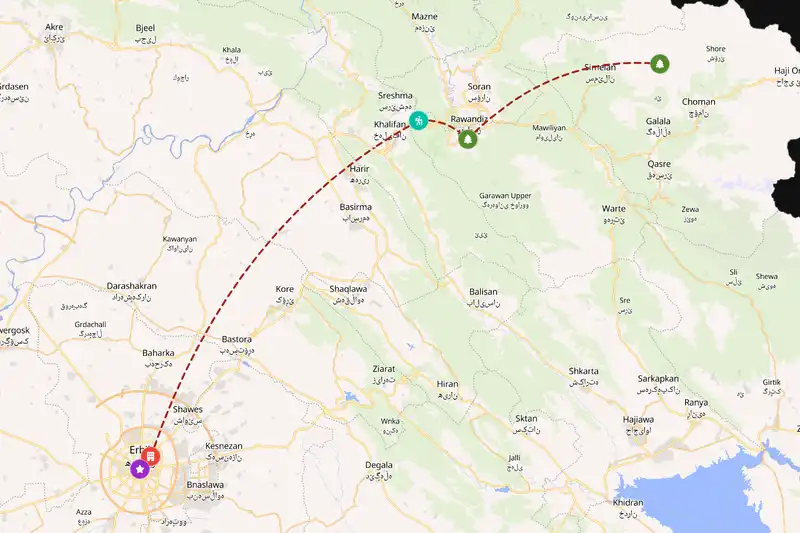
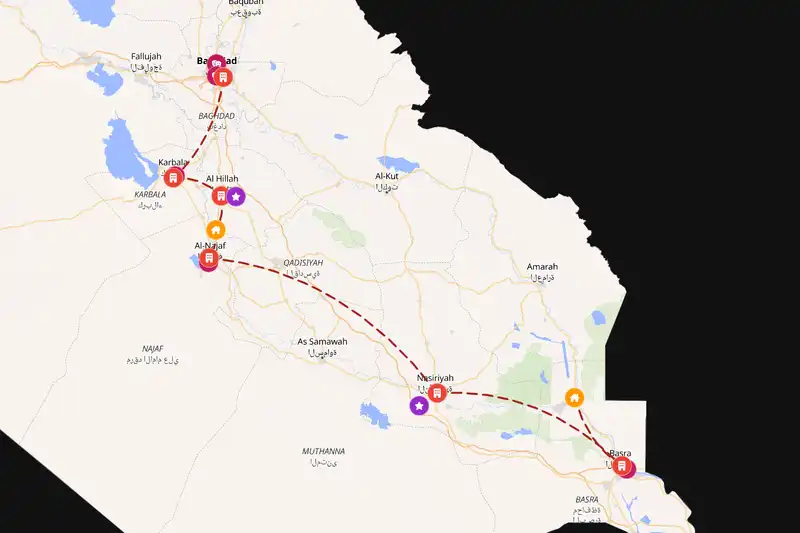
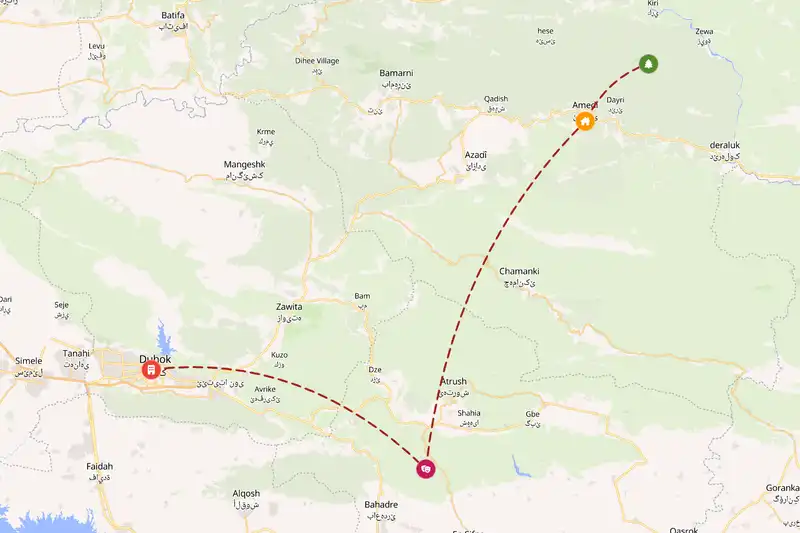
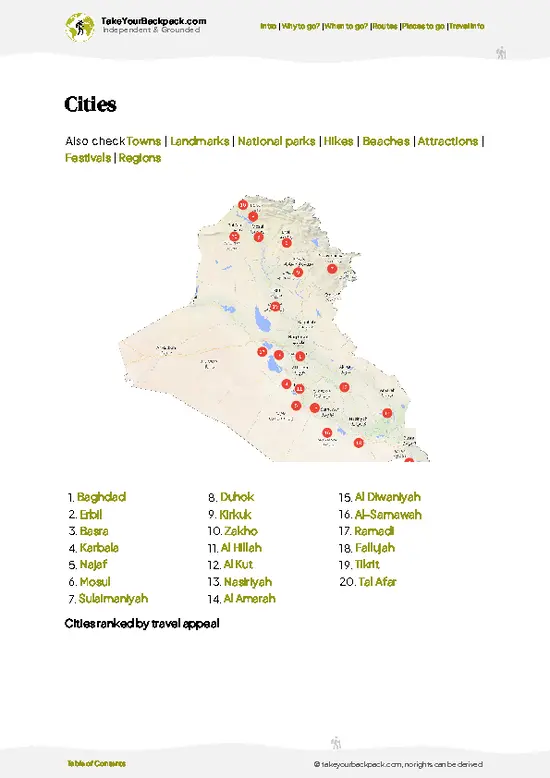
This fifteen-day route through Iraq is for travelers who want the whole arc of the country: the Kurdish mountains, the rebuilt north, and the Shia holy cities of the south, in one north-to-south line with no backtracking. Since you leave the Kurdistan Region, a Kurdistan visa won’t cover you; arrange the federal e-visa (about US$160) before you fly. The pace is steady, with two-night stops in most places and one-night hops where the sights are compact. You’ll move by shared taxi between cities, hire drivers for the mountain roads and the ruins around Mosul, and fly in to Erbil and out of Najaf.
Days 1-2: Erbil, Citadel and Galleries
Start in
Erbil because it is the easiest landing in Iraq: a calm airport and hotels at every level. Spend your first morning on the
Erbil Citadel, the oval mound above the city, and give an hour to the
Kurdish Textile Museum inside it, where felt, saddlebags and woven kilims trace how nomadic families carried their lives on horseback.
The second day is for slower …
read more 👉This fifteen-day route through Iraq is for travelers who want the whole arc of the country: the Kurdish mountains, the rebuilt north, and the Shia holy cities of the south, in one north-to-south line with no backtracking. Since you leave the Kurdistan Region, a Kurdistan visa won’t cover you; arrange the federal e-visa (about US$160) before you fly. The pace is steady, with two-night stops in most places and one-night hops where the sights are compact. You’ll move by shared taxi between cities, hire drivers for the mountain roads and the ruins around Mosul, and fly in to Erbil and out of Najaf.
Days 1-2: Erbil, Citadel and Galleries
Start in Erbil because it is the easiest landing in Iraq: a calm airport and hotels at every level. Spend your first morning on the Erbil Citadel, the oval mound above the city, and give an hour to the Kurdish Textile Museum inside it, where felt, saddlebags and woven kilims trace how nomadic families carried their lives on horseback.
The second day is for slower things. The Shanadar Gallery, a small art space in Shanidar Park, shows contemporary Kurdish painters and costs you little more than the taxi ride. Finish at the Qaysari Bazaar below the citadel gate, where the honey and cheese sellers cluster near the back lanes.Days 3-4: Mosul and the Desert City of Hatra
Mosul sits about 90 minutes west of Erbil, with checkpoints at the boundary between the Kurdistan Region and federal Iraq. In Mosul, walk the Old City along the Tigris, where the rebuilt al-Nuri Mosque and its leaning al-Hadba minaret stand among streets still being restored after the war against ISIS. Local guides here are worth paying for; they know which blocks are open and which families are back.
On Day 4, take a driver about 110 kilometers southwest to Hatra, a walled city from the Parthian era whose temple arches rise straight out of flat steppe. Visits run through Mosul’s authorities, so book through a Mosul guide a few days ahead rather than turning up.Day 5: Al-Qush and Lalish to Duhok
This is a day of two faiths on one road. In Al-Qush, an Assyrian Christian town at the foot of the hills, climb to the Rabban Hormizd Monastery cut into the cliff above. Then continue to Lalish Temple Complex, the holiest site of the Yazidis, where you remove your shoes at the edge of the valley and walk barefoot across the stone courtyards below the fluted conical spires. Sleep in Duhok, a relaxed valley city with a dam lake and a strip of grill restaurants.Days 6-7: Amedi and Its Valley
Amedi sits on a flat-topped rock with cliffs on every side, reached by a single road and entered through the old Bab Zebar gate cut into the stone. Two nights let you walk the town in the evening when families come out, then spend a full day in the Amedi Valley below, where orchards, picnic springs and small villages fill the green floor. In summer this area runs 8 to 10 degrees cooler than the plains.Days 8-9: Barzan Valley and Rawanduz Canyon
Day 8 is the longest drive of the north, 4 to 5 hours east through the Barzan Valley, a quiet, forested corridor with stone villages and a heavy sense of Kurdish political history (the Barzani family comes from here). Stop often; there is little traffic and no reason to rush.
End in Rawanduz, perched above Rawanduz Canyon. Use Day 9 to explore the gorge viewpoints and drive down to Gali Ali Beg, the waterfall on the old Hamilton Road, ideally on a weekday morning before the picnic crowds arrive.Day 10: Kirkuk and Its Citadel
Breaking the trip to Baghdad with a night in Kirkuk keeps both travel days to a manageable 3 to 4 hours. The city is a mix of Kurds, Turkmen and Arabs, and you’ll hear all three languages in the market. The Citadel of Kirkuk is mostly ruined, but the mound still gives you the city’s best view and the domed tomb attributed to the prophet Daniel.Days 11-12: Baghdad
Arrive in Baghdad by midday and head straight to the National Museum of Iraq, whose Assyrian winged bulls and Sumerian statues make sense of every ruin still ahead of you. Day 12 belongs to the old city: the Al-Mutanabbi Street Book Market, best on a Friday when book sellers spread across the pavement and the Shabandar Café fills with poets, then a taxi north to Khadimiyah, where the gold domes of the shrine glow at dusk. Women need an abaya at the entrance, usually lent on site.Days 13-15: Babylon, Karbala and Najaf
Drive south via Babylon, about 90 minutes from the capital. Look closely at the walls: some bricks carry Nebuchadnezzar’s name, and the reconstructed sections carry Saddam Hussein’s. Continue to Karbala for the night, walking the plaza between the shrines of Imam Husayn and Abbas after dark, and visit the Imam Husayn Shrine Complex Museums for centuries of gifted manuscripts, carpets and metalwork.
On Day 14, a short hop takes you to Najaf. The Imam Ali Shrine Complex Museums hold a similar collection on a grander scale, and the Wadi al-Salam cemetery stretching beyond the city is among the largest on Earth. Fly home from Najaf’s airport on Day 15.
For an extra day in the north, the hillside town of Akre, its houses stacked up a slope near Duhok, lights its hills with torches for Newroz every March and sees almost no foreign visitors the rest of the year.
 Best Backpacking