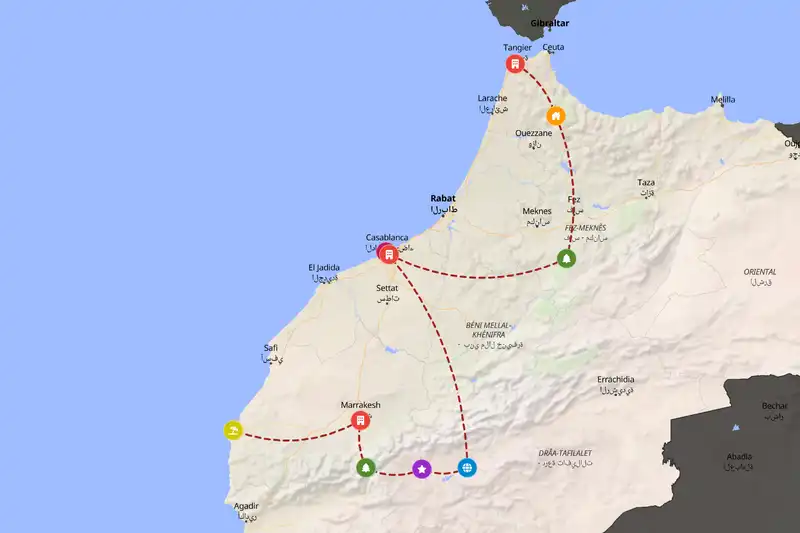
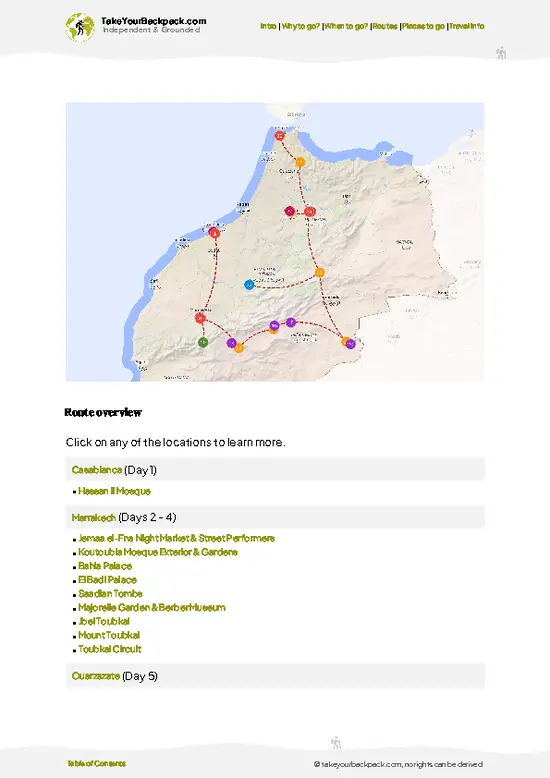
This 15-day route is for travelers who want the full Morocco arc: big cities, blue towns, mountains, desert, and coast, moving by a mix of trains, intercity buses, and a couple of private or shared transfers where public transport gets thin. The pace is adventurous but not punishing, with no back-to-back brutal travel days and enough time in each stop to feel like you’ve actually lived there for a minute instead of just passing through.
Days 1-3: Atlantic Gateway & Imperial Marrakech
You start in
Casablanca, using a night to shake off the flight and walk the corniche before heading to the
Hassan II Mosque, whose oceanside setting and intricate detailing give you a first, jaw-dropping hit of Moroccan craftsmanship. From there, a quick train run takes you to
Marrakech, where two nights let you dive into the medina and feel the city’s pulse. You spend evenings in
Jemaa el-Fna Night Market & Street Performers, watching the square morph from food court to open-air theater, and slip away to the …
read more 👉This 15-day route is for travelers who want the full Morocco arc: big cities, blue towns, mountains, desert, and coast, moving by a mix of trains, intercity buses, and a couple of private or shared transfers where public transport gets thin. The pace is adventurous but not punishing, with no back-to-back brutal travel days and enough time in each stop to feel like you’ve actually lived there for a minute instead of just passing through.
Days 1-3: Atlantic Gateway & Imperial Marrakech
You start in Casablanca, using a night to shake off the flight and walk the corniche before heading to the Hassan II Mosque, whose oceanside setting and intricate detailing give you a first, jaw-dropping hit of Moroccan craftsmanship. From there, a quick train run takes you to Marrakech, where two nights let you dive into the medina and feel the city’s pulse. You spend evenings in Jemaa el-Fna Night Market & Street Performers, watching the square morph from food court to open-air theater, and slip away to the Koutoubia Mosque Exterior & Gardens when you need a breather. This phase is about anchoring yourself in Morocco’s present and then stepping into its most famous old-city maze without rushing straight to the desert.Days 4-6: Palaces, Gardens & High Atlas Peaks
With more time in Marrakech, you go deeper into its architecture and green spaces, starting with Bahia Palace and El Badi Palace to see both the polished and ruined sides of royal power, then the Saadian Tombs for a quieter, more intimate look at dynastic history. You carve out a half-day at the Majorelle Garden & Berber Museum, where bold blues, palms, and a focused museum collection give you a curated window into Berber culture and design. Then you trade city walls for altitude, heading into Jbel Toubkal National Park and the Mount Toubkal area, where even if you don’t summit, you can base in a village and hike sections of the Toubkal Circuit to feel the scale of the High Atlas. Two nights in the mountains give you cool air, stone villages, and starry skies, balancing out the sensory overload of Marrakech before you swing east toward the desert.Days 7-9: Oases, Gorges & Sahara Silence
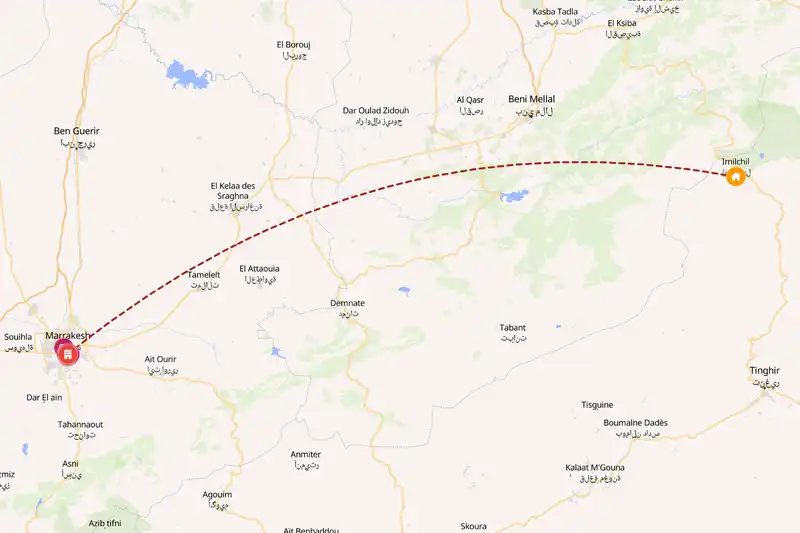
From the High Atlas, you cross the pass toward Ouarzazate, using it as a comfortable base to explore the fortified Ksar of Ait-Ben-Haddou, whose mud-brick alleys and hilltop views have earned their fame for good reason. Continuing along the valley, you reach Boumalne Dades, your jumping-off point for the carved cliffs of Gorges du Dadès, where winding roads and layered rock formations make even short walks feel dramatic. You then push on to Tinghir and the sheer walls of Todra Gorge, where a simple stroll between towering rock faces gives you a sense of scale that photos never quite capture. Finally, you roll into Merzouga for two nights, using it as your base for the Merzouga Sahara, trading asphalt for sand as you ride out into the dunes, sleep in a desert camp, and watch the stars in a silence that makes every city you’ve visited so far feel very far away.Days 10-12: Middle Atlas Forests & Imperial Fes
Leaving the desert, you break the journey north with a night in Midelt, a practical but welcome pause between dunes and forests that keeps you from stacking two long road days back-to-back. From there, you continue into the Middle Atlas, stopping in Azrou to walk among cedar forests and, if you’re lucky, spot Barbary macaques, a reminder that Morocco isn’t just sand and stone. You then roll into Fes for two nights, diving into its dense medina and scholarly heritage. You explore Bou Inania Madrasa and Al Attarine Madrasa to see how learning and artistry intertwined here, and, if you’re up for it, you can swing by the Tanneries of Fes el-Bali for a short, intense look at traditional leather work. Evenings on rooftop terraces, listening to the layered call to prayer, give you time to process just how far you’ve come since the Atlantic coast.Days 13-15: Roman Ruins, Blue Town & Northern Exit
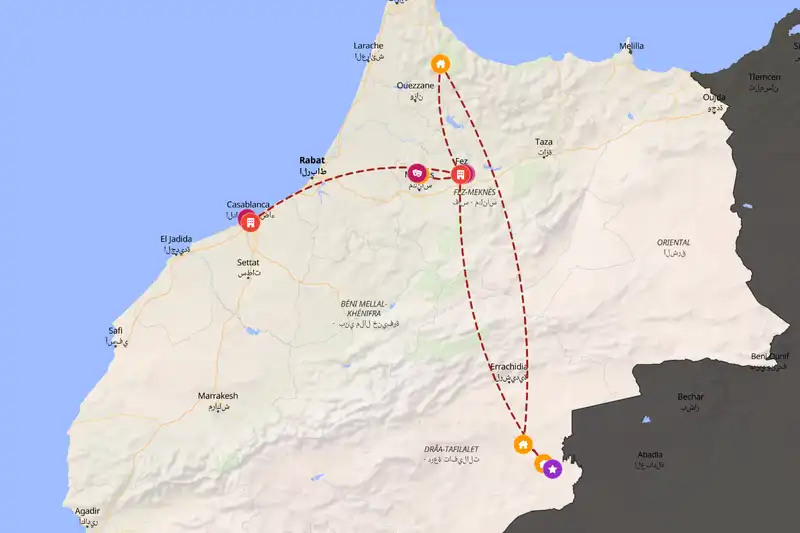
With the imperial cities and desert behind you, the final phase is about northern nuance and softer landscapes. You head out to the Volubilis Roman Ruins Archaeological Site, where mosaics lie open to the sky and you can wander through the remains of villas and streets without the usual museum barriers. Nearby, you pause in Moulay Idriss for a short visit, feeling the compact, whitewashed town’s spiritual weight and its importance to Moroccans themselves. You then continue to Chefchaouen for two nights, letting the blue alleys, mountain backdrop, and slower pace act as a decompression chamber after the intensity of Fes and the desert. On your final day, you roll to Tangier, where a last evening on the Strait of Gibraltar—between Africa and Europe—closes the loop on a route that’s taken you from ocean to mountains to desert and back to the sea.
What I love most about this long route is the whiplash moment of arriving in blue-washed Chefchaouen after days of red Marrakech dust and golden desert dunes, realizing that one country can hold that many different worlds in just a couple of weeks.v2.webp)
 Best Backpacking