×
Peru🇵🇪 | 14 days itinerary

14 Days in Peru

By Johan Kruseman 🇳🇱 | Updated May 9, 2026
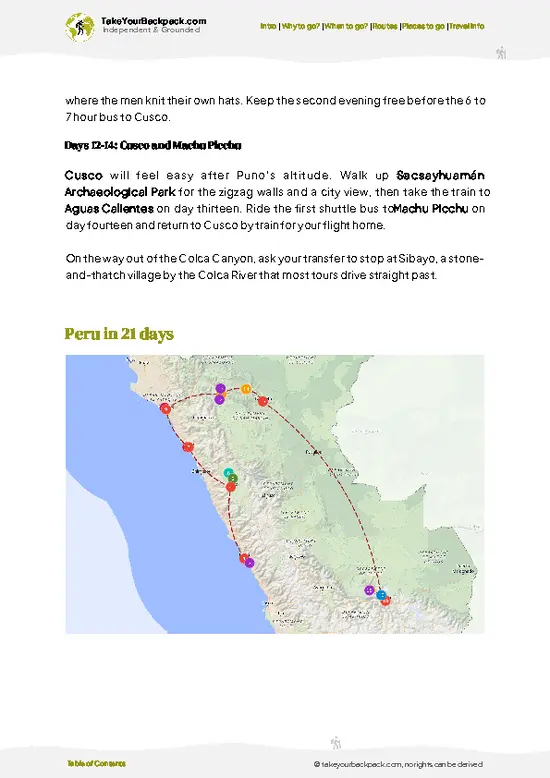
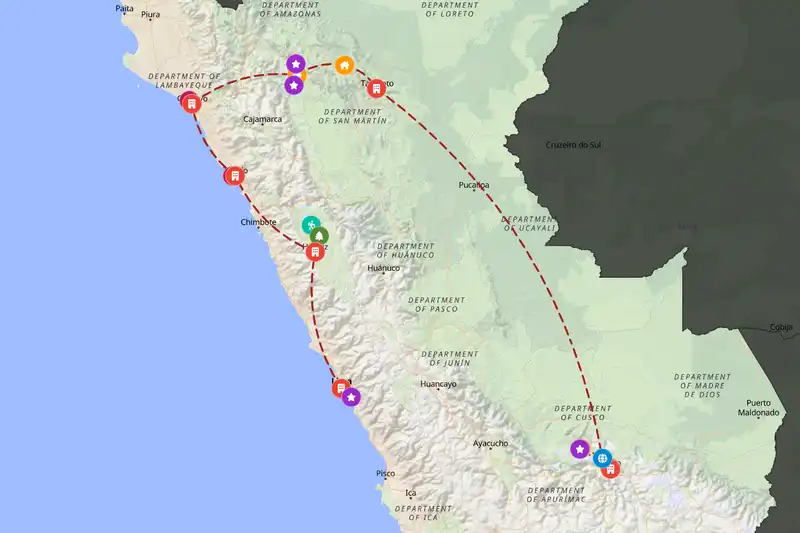
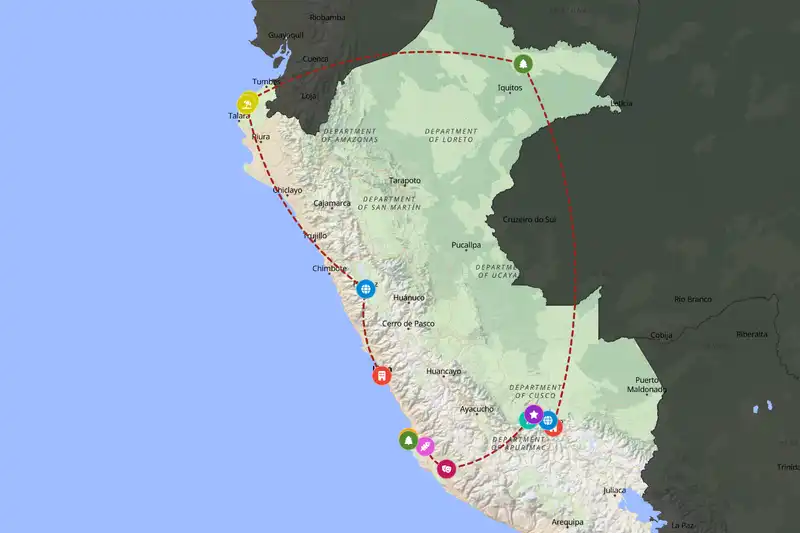
This 14-day route is for travelers who want a classic “first big Peru” trip that balances ruins, high mountains, and a taste of the coast, moving at a moderate pace with one domestic flight, intercity buses, and a mix of trains and taxis. You’ll connect Lima, Cusco, the Cuzco Sacred Valley, and the desert oasis of Huacachina, trading a little extra movement for a much broader snapshot of the country without turning it into a marathon.

Days 1-2: Lima - coastal capital and pre-Inca crash course

Land in Lima and give yourself two days to eat well and get your archaeological bearings before heading to the highlands. Spend time at the Larco Museum, where the ceramics and gold pieces lay out thousands of years of history in a way that makes later sites click into place, then walk over to Huaca Pucllana to stand inside an adobe pyramid that’s somehow still holding its own in the middle of modern Miraflores. If you have the energy, add Huaca Huallamarca as a shorter, quieter contrast, using taxis … read more 👉
This 14-day route is for travelers who want a classic “first big Peru” trip that balances ruins, high mountains, and a taste of the coast, moving at a moderate pace with one domestic flight, intercity buses, and a mix of trains and taxis. You’ll connect Lima, Cusco, the Cuzco Sacred Valley, and the desert oasis of Huacachina, trading a little extra movement for a much broader snapshot of the country without turning it into a marathon.

Days 1-2: Lima - coastal capital and pre-Inca crash course

Land in Lima and give yourself two days to eat well and get your archaeological bearings before heading to the highlands. Spend time at the Larco Museum, where the ceramics and gold pieces lay out thousands of years of history in a way that makes later sites click into place, then walk over to Huaca Pucllana to stand inside an adobe pyramid that’s somehow still holding its own in the middle of modern Miraflores. If you have the energy, add Huaca Huallamarca as a shorter, quieter contrast, using taxis or rideshares to keep logistics simple and your focus on food, museums, and the Pacific light rather than traffic stress.

Days 3-6: Cusco, Qorikancha, and Sacsayhuamán

Fly to Cusco and slow the pace for proper acclimatization, using four days to blend city wandering with key Inca sites. Start with gentle walks around the historic center and a visit to Qorikancha, where the clash and overlap of Inca and Spanish architecture sets the tone for everything you’ll see in the region. Once you’re feeling stronger, head up to Sacsayhuamán Archaeological Park for half a day among the giant stone walls, then round things out with the Museo Inka to connect the artifacts with the landscapes you’re about to hike through. Keeping these days flexible lets you respond to how your body handles altitude instead of locking yourself into a punishing schedule.

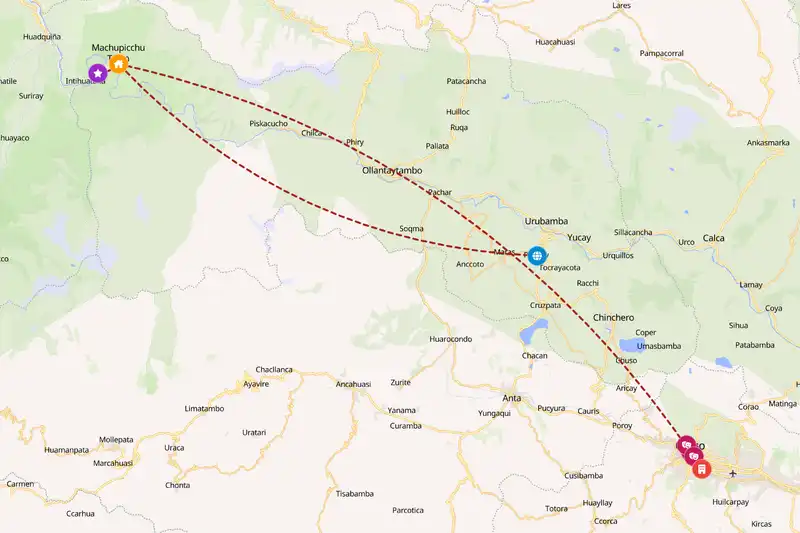
Days 7-9: Sacred Valley base and Machu Picchu

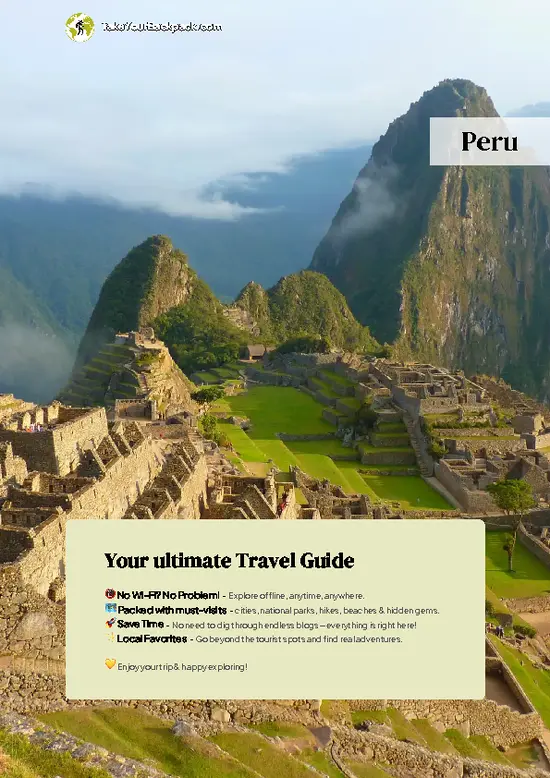
Shift your base into the Cuzco Sacred Valley using a taxi or organized transfer, and spend two days exploring valley towns and terraces at a relaxed pace, using the lower altitude as a breather between Cusco and the big show. Then ride the train to Aguas Calientes and set up for your early-morning visit to the Machu Picchu Sanctuary archaeological complex, giving the site a full day so you can wander the different sectors, linger at viewpoints, and let the crowds ebb and flow around you instead of rushing to keep up. With three nights split between the valley and Aguas Calientes, you get the full Machu Picchu experience without stacking long travel days back-to-back.

Days 10-12: Return to Cusco and optional Huayna Picchu hike

Head back to Cusco by train and keep three days open for either deeper exploration or a big side mission, depending on your energy. If you’re feeling strong and have secured permits, dedicate one of these days to hiking Huayna Picchu, the steep peak that towers over the ruins and gives you a completely different angle on the citadel and surrounding mountains. The remaining time can be used for extra museum visits, café-hopping, or simply wandering neighborhoods you missed the first time, giving the city space to feel familiar rather than just functional.

Days 13-14: Huacachina Desert Oasis via Lima

Fly back to Lima, then take a bus down the coast to the Huacachina Desert Oasis, where you’ll swap stone walls and thin air for sand dunes and warm evenings. Base yourself in Huacachina for two nights, using one full day for dune walks or a sandboarding session and the other for slow mornings by the lagoon and sunset on the ridges above town. On your final day, return by bus to Lima for your onward flight, closing the loop with the feeling that you’ve seen Peru’s coast, highlands, and desert without ever needing to sprint to keep up with your own itinerary.

My favorite moment on this route is the whiplash of watching the sun set over Cusco’s tiled roofs one evening and then, a few days later, standing on a dune above Huacachina watching the desert glow like another planet entirely.
Loading the map 🌍
film
0
0
0a
Lima
Pixabay
film
1
1
1a
Larco Museum
film
2
2
2a
Huaca Pucllana
film
3
3
3a
Cusco
Pixabay
film
4
4
4a
Qorikancha
film
5
5
5a
Sacsayhuamán Archaeological Park
film
6
6
6a
Cuzco Sacred Valley
film
7
7
7a
Machu Picchu Sanctuary archaeological complex
film
8
8
8a
Huayna Picchu
Unsplash
film
9
9
9a
Huacachina Desert Oasis
Laguna De Huacachina Ica
film
10
10
10a
Huacachina
Alexa

🛏️ Where to stay?The Route Breakdown

✈️ The backpacker research shortcutPeru Travel Guide

An offline-friendly backpacking guide with optimized travel routes, ranked highlights, transport advice, and the best areas to stay.
example page 0 from our offline Travel Guide for Peruexample page 1 from our offline Travel Guide for Peruexample page 2 from our offline Travel Guide for Peruexample page 3 from our offline Travel Guide for Peruexample page 4 from our offline Travel Guide for Peruexample page 5 from our offline Travel Guide for Peru
The digital guide (375 pages) contains:
118 highlights, ranked by travel appeal
Optimized 7, 14 & 21-day travel routes
Best neighborhoods to stay
How to get around
Offline-friendly for travel without Wi-Fi
👉 See all 30+ guide features

📅 Plan smarter in minutes, not weeks
Month by month travel advice
Festivals & national holidays
Budget expectations

🗺️ Go to the right places, skip the overrated ones
Honest pros & cons of destinations
Top hikes, parks & viewpoints
Lesser-known places most travelers miss
Clear “worth it vs skip it” guidance

🛏️ Travel smoothly without rookie mistakes
Best areas to stay
Transport systems explained simply
Common scams & safety advice
SIM cards, money & practical tips

🌍 Understand the country, not just visit it
Culture & traditions
52 Essential phrases & customs
Festivals worth planning around
Traveler-friendly historical context
Insights that make places more meaningful

📱 Built for real travel conditions
Fully downloadable PDF
Works completely offline
Optimized for phone use
Useful in remote areas & buses
Everything in one place
Save weeks of stressful planning
Get instant access to the full guide directly. 30-day money-back guarantee.


Sent to your inbox immediately after payment • 100% Secure Checkout
Best Backpacking Travel Advisor 2025 tourism awardBest Backpacking
Travel Advisor
2025
What others say about Take Your Backpack Guides:
⭐⭐⭐⭐⭐
Fantastic, amazing amount of information!
⭐⭐⭐⭐⭐
My goodness this is amazing, it's what I've been looking for hats off too you!
⭐⭐⭐⭐⭐
I think this is absolutely BRILLIANT
⭐⭐⭐⭐
Very complete and informative. It's still missing places, but I gotta to commend you
⭐⭐⭐⭐⭐
This is truly amazing, thank you, can't wait to explore it with my kids!
⭐⭐⭐⭐⭐
Awesome resource, thank you!
⭐⭐⭐⭐⭐
This is amazing! Can't wait to explore the ones I haven't seen
⭐⭐⭐⭐
I love this! Well done, great idea.
⭐⭐⭐⭐⭐
Thanks for taking the time to make this gem!
⭐⭐⭐⭐⭐
This might be the best website I've ever seen.
⭐⭐⭐⭐⭐
Congratulations, and thank you so much for your work; it's incredibly valuable.
⭐⭐⭐⭐
In all seriousness I think you did a great job pointing out the important spots
⭐⭐⭐⭐⭐
10/10 very good
⭐⭐⭐⭐⭐
As someone who's only just starting to visit regularly this is awesome, thank you.
⭐⭐⭐⭐
Thank you very much! I'm going to visit my dad, it's going to be very useful!
⭐⭐⭐⭐⭐
This is really cool! We'll be travelling for the first time and this definitely come in handy.
⭐⭐⭐⭐⭐
You are now our minister of culture, congratulations 👨‍💼
⭐⭐⭐⭐⭐
Just wanted to tell you that this is a pearl! Going to follow your recommendations.
⭐⭐⭐⭐⭐
This is so cool. I'll definitely be using the resource for my travels soon.
⭐⭐⭐⭐⭐
This is very impressive! Good work.
⭐⭐⭐⭐⭐
This is an amazing and informative site. Very well done!

🧭 RouteGot More or Less Time?

Travel Peru your way — from a quick highlights trip to a slow-paced adventure.

🙋 FAQCommon Questions

Peru is one of the easiest countries in South America to backpack independently, especially for a first big trip. The classic backpacker circuit is well-worn, hostels are everywhere, and most people in tourism speak at least basic English, though learning a bit of Spanish makes your life cheaper and smoother. You can land in Lima with no bookings and still find a dorm bed the same day in most seasons, but for Machu Picchu and the Inca Trail you need to plan ahead. Safety-wise, Peru is manageable if you use normal city sense: avoid flashing phones in busy markets, use registered taxis or app taxis in big cities, and keep your daypack in front of you on buses. Solo travelers are common, and it’s easy to meet people on long-distance buses, in hostel common areas, and on group tours for treks or day trips. The main challenge is altitude and long distances, not logistics. As long as you respect acclimatization (especially in Cusco, Arequipa, Huaraz, Puno) and don’t try to do everything in ten days, Peru is very backpacker-friendly on both cost and infrastructure.
For a tight but satisfying first trip, 2 weeks is the realistic minimum; 3–4 weeks lets you breathe and see more than just the greatest hits. In about 14 days on a budget you can do: Lima (1–2 days), Cusco and Sacred Valley with Machu Picchu (5–6 days), plus either Arequipa and Colca Canyon or Lake Titicaca (3–4 days), with travel days in between. If you have 3 weeks, you can add Huaraz for high-altitude trekking or the northern beaches (Máncora, etc.), or go deeper in the Sacred Valley instead of rushing. With 4 weeks or more, you can slow down, take more night buses instead of flights, and add the Peruvian Amazon or offbeat spots like Ayacucho or Chachapoyas. Anything under 10 days forces you into a fly-in, fly-out highlight reel: Lima plus Cusco and Machu Picchu, maybe one extra stop. For budget travelers, more time usually means less money per day because you can take buses instead of flights, negotiate longer hostel stays, and avoid paying for rushed tours.
You can easily travel Peru without ever renting a car; in fact, most backpackers never touch a steering wheel. Long-distance buses are the backbone of budget travel here: companies like Cruz del Sur and others run comfortable, semi-cama and cama seats with assigned seating, snacks, and sometimes onboard movies. Night buses save you both time and a night of accommodation, especially on routes like Lima–Arequipa, Arequipa–Cusco, and Lima–Huaraz. Inside cities, you’ll rely on a mix of official taxis, app-based rides, and local buses or minibuses; they’re cheap but can be chaotic, so for short stays it’s often worth paying a bit more for taxis. For huge distances or tight schedules, domestic flights between Lima, Cusco, Arequipa, and Iquitos are common and can be good value if booked early. Trains are limited mainly to tourist routes around Cusco and Machu Picchu, not a general transport option. Hitchhiking is not a mainstream strategy here and isn’t worth the risk or time for most travelers. With a mix of buses, occasional flights, and local transport, you can cover the country comfortably without a car.
For a first-time backpacker on a budget, the core must-visit list is about variety: mountains, history, and at least one desert or jungle experience. Cusco and the Sacred Valley are non-negotiable: the city itself is full of cheap hostels, backpacker bars, and markets, and the surrounding valley has ruins like Pisac and Ollantaytambo that are as impressive as Machu Picchu for a fraction of the cost. Machu Picchu is expensive but still worth the splurge once; you can keep it budget-friendly by taking the cheaper train times, hiking in via alternative treks like Salkantay, or combining buses and walking to Aguas Calientes instead of the full Inca Trail. Arequipa and the Colca Canyon give you colonial architecture, good food, and a chance to do a multi-day canyon trek on a backpacker budget. Huaraz is a top-tier stop if you like trekking: Laguna 69, Santa Cruz trek, and other routes offer big-mountain scenery without Nepal prices. For something different, the Peruvian Amazon (Puerto Maldonado or Iquitos) is worth it if you have time and money for a basic lodge or multi-day tour. If you want coast and desert, Huacachina and Paracas are easy additions from Lima: sandboarding, dune buggies, and cheap hostels around an oasis and the coast. Lima itself is worth at least a day or two for food and a feel for modern Peru, especially if you like street food and big-city energy.
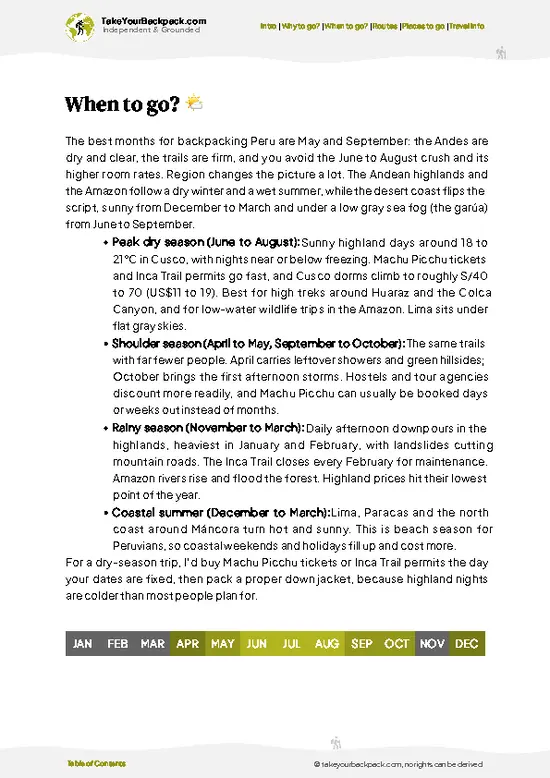
If you are short on time, skip anything that is only famous for Instagram shots or that duplicates experiences you’ll have elsewhere in Peru. Huacachina is fun but very tourist-focused; if you’re tight on days, you can skip it and not miss the essence of Peru, especially if you’re more into mountains than desert. The floating islands of Uros on Lake Titicaca can feel staged and rushed on quick tours; if you don’t have time for a proper homestay on Amantaní or Taquile, consider skipping Titicaca entirely and using those days for Huaraz or more time in the Sacred Valley. The Nazca Lines overflight is expensive for what you get and not essential unless you’re really into archaeology or aviation; budget travelers often regret the cost-to-experience ratio. You can also skip trying to see both the Amazon and every Andean region on a short trip; pick either mountains or jungle as your main focus. In Lima, you don’t need to chase every museum or far-flung district; stick to a couple of neighborhoods like Miraflores, Barranco, and the historic center, then move on. The key is to avoid overstuffing your itinerary with long bus rides just to tick off names; it’s better to go deeper in Cusco, Sacred Valley, and one or two other regions than to skim six places in ten days.

🇵🇪 PeruWhere to Go Next

Ready to build a truly unique trip? Predefined routes are perfect for first-time visitors, but there is so much more to discover. Whether you are chasing a city trip, pristine national parks, local food scenes, or quiet beaches, pick a category to design your own path.