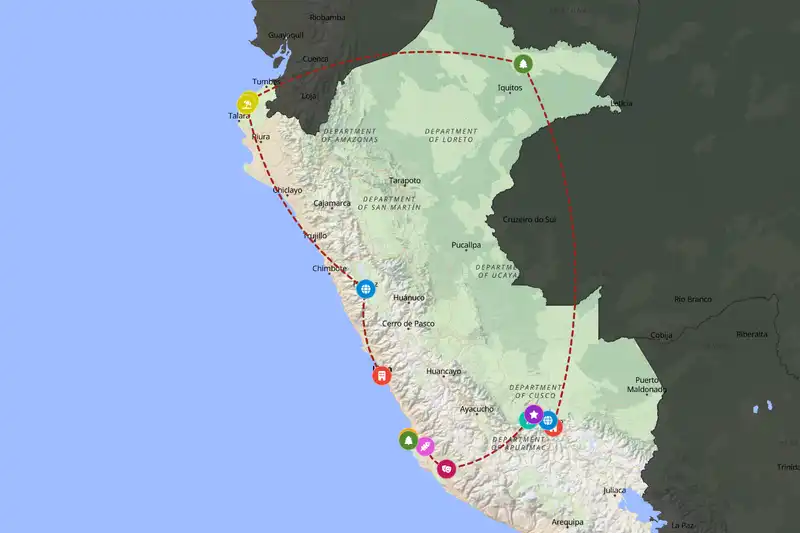
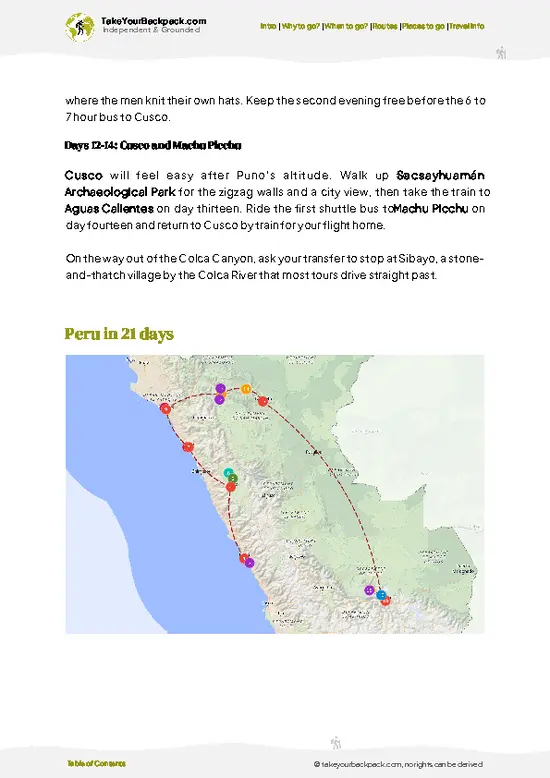
This three-week loop suits travelers who have a little Peru experience, or plenty of curiosity, and want the country’s north as much as its Inca heartland: desert adobe cities, glacier lakes, cloud-forest fortresses and, finally, Machu Picchu. The pace is steady but unhurried, with two or more nights almost everywhere and only two overnight buses, each followed by an easy day. You’ll ride long-distance buses (day and overnight), shared colectivos and taxis in the north, one domestic flight from Tarapoto to Cusco via Lima, and the tourist train to Aguas Calientes.
Days 1-2: Lima
Give
Lima two nights and use them to set up the north. Take a taxi or tour 40 to 60 minutes south to
Pachacamac, a desert sanctuary of adobe pyramids used for more than a thousand years before the Inca took it over, and walk through the
Museo de Sitio Pachacamac first so the ruins make sense. Back in the center, the
Museo de Arte de Lima in the Parque de la Exposición covers roughly 3,000 years of Peruvian art, from …
read more 👉This three-week loop suits travelers who have a little Peru experience, or plenty of curiosity, and want the country’s north as much as its Inca heartland: desert adobe cities, glacier lakes, cloud-forest fortresses and, finally, Machu Picchu. The pace is steady but unhurried, with two or more nights almost everywhere and only two overnight buses, each followed by an easy day. You’ll ride long-distance buses (day and overnight), shared colectivos and taxis in the north, one domestic flight from Tarapoto to Cusco via Lima, and the tourist train to Aguas Calientes.
Days 1-2: Lima
Give Lima two nights and use them to set up the north. Take a taxi or tour 40 to 60 minutes south to Pachacamac, a desert sanctuary of adobe pyramids used for more than a thousand years before the Inca took it over, and walk through the Museo de Sitio Pachacamac first so the ruins make sense. Back in the center, the Museo de Arte de Lima in the Parque de la Exposición covers roughly 3,000 years of Peruvian art, from Chavín textiles to colonial painting, in a 19th-century palace. Spend the evenings eating your way through ceviche counters and chifa (Peruvian-Chinese) joints, because the north’s food stays good but Lima’s range is unmatched.Days 3-7: Huaraz and Huascarán National Park
The day bus to Huaraz takes 8 to 9 hours and climbs from sea level to 3,050 meters, so the first full day is for walking the market, drinking coca tea and doing nothing strenuous. On day five, join a shared tour (about S/40 to 60, plus the park fee) into Huascarán National Park for Laguna 69: a 2.5 to 3 hour climb from about 3,900 to 4,600 meters to a turquoise lake under the white wall of Chacraraju, passing the Llanganuco lakes on the drive in. Keep day six for a gentler park outing such as the Pastoruri glacier or simply rest, then catch the night bus north on day seven.Days 8-9: Trujillo and Chan Chan
The overnight ride to Trujillo runs 8 to 9 hours and drops you back at the warm coast, so plan only a slow first day. The big reason to come is the Chan Chan Archaeological Zone, capital of the Chimú kingdom and the largest adobe city in the Americas at around 20 square kilometers. The restored Tschudi palace has walls carved with fish, pelicans and wave patterns, and one ticket of about S/15 also covers two smaller huacas nearby. Trujillo’s yellow-and-blue colonial center is pleasant for an evening stroll after the heat breaks.Days 10-11: Chiclayo and the Lord of Sipán
A short 3 to 4 hour bus brings you to Chiclayo, where the witchcraft market sells dried herbs, potions and snake skins next to fruit stalls. The next morning, a 15 to 20 minute colectivo reaches Lambayeque and the Museo Tumbas Reales de Sipán, built around the Moche royal tomb found in 1987 and filled with gold ear spools, peanut-shaped necklaces and the reconstructed burial itself. It ranks among the finest archaeological museums in South America. Leave luggage at your hostel and take the night bus east that evening.Days 12-14: Chachapoyas, Kuelap and Gocta
The 9 to 10 hour overnight bus climbs into the cloud forest and arrives in Chachapoyas, a whitewashed town at about 2,300 meters with far fewer visitors than the south. On day thirteen, head to Kuelap, the mountaintop citadel of the Chachapoya people, with outer walls rising to roughly 20 meters and the stone bases of hundreds of round houses covered in moss and bromeliads; some sections stay roped off for conservation. Day fourteen is for Gocta Waterfall, a two-tiered drop of about 770 meters reached by a 5 to 6 hour round-trip hike from the village of Cocachimba, muddy in places and loud with birdsong.Days 15-16: Moyobamba and Tarapoto
Instead of retracing the long road to the coast, roll downhill into the Amazon fringe. The 5 to 6 hour ride via Pedro Ruiz reaches Moyobamba, known for its orchid gardens and the sulfur-scented San Mateo hot springs, a fine soak after Gocta. The next day, it’s only about 2 hours to Tarapoto, a hot, humid city of motorcycle taxis and jungle fruit juices, which has the airport you need.Days 17-19: Cuzco Sacred Valley, Aguas Calientes and Machu Picchu
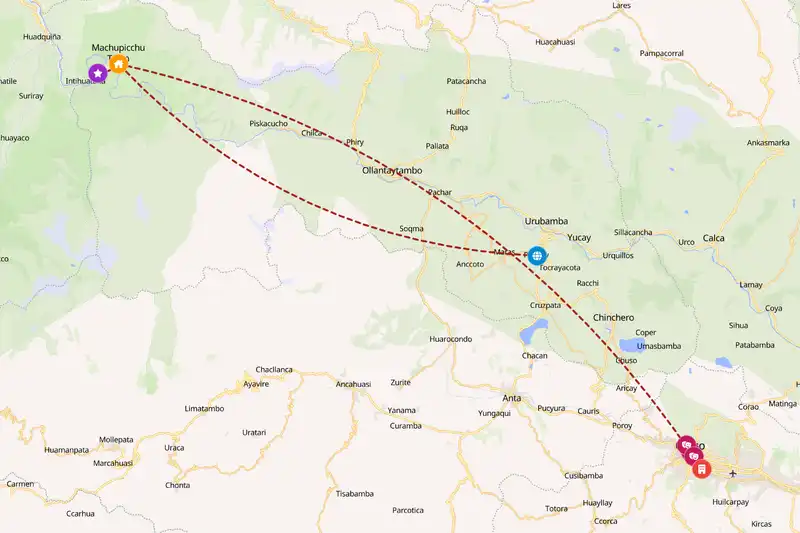
Fly from Tarapoto to Cusco via Lima and go straight down to the Cuzco Sacred Valley, 1.5 to 2 hours by taxi or colectivo, where Ollantaytambo sits around 2,800 meters and lets your body adjust after the jungle. On day eighteen, explore the Ollantaytambo terraces in the morning and take the afternoon train (about 1.5 hours, US$60 to 90 each way) to Aguas Calientes. Ride the first shuttle up to Machu Picchu on day nineteen, when the cloud often lifts off Huayna Picchu, then take the train and bus back to Cusco in the evening.Days 20-21: Cusco
Finish with an easy final stretch in Cusco. At Qorikancha, the Inca Temple of the Sun, the Dominicans built their church directly on top of curved, mortarless walls that have survived every earthquake since. Walk 20 to 30 minutes uphill to Sacsayhuamán Archaeological Park for the three tiers of zigzag walls and a view over the red-tiled city, then fly out on day twenty-one.
From Chachapoyas, I’d send a friend 2.5 to 3 hours south to the museum in Leymebamba, where more than 200 Chachapoya mummies from the Laguna de los Cóndores rest in glass-fronted cases, and I’d tell them to stay the night because the return bus schedule is thin.v2.webp)



 Best Backpacking