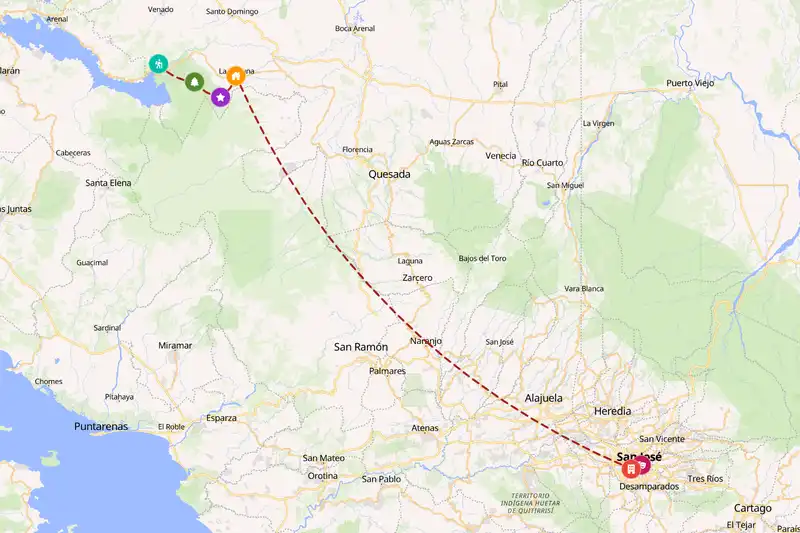
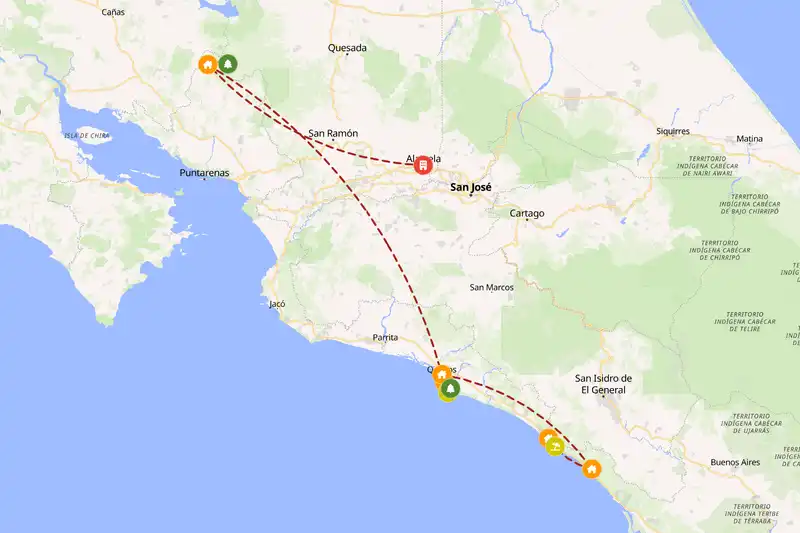
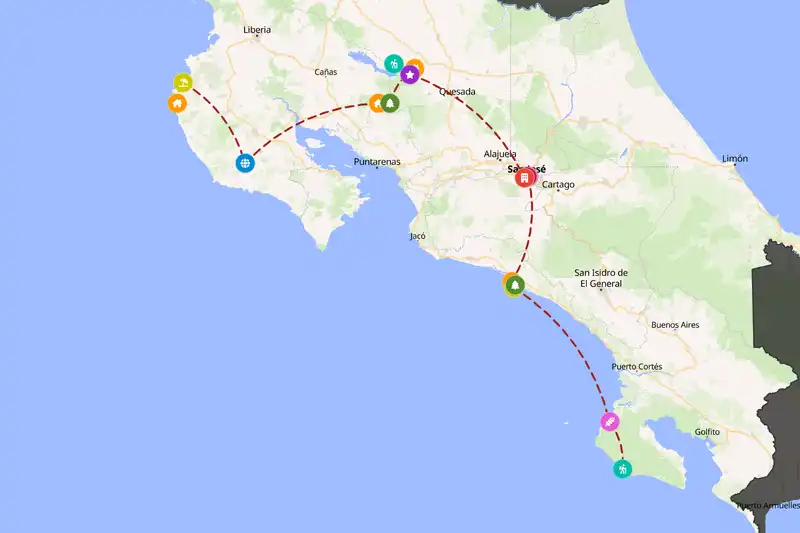
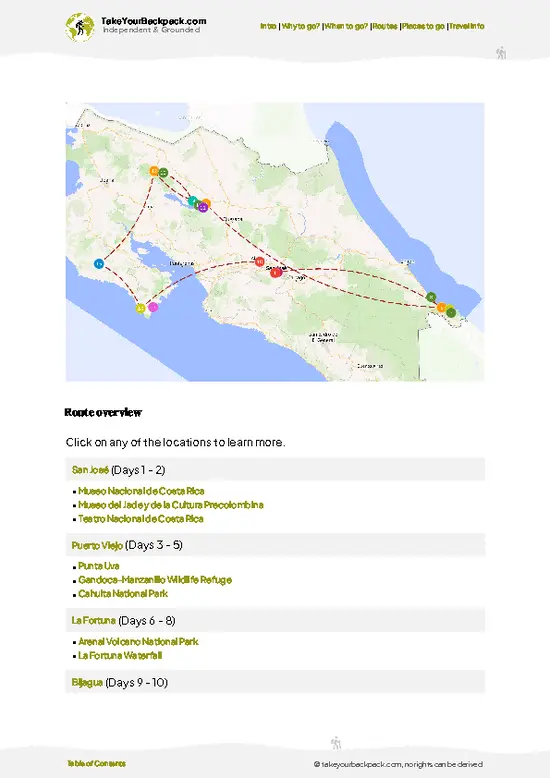
This fifteen-day Costa Rica loop is for travelers who want the country’s range in one trip: a capital with serious museums, the reggae-and-rice-and-beans Caribbean coast, an active-looking volcano, a river dyed sky blue by minerals and a Pacific surf town at the end of a dirt road. The style is independent and budget-minded, mostly hostels and guesthouses, and the pace is relaxed, with two or three nights per base and never two long travel days in a row. You will use long-distance public buses out of San José, local buses along the Caribbean road, a shared shuttle or bus-and-taxi combination to reach Bijagua, and the Puntarenas to Paquera car ferry to cross onto the Nicoya Peninsula.
Days 1-2: San José
Give
San José two full nights, because the capital is where the country’s pre-Columbian story is kept, and the rest of the trip is all forests and beaches. Start at the
Museo Nacional de Costa Rica, housed in the old Bellavista Fortress, whose walls still carry bullet marks from the 1948 civil …
read more 👉This fifteen-day Costa Rica loop is for travelers who want the country’s range in one trip: a capital with serious museums, the reggae-and-rice-and-beans Caribbean coast, an active-looking volcano, a river dyed sky blue by minerals and a Pacific surf town at the end of a dirt road. The style is independent and budget-minded, mostly hostels and guesthouses, and the pace is relaxed, with two or three nights per base and never two long travel days in a row. You will use long-distance public buses out of San José, local buses along the Caribbean road, a shared shuttle or bus-and-taxi combination to reach Bijagua, and the Puntarenas to Paquera car ferry to cross onto the Nicoya Peninsula.
Days 1-2: San José
Give San José two full nights, because the capital is where the country’s pre-Columbian story is kept, and the rest of the trip is all forests and beaches. Start at the Museo Nacional de Costa Rica, housed in the old Bellavista Fortress, whose walls still carry bullet marks from the 1948 civil war, with a butterfly garden tucked inside. The next morning, walk to the Museo del Jade y de la Cultura Precolombina, a modern building with one of the largest collections of American jade anywhere, then finish at the Teatro Nacional de Costa Rica, opened in 1897 and paid for with a coffee export tax. A guided tour of the gilded auditorium runs roughly ₡5,000 to 7,500 (US$10 to 15), and the café inside is the best-value spot in the city for an hour off your feet.Days 3-5: Puerto Viejo and the Southern Caribbean
The MEPE bus from Terminal Caribeño reaches Puerto Viejo in 4.5 to 5 hours for about ₡6,000 to 7,000 (US$12 to 14), dropping from the cool Central Valley through Braulio Carrillo’s cloud forest to the hot, wet coast. This is a different country in spirit: Afro-Caribbean cooking with coconut, Creole English on the street and bicycles as the main transport. Rent a bike for ₡3,000 to 5,000 (US$6 to 10) a day and ride south to Punta Uva, where a calm, reef-sheltered cove makes the best swimming on this coast. On another day, push on to the Gandoca-Manzanillo refuge for a jungle trail that ends at rocky viewpoints over the sea. Spend the third day in Cahuita National Park, 30 minutes back up the road by local bus; the Kelly Creek entrance in Cahuita town runs on donations, and the flat beach trail is thick with howler monkeys, sloths and raccoons raiding bags.Days 6-8: La Fortuna and Arenal
This is the longest transfer of the trip, 5 to 6 hours by shared shuttle (US$55 to 70) or a full day by bus with a change in San José, so leave early and treat the evening as a rest. La Fortuna sits at the foot of the cone, and three nights let you match activities to the weather, since the summit hides in cloud more often than not. Walk the old lava fields in Arenal Volcano National Park (about ₡7,500 or US$15) on a clear morning, and save the La Fortuna Waterfall for whichever day looks gray: its 70-meter drop into a green pool is just as good in drizzle, and the climb down is around 500 steps. Skip the big hot spring resorts if money is tight; the free warm river near Tabacón is where locals soak after work.Days 9-10: Bijagua and Tenorio Volcano
A 2 to 3 hour shuttle (around US$40 to 55) brings you to Bijagua, a farming village of cattle pasture and small lodges that most travelers drive past. It exists for one reason: Tenorio Volcano National Park. The Out-and-Back at Tenorio Volcano National Park runs roughly 6 to 7 kilometers to the Río Celeste waterfall, the blue lagoons and the spot where two clear streams meet and turn milky turquoise from a chemical reaction. Get there when the gates open, because entry stops in the early afternoon and the color is brightest before the afternoon rain churns the water. Foreign entry is around ₡7,000 (US$14), and two nights mean you never have to rush the hike.Days 11-13: Santa Teresa and the Nicoya Peninsula
The second long day crosses to the Nicoya Peninsula: bus or shuttle down to Puntarenas, the 70-minute ferry to Paquera with pelicans riding alongside, then a bus or shuttle west. Santa Teresa Beach is the payoff, kilometers of surfable beach break, yoga studios and sunsets that pull the whole town onto the sand at 5:30 pm. Take a beginner surf lesson for US$40 to 60, rent a board for the rest of your stay, and spend one day in Montezuma, 45 minutes away by shuttle, where a short river hike leads to a set of waterfalls and the village keeps a slower, older hippie rhythm.Days 14-15: Alajuela and Departure
Head back via the ferry or the direct Santa Teresa to San José bus (about 6 hours), but sleep in Alajuela rather than the capital. It is 15 minutes from Juan Santamaría airport, its central park is shaded by mango trees, and you wake up on the last day with no traffic between you and your flight.
If a friend were doing this loop, I would send them from Santa Teresa to the Cabo Blanco reserve at the peninsula’s tip for the forest trail down to an empty beach, with an early start and at least 3 liters of water each.

 Best Backpacking