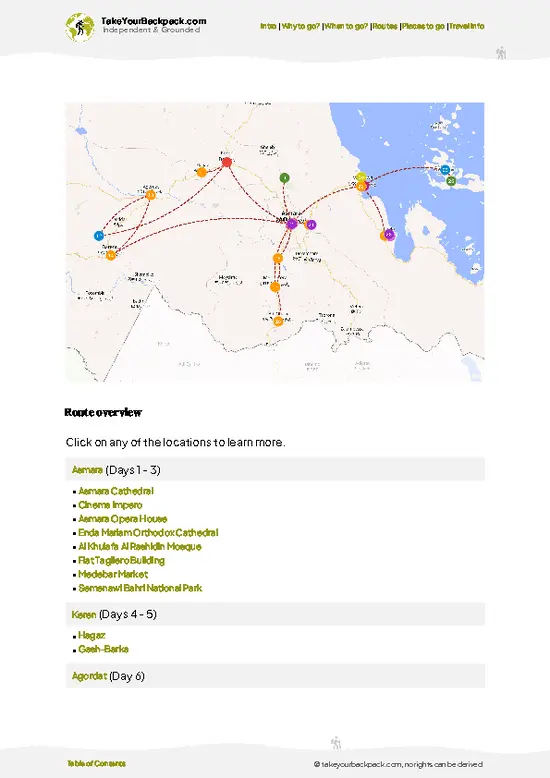
This fifteen-day loop through Eritrea suits travelers with patience and curiosity who want the full range of the country: the modernist capital, the lowland markets of the west, the farming plateau to the south, a cliff-top monastery and the Red Sea coast with its islands and ancient ruins. The pace is steady but never frantic, with only one genuinely long road day. You will rely on intercity buses from Asmara’s main bus station, minibuses for short hops between highland towns, city taxis, and a hired car or 4x4 with driver for Filfil, Adulis and the boat out to the Dahlak islands. Every destination outside the capital must be written on your travel permit, so the order below is also the order you request at the tourism office.
Days 1-3: Asmara and the Semenawi Bahri Escarpment
Three nights in
Asmara give you time to file permits on day one and still see the city properly. Spend the first full day on foot along Harnet Avenue:
Asmara Cathedral with its Lombard-Romanesque bell tower, the 1937 …
read more 👉This fifteen-day loop through Eritrea suits travelers with patience and curiosity who want the full range of the country: the modernist capital, the lowland markets of the west, the farming plateau to the south, a cliff-top monastery and the Red Sea coast with its islands and ancient ruins. The pace is steady but never frantic, with only one genuinely long road day. You will rely on intercity buses from Asmara’s main bus station, minibuses for short hops between highland towns, city taxis, and a hired car or 4x4 with driver for Filfil, Adulis and the boat out to the Dahlak islands. Every destination outside the capital must be written on your travel permit, so the order below is also the order you request at the tourism office.
Days 1-3: Asmara and the Semenawi Bahri Escarpment
Three nights in Asmara give you time to file permits on day one and still see the city properly. Spend the first full day on foot along Harnet Avenue: Asmara Cathedral with its Lombard-Romanesque bell tower, the 1937 Cinema Impero, the Asmara Opera House, and then the city’s other faiths at Enda Mariam Orthodox Cathedral and the Al Khulafa Al Rashidin Mosque, whose minaret faces the Catholic tower across the old center. Finish at the Fiat Tagliero Building, the 1938 service station whose concrete wings stretch about 15 meters without visible support.
Day two belongs to Medebar Market in the morning, when metalworkers are hammering oil drums into coffee roasters and bed frames, and then a café macchiato on Harnet Avenue while your permit is processed. On day three, hire a car and driver for the drive northeast into Semenawi Bahri National Park and the forest around Filfil National Park, where the road drops off the plateau through coffee and fig trees and mist often hangs in the canopy. Baboons on the road are common. You are back in Asmara for dinner.Days 4-5: Keren
The bus to Keren takes 2.5 to 3 hours and descends to about 1,400 meters, so the air warms noticeably. Two nights let you catch the Monday livestock market if you time it right, when camels, goats and cattle are traded at the edge of town. Keren also holds the Commonwealth and Italian war cemeteries from the 1941 battle and the small shrine of Mariam Dearit set inside the trunk of a baobab. The town mixes Tigre, Bilen and Tigrinya communities, and you hear it in the market.Days 6-7: Gash-Barka Lowlands
Heading west, the road passes Hagaz and drops into Gash-Barka, the hot, flat breadbasket of the country. A night in Agordat (about 2 hours from Keren) gives you the riverside market and evening tea with locals once the heat breaks, then a short 1.5-hour hop takes you to Barentu, the main town of the Kunama people, for the second night. Go between November and February if you can; from April to June, temperatures here push past 40°C.Day 8: Return to Asmara
This is the long day: 5 to 7 hours by bus back through Agordat and Keren to Asmara. Leave early, carry water, and plan nothing for the evening beyond a decent meal.Days 9-10: Debarwa, Mendefera and Adi Quala
After the long ride, the southern highlands come in short hops. Stop at Debarwa, about 25 kilometers south of the capital and once the seat of the Bahri Negash rulers, then continue to Mendefera, a market town at around 1,950 meters where you spend the night. The next morning, a 30 to 45 minute minibus reaches Adi Quala, close to the Ethiopian border, where the Italian ossuary for the dead of the 1896 Battle of Adwa stands outside town. Return to Asmara for the night; the whole run is about 1.5 hours.Day 11: Nefasit and Debre Bizen
Take an early minibus to Nefasit, under an hour down the Massawa road, and climb to the 14th-century monastery at the top of Debre Bizen National Park. The path gains roughly 1,000 meters in 2 to 3 hours, and the reward is a view down the escarpment toward the coast. Only men may enter the monastery grounds, and you need a separate permit arranged in Asmara; women can walk the lower slopes of the path instead. Sleep in Asmara again.Days 12-15: Massawa, the Dahlak Islands and Adulis
The bus down to Massawa takes 3 to 4 hours and loses 2,300 meters of altitude, from cool highland air to sticky sea heat. Spend arrival day in Massawa Old Town, where coral-stone houses with carved wooden balconies line narrow lanes, and walk past the shell-pocked Imperial Palace of Massawa on the causeway. Day thirteen is for the sea: a boat to the Dahlak Archipelago and the reefs of Dahlak Marine National Park, booked and permitted through the Eritrean Shipping Lines office in town. Share the boat if you can, since it is the single biggest cost of the trip. On day fourteen, hire a 4x4 south past Foro to the half-excavated Aksumite port of Adulis, then on to the shore at Zula. End the evening with a swim at Massawa Beach and grilled fish. Day fifteen is the morning bus back to Asmara for your flight.
If you have a spare day and a permit, Nakfa, the trench-lined mountain town in the far north that held out through the independence war, is the place almost no visitor reaches.
 Best Backpacking


