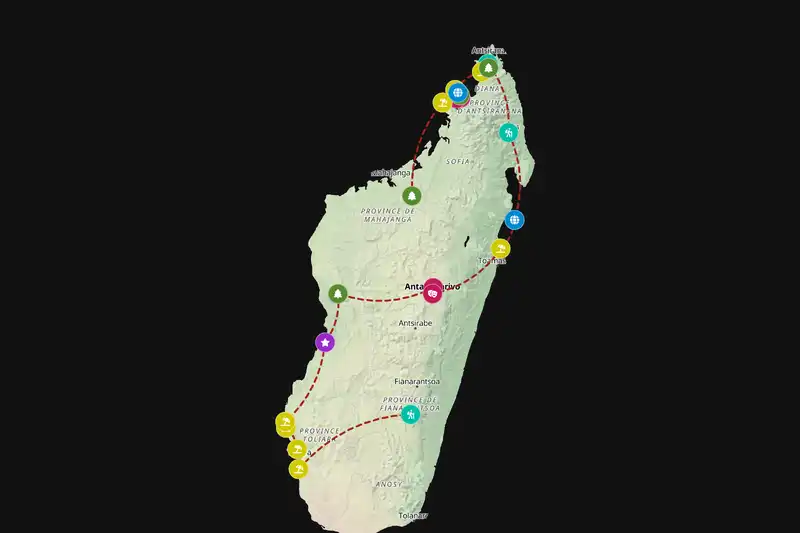
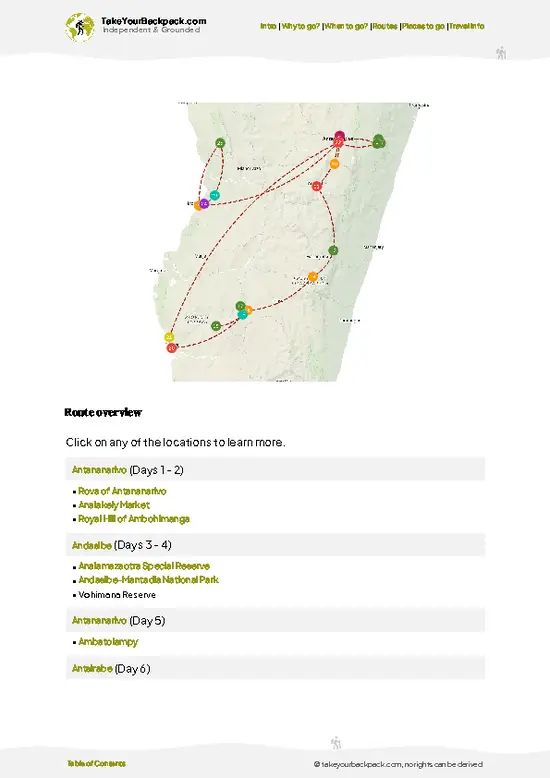
This two-week route links the rainforest east of the capital with Madagascar’s far north, for travelers who want lemurs, limestone and mountain forest first and island beaches as a finale. The pace is moderate: two drives of 3 to 4 hours, one domestic flight, one long road-and-boat day, and plenty of full days on foot in between. You’ll take a taxi-brousse or minibus to Andasibe, fly from Antananarivo to Antsiranana, ride taxi-brousses down the RN6 to Ambanja, and cross from Ankify to Nosy Be by speedboat before flying out.
Days 1-2: Antananarivo
Treat
Antananarivo as a city to read from above. The
Rova of Antananarivo crowns the highest of its twelve sacred hills, and from its terrace you see rice paddies running right up to the edge of the suburbs. Just below it, the
Andafiavaratra Palace Museum, the former residence of the 19th-century prime minister Rainilaiarivony, holds the royal objects rescued when the Rova burned in the 1990s: thrones, portraits and a coronation canopy. On Day 2, …
read more 👉This two-week route links the rainforest east of the capital with Madagascar’s far north, for travelers who want lemurs, limestone and mountain forest first and island beaches as a finale. The pace is moderate: two drives of 3 to 4 hours, one domestic flight, one long road-and-boat day, and plenty of full days on foot in between. You’ll take a taxi-brousse or minibus to Andasibe, fly from Antananarivo to Antsiranana, ride taxi-brousses down the RN6 to Ambanja, and cross from Ankify to Nosy Be by speedboat before flying out.
Days 1-2: Antananarivo
Treat Antananarivo as a city to read from above. The Rova of Antananarivo crowns the highest of its twelve sacred hills, and from its terrace you see rice paddies running right up to the edge of the suburbs. Just below it, the Andafiavaratra Palace Museum, the former residence of the 19th-century prime minister Rainilaiarivony, holds the royal objects rescued when the Rova burned in the 1990s: thrones, portraits and a coronation canopy. On Day 2, take the shuttle 22 km west to Lemurs’ Park, where rescued sifakas and ring-tailed lemurs range free through a botanical garden of endemic plants. It’s a gentle introduction before the wild ones.Days 3-5: Andasibe
The 3.5 to 4 hour ride east to Andasibe drops you into misty montane rainforest. Spend Day 4 inside Andasibe-Mantadia National Park, timing your walk for the morning, when the indri, Madagascar’s largest living lemur, calls across the valleys in long eerie sirens. Book a guided night walk on the road outside the park for tiny mouse lemurs and Parson’s chameleons the size of a forearm. On Day 5, return to the capital for one night near the airport.Days 6-8: Antsiranana (Diego Suarez)
A flight of about 1.5 to 2 hours lands you in Antsiranana (Diego Suarez), a laid-back port with faded French colonial facades wrapped around one of the largest natural bays in the Indian Ocean. Spend an afternoon at Ramena Beach, 30 to 40 minutes east, with fish curry at a beach shack and boat trips out past the mouth of the bay. Day 8 heads 30 km south to Joffreville and Amber Mountain National Park, where the Montagne d’Ambre Circuit climbs through cool, wet forest at around 1,000 meters to waterfalls and crater lakes. Ask your guide to find the Brookesia leaf chameleons, some of the smallest reptiles on earth, small enough to sit on a fingertip.Day 9: Ankarana
Ride 2 to 3 hours south on the RN6 to Mahamasina, the eastern gateway of the Ankarana Special Reserve. Here the limestone erupts into gray tsingy pinnacles, crossed by a hanging bridge and riddled with caves where bats roost and crowned lemurs feed in the canyon forests. It’s an easier Tsingy to reach than Bemaraha in the west, and you can walk the main loop in half a day.Days 10-14: Nosy Be
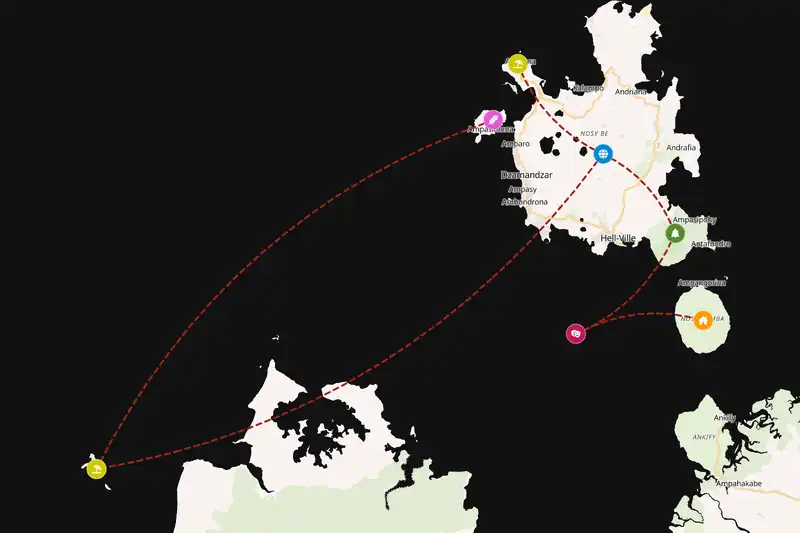
Day 10 is the long one: about 3 hours by road to Ambanja, another 30 minutes to the jetty at Ankify, and a 30 to 45 minute speedboat crossing to Nosy Be. You’ve earned four slow nights. Take a day trip to Nosy Komba for black lemurs and wood carvings, spend your evenings on Andilana Beach watching the sun sink into the channel, and leave the rest of your time unscheduled. On Day 14, fly out from Fascene airport.
Back in Diego, a guide and an early start get you up Windsor Castle, a flat-topped rock above the Baie du Courrier with an old military stairway and views over the whole northern tip of the island.v2.webp)
 Best Backpacking