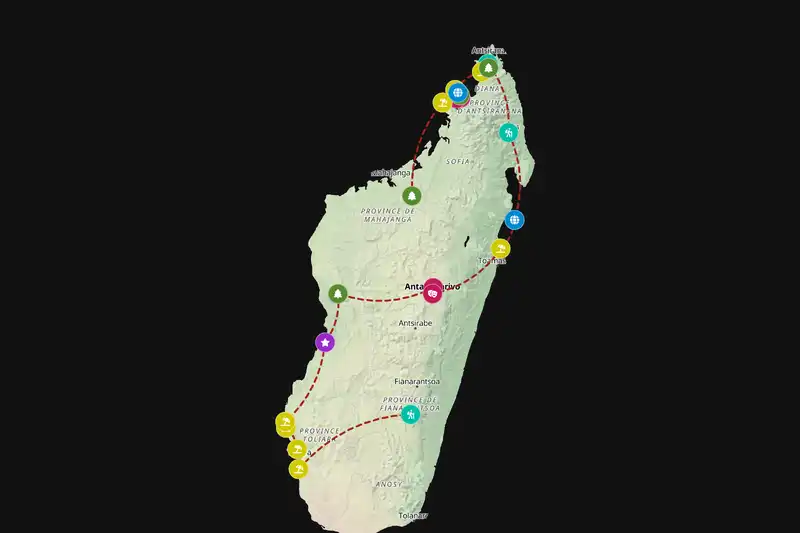
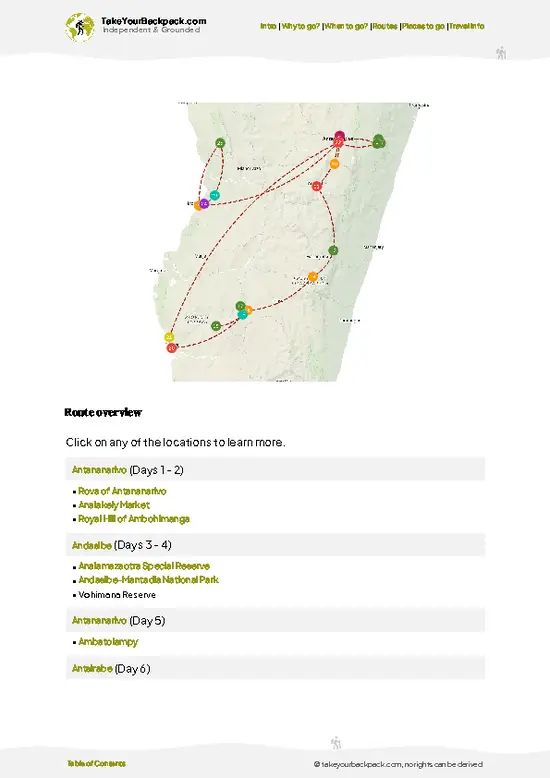
This three-week loop through Madagascar suits travelers who want the big landscapes and the lemurs without sprinting, and who accept that the trade for seeing the highlands, the spiny southwest and the western limestone in one trip is a lot of road. The pace is steady, with a rest or walking day after every long drive. You’ll use taxi-brousses and premium minibus companies such as Cotisse on the RN7, two domestic flights (Toliara to Antananarivo, then on to Morondava), and a shared or hired 4x4 with driver for the dirt track to the Tsingy. Plan it for roughly May to November, when the Tsingy de Bemaraha park is open and the western tracks are passable.
Days 1-2: Antananarivo and the Royal Hills
Two nights in
Antananarivo give your body time to adjust to the 1,280-meter altitude and give you the political backstory that makes the rest of the trip make sense. Spend a morning walking up through Haute-Ville to the
Rova of Antananarivo, the stone shell of the Merina queens’ palace on the city’s …
read more 👉This three-week loop through Madagascar suits travelers who want the big landscapes and the lemurs without sprinting, and who accept that the trade for seeing the highlands, the spiny southwest and the western limestone in one trip is a lot of road. The pace is steady, with a rest or walking day after every long drive. You’ll use taxi-brousses and premium minibus companies such as Cotisse on the RN7, two domestic flights (Toliara to Antananarivo, then on to Morondava), and a shared or hired 4x4 with driver for the dirt track to the Tsingy. Plan it for roughly May to November, when the Tsingy de Bemaraha park is open and the western tracks are passable.
Days 1-2: Antananarivo and the Royal Hills
Two nights in Antananarivo give your body time to adjust to the 1,280-meter altitude and give you the political backstory that makes the rest of the trip make sense. Spend a morning walking up through Haute-Ville to the Rova of Antananarivo, the stone shell of the Merina queens’ palace on the city’s highest ridge, then drop down the long staircases into the Analakely Market for stalls of vanilla pods, hand-forged knives and pyramids of red-skinned bananas. Day 2 is for the Royal Hill of Ambohimanga, about 20 km north, a forested hilltop compound with fortified stone gates sealed by giant stone discs. It takes 45 minutes to an hour by taxi depending on traffic, so leave early.Days 3-5: Andasibe
The drive east to Andasibe takes 3.5 to 4 hours, and the air turns damp and green somewhere past Moramanga. Two nights is the right amount. Morning one goes to the Analamazaotra Special Reserve section of Andasibe-Mantadia National Park, where habituated indri families sing a wailing call that carries a kilometer or more through the eucalyptus and native forest. On the second day, take a 4x4 north to wilder Mantadia for diademed sifakas, or stay close and walk Vohimana Reserve, a community-run forest just west of the village with good night walks for mouse lemurs and leaf-tailed geckos. Day 5 is the 3.5 to 4 hour ride back to the capital for one night, which splits what would otherwise be a brutal Andasibe-to-Antsirabe slog.Days 6-9: The Highlands Road to Ranomafana and Ambalavao
Heading south on the RN7, stop in Ambatolampy to watch artisans pour molten recycled aluminum into sand molds for the cooking pots sold all over the country. Spend the night in Antsirabe, a wide-avenued spa town where the colonial-era Hôtel des Thermes and the town’s thermal baths sit a pousse-pousse ride apart. Day 7 is the longest highland drive, 6 to 7 hours to Ranomafana National Park, so book a guesthouse near the park gate and do nothing that evening except soak in the village hot springs. Day 8 is for the forest itself: steep, slippery hillside trails where guides track golden bamboo lemurs and the greater bamboo lemur, then a night walk along the road for chameleons. On Day 9, continue 3 to 4 hours to Ambalavao, a red-brick town of carved wooden balconies. Time it for the Ambalavao zebu market: the cattle market runs on Wednesday and Thursday mornings, and herders walk their zebu here for weeks from the south. The Antaimoro paper workshop, where flowers are pressed into handmade bark paper, is open daily.Days 10-11: Isalo
The RN7 leaves the rice terraces behind and crosses the empty Horombe Plateau, 5 hours of grassland to Ranohira, the gateway village for Isalo National Park. Use the full Day 11 for a guided hike through sandstone canyons to natural pools with ring-tailed lemurs and Verreaux’s sifakas in the gallery forest, then finish on the Isalo Window Trail, where the sun sets through a hole in an eroded rock wall. Bring a headlamp for the walk out.Days 12-15: Ifaty and the Southwest Coast
Day 12 runs 4 to 5 hours down to the coast, with a stop at Zombitse-Vohibasia National Park right on the highway for an hour of dry forest birding and sportive lemurs in tree hollows. Pass through Toliara and carry on 45 minutes to an hour north to Ifaty. Three nights here is deliberate: after nearly two weeks of road, you need a few days of lagoon swimming, snorkeling off Vezo fishermen’s outrigger pirogues and walking through the spiny forest of octopus trees and fat-trunked baobabs behind the beach. On Day 15, ride back to Toliara airport and fly to Antananarivo for one night.Days 16-21: Morondava, the Tsingy and Kirindy
A one-hour flight puts you in Morondava by lunchtime, which leaves the afternoon for the 30-minute ride north to the Avenue of the Baobabs. Stay until the sun drops behind the 30-meter Grandidier’s baobabs, then come back after dark for a sky full of stars. Day 17 is the big haul: 8 to 10 hours by 4x4 on sand and clay, with ferry crossings at Belo-sur-Tsiribihina and the Manambolo River, to Bekopaka and Tsingy de Bemaraha National Park. On Day 18, clip into a harness and climb ladders and walkways through the Grands Tsingy to the viewpoints and the suspension bridge, with knife-edged limestone pinnacles dropping into ravines on either side. Day 19 heads back south 6 to 7 hours to the Kirindy Forest Trail, a dry deciduous forest where night walks turn up giant jumping rats and, with luck, a fossa prowling near camp. On Day 20, take the easy 2-hour drive to Morondava for a beach evening and a plate of grilled crab, then fly out to Antananarivo on Day 21.
If a friend asked me for one extra stop on this route, I would send them to Anja Community Reserve, about 13 km south of Ambalavao, and tell them to arrive at opening time so they have the ring-tailed lemurs on the granite boulders to themselves before the tour vans pull in.v2.webp)

 Best Backpacking