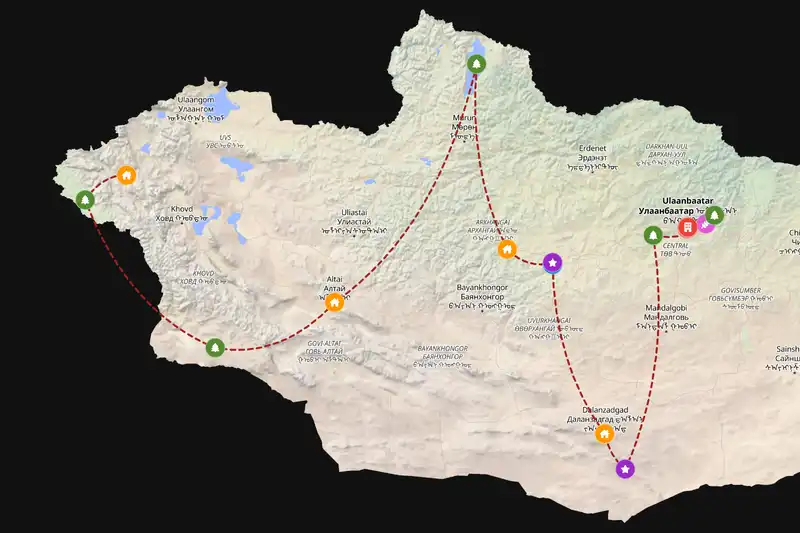
Short version: Mongolia is absolutely doable independently, but it’s not a “wing it and see” country like Southeast Asia. It rewards people who can handle uncertainty, long distances, and very little English outside Ulaanbaatar.
Backpacking solo works best if you:
- Are comfortable with basic logistics (booking shared jeeps, reading a paper map, dealing with no phone signal).
- Don’t mind rough conditions: pit toilets, no showers for days, and sleeping in basic gers or your tent.
- Can handle plans changing because of weather, broken vehicles, or a herder deciding he actually needs the horse you rented.
What makes it easier:
- Ulaanbaatar has hostels that act as backpacker hubs. They help you:
- Join group tours to Gobi or central Mongolia.
- Find other travelers to split 4x4 costs.
- Arrange homestays with nomad families.
- Popular areas like Terelj, Kharkhorin, and the Gobi have semi-regular tourist traffic, so you’re not blazing a trail alone.
- You can wild camp almost anywhere, which gives you huge flexibility if you carry your own gear and food.
What makes it harder:
- Outside cities, public transport is sparse, irregular, and often just a minivan that leaves “when full.”
- Road signs are minimal; many tracks are unmarked dirt roads. GPS maps can be off, and drivers navigate by memory.
- English is limited; Russian or a few Mongolian phrases help a lot.
- Weather is brutal if you’re unprepared: cold nights even in summer, sudden storms, and strong wind on the steppe.
For a budget backpacker, the sweet spot is a hybrid approach:
- Travel independently between hubs (Ulaanbaatar, Kharkhorin, Dalanzadgad, Moron).
- From each hub, join short group trips or shared jeeps to reach remote areas.
If you’re expecting easy hitchhiking, daily buses, and last-minute hostels everywhere, Mongolia will feel tough. If you treat it like a semi-expedition with some structure and backup plans, it’s one of the most rewarding countries you can backpack.
For a budget backpacker, the minimum that feels worthwhile is about 10–14 days, and the sweet spot is 3–4 weeks. Distances are huge, roads are slow, and the best parts of Mongolia are far from each other.
Rough timing guide:
- 5–7 days: Only if you’re already in the region and just want a taste. You can:
- Base in Ulaanbaatar.
- Do a 2–3 day Terelj National Park trip (or Hustai for wild horses).
- Add 1–2 days in Kharkhorin and the Orkhon Valley if you move fast.
- This is rushed and mostly central Mongolia.
- 10–14 days: Good first trip if you focus on one region. For example:
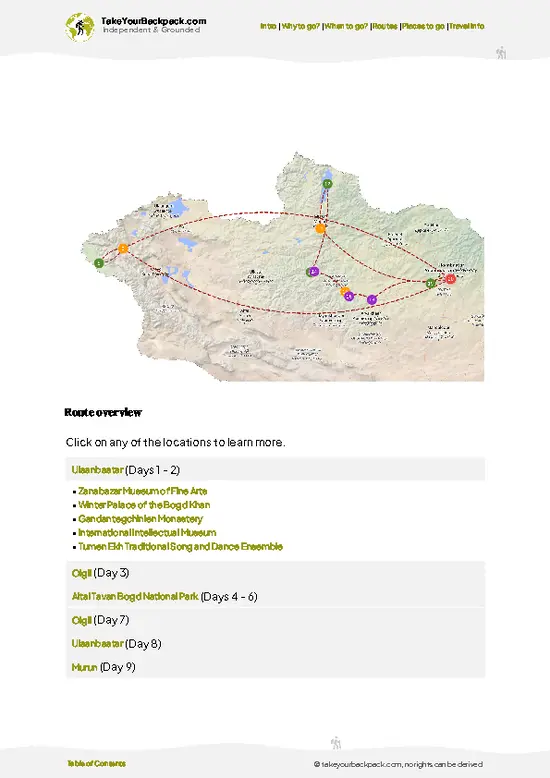
- Central Mongolia loop: Ulaanbaatar → Terelj → Kharkhorin → Orkhon Valley → Tsenkher hot springs → back to UB.
- Or a Gobi-focused route: Ulaanbaatar → Dalanzadgad → 5–7 days in the Gobi (flaming cliffs, dunes, canyons) → back to UB.
- You’ll spend full days in jeeps, but you’ll actually see landscapes change instead of just ticking boxes.
- 3 weeks: Ideal for budget travelers. You can:
- Combine central Mongolia and the Gobi, or
- Do a deeper northern route (Khuvsgul Lake, taiga, reindeer herders) plus some central highlights.
- You get enough time to wait for shared transport, join cheaper group tours, and not panic if a jeep breaks down.
- 4+ weeks: Perfect if you like slow, cheap travel. You can:
- Stitch together multiple regions (Gobi, central, north, maybe western Altai).
- Rely more on public transport and hitchhiking instead of private 4x4s.
- Spend extra nights with nomad families, which is where Mongolia really shines.
Season matters:
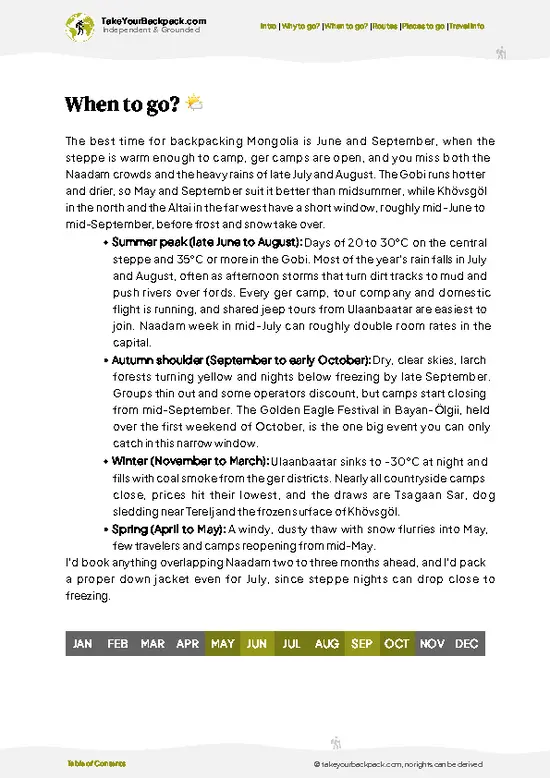
- Late May–September is the main window for backpackers. Earlier or later, transport is thinner, nights are colder, and some routes are muddy or snowed in.
If you’re on a tight budget, more time usually means less money per day, because you can:
- Wait for cheaper shared jeeps instead of hiring a private car.
- Negotiate better rates for longer stays.
- Avoid paying extra to rush between far-apart regions.
You can get around Mongolia without driving yourself, but you can’t rely on a neat, frequent bus network. Think of it as a patchwork of options you combine:
1. Intercity buses and minivans
- Between major towns (Ulaanbaatar–Kharkhorin, Ulaanbaatar–Dalanzadgad, Ulaanbaatar–Moron), there are regular buses or shared minivans.
- They’re cheap, crowded, and slow, but they work. Expect long days (8–12 hours) on rough roads.
- Tickets are usually bought at bus stations; you often need to show up early and be flexible.
2. Shared jeeps
- From town hubs to smaller settlements or national parks, shared jeeps are the backbone of local travel.
- They leave when full, not on a strict timetable. This can mean waiting hours, but it keeps costs low.
- Hostels and guesthouses in Ulaanbaatar and regional towns often know drivers and can help you join a group.
3. Hitchhiking
- Common and relatively safe if you use normal caution. Many locals expect a small payment, so it’s more like informal shared transport than free rides.
- Works best on main routes between towns; in very remote areas, you might wait a long time.
- Have a paper map or offline GPS so you can track where you are.
4. Organized tours and group trips
- For the Gobi, Khuvsgul, and remote western areas, a 4x4 with driver is often the only realistic option.
- As a budget traveler, you keep costs down by:
- Joining group tours from hostels.
- Forming your own group of 4–6 people to split a jeep and driver.
- You don’t need a guide everywhere, but you do need a driver who knows the tracks and water sources.
5. Local transport within towns
- Ulaanbaatar has buses and cheap taxis; traffic is chaotic but manageable.
- Smaller towns are walkable; sometimes you’ll use a local taxi or motorbike ride to reach your guesthouse or ger camp.
What you realistically cannot do:
- Rely on trains for most of the country; the main useful line for travelers is the Trans-Mongolian, which is more about getting in/out than internal travel.
- Expect to just show up in a random village and find daily public transport deeper into the countryside. Often, you’ll need to arrange a local driver or hitch.
If you’re patient, flexible, and okay with long, dusty travel days, you can absolutely see Mongolia without renting a car. If your time is short and your route ambitious, budgeting for at least one multi-day 4x4 trip is almost essential.
For backpackers on a budget, the must-visit list is less about specific monuments and more about regions that show different sides of Mongolia. These are the places that justify the long bus rides and shared jeeps:
1. Ulaanbaatar (as a functional base, not the main event)
- Worth 1–2 days to:
- Sort permits, cash, SIM card, and supplies.
- Visit Gandan Monastery and the National Museum to get context.
- Hit a decent supermarket and outdoor market for food and gear.
- It’s not the reason you came, but it’s your launchpad.
2. Terelj National Park
- Closest, easiest taste of the steppe and rock formations from Ulaanbaatar.
- Good for:
- First ger stay with a nomad family or simple camp.
- Day hikes, horse riding, and getting used to Mongolian countryside life.
- Ideal if you’re short on time or easing into longer trips.
3. Central Mongolia: Kharkhorin & Orkhon Valley
- Kharkhorin (Karakorum) is the old capital of the Mongol Empire; Erdene Zuu Monastery gives you history plus active religious life.
- Orkhon Valley is classic Mongolian scenery: rolling steppe, rivers, waterfalls, and scattered gers.
- Great for budget travelers because:
- You can reach Kharkhorin by bus.
- From there, it’s relatively easy to arrange homestays, horse treks, and short jeep trips.
4. The Gobi Desert (South Gobi)
- This is the big-ticket region that actually lives up to the hype. Highlights usually include:
- Khongoryn Els dunes (huge sand dunes with camel trips and wild sunsets).
- Yolyn Am canyon (ice, narrow gorge, and wildlife if you’re lucky).
- Flaming Cliffs (dinosaur fossil site and red rock landscapes).
- It’s not just sand; it’s a mix of rocky plains, cliffs, and desert steppe.
- Best done as a 4–7 day jeep loop from Dalanzadgad or Ulaanbaatar, shared with other travelers to keep costs down.
5. Khuvsgul Lake (Northern Mongolia)
- Deep blue lake surrounded by forested hills and meadows; feels very different from the Gobi and central steppe.
- Good for:
- Multi-day hikes or horse treks along the shore.
- Chilling in a ger camp, swimming in icy water, and watching long northern sunsets.
- Reaching it takes time (bus or flight to Moron, then onward), so it’s best if you have at least 2–3 weeks in the country.
6. At least one proper nomad homestay or multi-day horse trek
- More important than any single location is spending real time with a family or on a trek.
- This is where you:
- Help with herding or milking if invited.
- Drink salty milk tea, try fermented mare’s milk, and see daily life up close.
- Learn how people actually live in such a harsh climate.
- You can do this in central Mongolia, near Khuvsgul, or even in parts of the Gobi.
If you hit Ulaanbaatar, Terelj or Kharkhorin/Orkhon, plus either the Gobi or Khuvsgul, you’ll get a surprisingly complete picture of Mongolia even on a budget.
If you’re short on time or money, the key is to skip long detours that don’t add a new type of experience. Mongolia is about variety of landscapes and lifestyles, not collecting every town. Here’s what you can safely skip or downsize:
1. Extra days in Ulaanbaatar
- Use UB as a logistics hub, not a destination.
- After 1–2 days for museums, markets, and errands, every extra day here is a day you’re not on the steppe.
- Nightlife and cafes are fine, but you didn’t come all this way for traffic and smog.
2. Multiple similar monasteries and museums
- See Gandan Monastery in UB and Erdene Zuu in Kharkhorin; beyond that, only add more if you’re deeply into religious architecture.
- Many provincial museums are small and repetitive; if you’re tight on time, prioritize landscapes and homestays instead.
3. Trying to do Gobi + Khuvsgul + Western Altai in one short trip
- On a 2-week trip, attempting all three means you’ll spend most of your time in vehicles or on domestic flights.
- Pick two regions at most:
- Short trip (7–10 days): UB + Terelj + central Mongolia or a compact Gobi loop.
- Medium trip (10–16 days): UB + central Mongolia + Gobi or UB + central Mongolia + Khuvsgul.
- The Altai in the far west is incredible but logistically heavy; skip it unless you have 3–4 weeks and a solid budget.
4. Overpriced, overly packaged “cultural shows” in the city
- If you’re on a budget, you don’t need to pay big money for staged performances to understand Mongolian culture.
- You’ll get more authentic insight from:
- A local festival in a small town.
- Time with a nomad family.
- Watching wrestling or horse racing informally if you’re around Naadam season.
5. Rushing to remote corners just for a map tick
- Some far-flung spots (like very remote lakes or minor desert areas) are mainly bragging rights unless you have time to linger.
- If reaching a place requires days of extra travel for scenery similar to what you’ve already seen, it’s not a good use of a short trip.
6. Overlong city-based day trips
- From UB, focus on 1–2 strong outings (Terelj, Hustai) instead of stacking lots of small, expensive day tours.
- Each day tour eats money and time you could put toward a multi-day countryside loop, which is where Mongolia really shines.
If you’re forced to choose, always prioritize:
- One solid region done well (Gobi, central, or Khuvsgul)
over
- Three regions done as a blur from a jeep window.
That trade-off is what makes a short Mongolia trip feel rich instead of rushed.