×
Mongolia🇲🇳 | 21 days itinerary

How to Spend 21 Days in Mongolia

By Johan Kruseman 🇳🇱 | Updated May 7, 2026
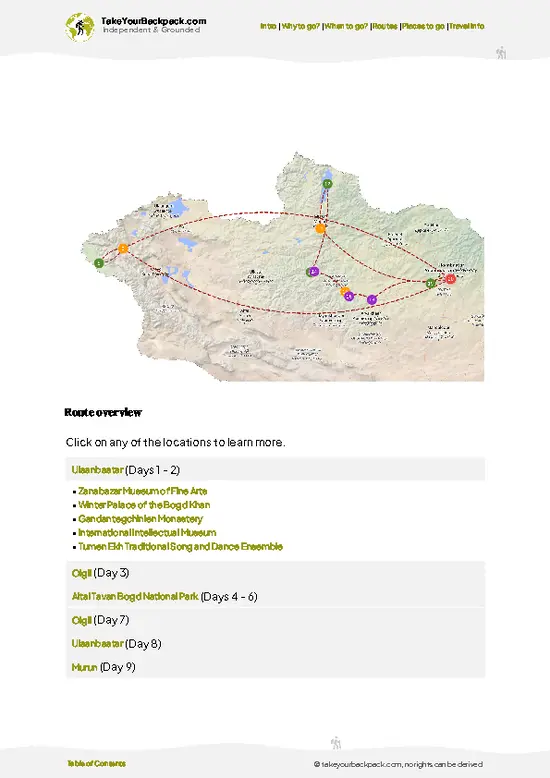
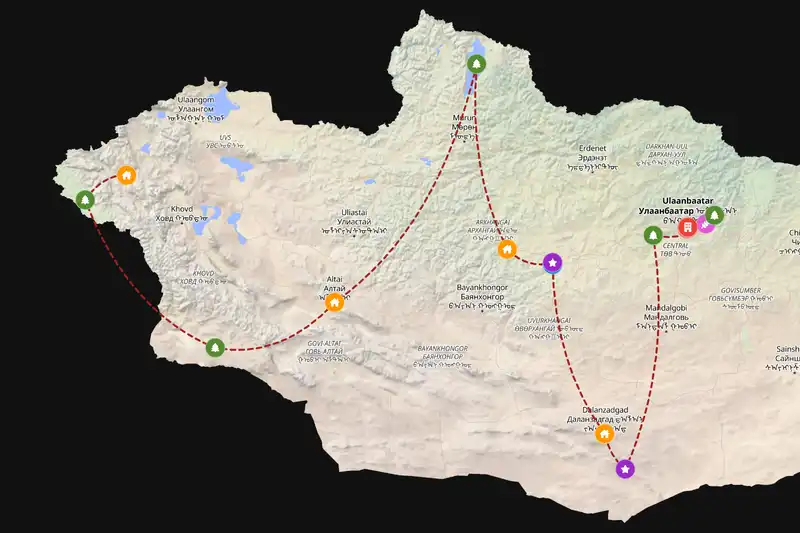
This 21-day route is for travelers who want the full arc of Mongolia: capital culture, central monasteries, northern lakes, western peaks, and the Gobi, with enough time to actually sit in a ger and drink tea instead of just snapping photos. You’ll move mostly by a mix of domestic flights and long-distance jeep transfers, with a few bus segments possible, keeping the pace adventurous but spaced so you’re not doing back-to-back marathon drives.

Days 1-3: Ulaanbaatar - Deep dive into Mongolia’s story

Start with three nights in Ulaanbaatar to build a solid foundation before you start bouncing across the country. Visit Gandantegchinlen Monastery for morning prayers, then spend serious time in the National Museum of Mongolia to trace the arc from ancient nomads to modern statehood. Add the Winter Palace of the Bogd Khan to see how Mongolia’s last spiritual ruler lived, and wander the Choijin Lama Temple Museum for a more intimate, slightly eerie temple complex surrounded by city streets. If you’re … read more 👉
This 21-day route is for travelers who want the full arc of Mongolia: capital culture, central monasteries, northern lakes, western peaks, and the Gobi, with enough time to actually sit in a ger and drink tea instead of just snapping photos. You’ll move mostly by a mix of domestic flights and long-distance jeep transfers, with a few bus segments possible, keeping the pace adventurous but spaced so you’re not doing back-to-back marathon drives.

Days 1-3: Ulaanbaatar - Deep dive into Mongolia’s story

Start with three nights in Ulaanbaatar to build a solid foundation before you start bouncing across the country. Visit Gandantegchinlen Monastery for morning prayers, then spend serious time in the National Museum of Mongolia to trace the arc from ancient nomads to modern statehood. Add the Winter Palace of the Bogd Khan to see how Mongolia’s last spiritual ruler lived, and wander the Choijin Lama Temple Museum for a more intimate, slightly eerie temple complex surrounded by city streets. If you’re into art and want a broader cultural lens, hit the Zanabazar Museum of Fine Arts and, time permitting, the Mongolian National Modern Art Gallery to see how Mongolian artists interpret their own landscapes and history. One evening, catch a show at the Mongolian National Academic Theatre of Opera and Ballet or the Tumen Ekh Traditional Song and Dance Ensemble to hear throat singing and see traditional dance live instead of just on YouTube.

Days 4-6: Kharkhorin & Orkhon Valley - Empire ruins and river canyons

Head west by road to Kharkhorin, your base near the old Mongol capital. Spend time at Erdene Zuu Monastery, walking the long line of stupas and stepping between active temples and ruined corners that hint at the buried city of Karakorum. Then move into the wider Orkhon Valley for two nights near Ulaan Tsutgalan Waterfall, where you can hike along the canyon, ride horses with local herders, and see how nomadic families use this UNESCO-listed landscape as actual pasture, not just a backdrop. This phase gives you a grounded sense of Mongolia’s imperial past and its living nomadic culture before you head into wilder terrain.

Days 7-9: Tsetserleg, Khorgo Volcano & Terkhiin Tsagaan Lake - Volcanic highlands

Continue west to the town of Tsetserleg, a relaxed provincial hub that makes a good overnight stop and a chance to restock snacks and stretch your legs. From there, push into the Khangai highlands toward Khorgo Volcano and nearby Terkhiin Tsagaan Lake, where you’ll spend two nights. Hike up the rim of Khorgo’s crater for big views over lava fields and scattered gers, then drop back to the lakeshore to paddle, walk, or just sit by the water as yaks graze along the shore. This is where the air feels crisp, the nights get properly cold, and you start to understand how varied Mongolia’s landscapes really are.

Days 10-13: Murun & Khovsgol Nuur - Mongolia’s northern blue

Travel north via road to Murun, the main town in the region and your jumping-off point for the lake. After a night to break the journey, continue to Khovsgol Nuur National Park for three nights on the shores of Mongolia’s “younger sister” to Baikal. Days here are for hiking along the lakeshore, riding horses into the surrounding hills, and watching the light change over deep blue water that locals treat with real reverence. With three nights, you can slow down: one day for a longer hike, one for a more relaxed horse ride or boat trip, and one just to sit by the water and let your brain catch up with how far you’ve come.

Days 14-16: Flight to Olgii & Altai Tavan Bogd - Peaks and glaciers

Return to Murun and connect back to Ulaanbaatar by air or road, then fly west to Olgii, the main town in Bayan-Ulgii province and the cultural center of Mongolia’s Kazakh minority. After a night in Olgii to organize logistics, head into Altai Tavan Bogd National Park for a three-day, two-night version of the Altai Tavan Bogd Trek, tailored to your fitness and interest. You’ll be walking in a world of snow-capped peaks, glaciers, and alpine lakes, often staying in tents or simple gers and meeting Kazakh families whose eagle-hunting traditions give this region a very different feel from the rest of the country. This is the most physically demanding stretch of the route, but also one of the most rewarding if you like big mountains and real remoteness.

Days 17-21: Back to Ulaanbaatar, Terelj & a Gobi taster - Closing the loop

Return from Altai Tavan Bogd National Park to Olgii, then fly back to Ulaanbaatar for a night to reset. With your final days, head out to the village of Terelj and nearby Terelj National Park for two nights of softer hiking, river walks, and ger stays in the forested valleys at the edge of the Khentii Mountains. On your last full day, take a long day trip south for a quick taste of the Gobi Desert via Dalanzadgad and into Gobi Gurvansaikhan National Park, focusing on one highlight such as the dunes or a canyon rather than trying to do a full loop. Return to Ulaanbaatar for your final night, maybe catching a last performance at the Tumen Ekh Traditional Song and Dance Ensemble or revisiting a favorite museum now that you’ve seen the landscapes that shaped everything inside them.

The moment that always pulls me back to this route is standing on the rim of Khorgo Volcano at sunset, knowing that in a single trip you’ve gone from glacier edges in the Altai to the quiet shores of Khovsgol and back to the bright lights of Ulaanbaatar.
Loading the map 🌍
film
0
0
0a
Erdene Zuu Monastery
film
1
1
1a
Orkhon Valley
film
2
2
2a
Ulaan Tsutgalan Waterfall
film
3
3
3a
Khorgo Volcano
film
4
4
4a
Altai Tavan Bogd
film
5
5
5a
Altai Tavan Bogd Trek
film
6
6
6a
Terelj
film
7
7
7a
Khentii Mountains
film
8
8
8a
Dalanzadgad
film
9
9
9a
Gobi Gurvansaikhan
Pixabay

✈️ The backpacker research shortcutMongolia Travel Guide

An offline-friendly backpacking guide with optimized travel routes, ranked highlights, transport advice, and the best areas to stay.
example page 0 from our offline Travel Guide for Mongoliaexample page 1 from our offline Travel Guide for Mongoliaexample page 2 from our offline Travel Guide for Mongoliaexample page 3 from our offline Travel Guide for Mongoliaexample page 4 from our offline Travel Guide for Mongoliaexample page 5 from our offline Travel Guide for Mongolia
The digital guide (250 pages) contains:
70 highlights, ranked by travel appeal
Optimized 7, 14 & 21-day travel routes
Best neighborhoods to stay
How to get around
Offline-friendly for travel without Wi-Fi
👉 See all 30+ guide features

📅 Plan smarter in minutes, not weeks
Month by month travel advice
Festivals & national holidays
Budget expectations

🗺️ Go to the right places, skip the overrated ones
Honest pros & cons of destinations
Top hikes, parks & viewpoints
Lesser-known places most travelers miss
Clear “worth it vs skip it” guidance

🛏️ Travel smoothly without rookie mistakes
Best areas to stay
Transport systems explained simply
Common scams & safety advice
SIM cards, money & practical tips

🌍 Understand the country, not just visit it
Culture & traditions
52 Essential phrases & customs
Festivals worth planning around
Traveler-friendly historical context
Insights that make places more meaningful

📱 Built for real travel conditions
Fully downloadable PDF
Works completely offline
Optimized for phone use
Useful in remote areas & buses
Everything in one place
Save weeks of stressful planning
Get instant access to the full guide directly. 30-day money-back guarantee.


Sent to your inbox immediately after payment • 100% Secure Checkout
Best Backpacking Travel Advisor 2025 tourism awardBest Backpacking
Travel Advisor
2025
What others say about Take Your Backpack Guides:
⭐⭐⭐⭐⭐
Fantastic, amazing amount of information!
⭐⭐⭐⭐⭐
My goodness this is amazing, it's what I've been looking for hats off too you!
⭐⭐⭐⭐⭐
I think this is absolutely BRILLIANT
⭐⭐⭐⭐
Very complete and informative. It's still missing places, but I gotta to commend you
⭐⭐⭐⭐⭐
This is truly amazing, thank you, can't wait to explore it with my kids!
⭐⭐⭐⭐⭐
Awesome resource, thank you!
⭐⭐⭐⭐⭐
This is amazing! Can't wait to explore the ones I haven't seen
⭐⭐⭐⭐
I love this! Well done, great idea.
⭐⭐⭐⭐⭐
Thanks for taking the time to make this gem!
⭐⭐⭐⭐⭐
This might be the best website I've ever seen.
⭐⭐⭐⭐⭐
Congratulations, and thank you so much for your work; it's incredibly valuable.
⭐⭐⭐⭐
In all seriousness I think you did a great job pointing out the important spots
⭐⭐⭐⭐⭐
10/10 very good
⭐⭐⭐⭐⭐
As someone who's only just starting to visit regularly this is awesome, thank you.
⭐⭐⭐⭐
Thank you very much! I'm going to visit my dad, it's going to be very useful!
⭐⭐⭐⭐⭐
This is really cool! We'll be travelling for the first time and this definitely come in handy.
⭐⭐⭐⭐⭐
You are now our minister of culture, congratulations 👨‍💼
⭐⭐⭐⭐⭐
Just wanted to tell you that this is a pearl! Going to follow your recommendations.
⭐⭐⭐⭐⭐
This is so cool. I'll definitely be using the resource for my travels soon.
⭐⭐⭐⭐⭐
This is very impressive! Good work.
⭐⭐⭐⭐⭐
This is an amazing and informative site. Very well done!

🧭 RouteChoose Your Itinerary

Travel Mongolia your way — from a quick highlights trip to a slow-paced adventure.

🙋 FAQFrequently Asked Questions

Short version: Mongolia is absolutely doable independently, but it’s not a “wing it and see” country like Southeast Asia. It rewards people who can handle uncertainty, long distances, and very little English outside Ulaanbaatar.

Backpacking solo works best if you:
- Are comfortable with basic logistics (booking shared jeeps, reading a paper map, dealing with no phone signal).
- Don’t mind rough conditions: pit toilets, no showers for days, and sleeping in basic gers or your tent.
- Can handle plans changing because of weather, broken vehicles, or a herder deciding he actually needs the horse you rented.

What makes it easier:
- Ulaanbaatar has hostels that act as backpacker hubs. They help you:
- Join group tours to Gobi or central Mongolia.
- Find other travelers to split 4x4 costs.
- Arrange homestays with nomad families.
- Popular areas like Terelj, Kharkhorin, and the Gobi have semi-regular tourist traffic, so you’re not blazing a trail alone.
- You can wild camp almost anywhere, which gives you huge flexibility if you carry your own gear and food.

What makes it harder:
- Outside cities, public transport is sparse, irregular, and often just a minivan that leaves “when full.”
- Road signs are minimal; many tracks are unmarked dirt roads. GPS maps can be off, and drivers navigate by memory.
- English is limited; Russian or a few Mongolian phrases help a lot.
- Weather is brutal if you’re unprepared: cold nights even in summer, sudden storms, and strong wind on the steppe.

For a budget backpacker, the sweet spot is a hybrid approach:
- Travel independently between hubs (Ulaanbaatar, Kharkhorin, Dalanzadgad, Moron).
- From each hub, join short group trips or shared jeeps to reach remote areas.

If you’re expecting easy hitchhiking, daily buses, and last-minute hostels everywhere, Mongolia will feel tough. If you treat it like a semi-expedition with some structure and backup plans, it’s one of the most rewarding countries you can backpack.
For a budget backpacker, the minimum that feels worthwhile is about 10–14 days, and the sweet spot is 3–4 weeks. Distances are huge, roads are slow, and the best parts of Mongolia are far from each other.

Rough timing guide:
- 5–7 days: Only if you’re already in the region and just want a taste. You can:
- Base in Ulaanbaatar.
- Do a 2–3 day Terelj National Park trip (or Hustai for wild horses).
- Add 1–2 days in Kharkhorin and the Orkhon Valley if you move fast.
- This is rushed and mostly central Mongolia.

- 10–14 days: Good first trip if you focus on one region. For example:
- Central Mongolia loop: Ulaanbaatar → Terelj → Kharkhorin → Orkhon Valley → Tsenkher hot springs → back to UB.
- Or a Gobi-focused route: Ulaanbaatar → Dalanzadgad → 5–7 days in the Gobi (flaming cliffs, dunes, canyons) → back to UB.
- You’ll spend full days in jeeps, but you’ll actually see landscapes change instead of just ticking boxes.

- 3 weeks: Ideal for budget travelers. You can:
- Combine central Mongolia and the Gobi, or
- Do a deeper northern route (Khuvsgul Lake, taiga, reindeer herders) plus some central highlights.
- You get enough time to wait for shared transport, join cheaper group tours, and not panic if a jeep breaks down.

- 4+ weeks: Perfect if you like slow, cheap travel. You can:
- Stitch together multiple regions (Gobi, central, north, maybe western Altai).
- Rely more on public transport and hitchhiking instead of private 4x4s.
- Spend extra nights with nomad families, which is where Mongolia really shines.

Season matters:
- Late May–September is the main window for backpackers. Earlier or later, transport is thinner, nights are colder, and some routes are muddy or snowed in.

If you’re on a tight budget, more time usually means less money per day, because you can:
- Wait for cheaper shared jeeps instead of hiring a private car.
- Negotiate better rates for longer stays.
- Avoid paying extra to rush between far-apart regions.
You can get around Mongolia without driving yourself, but you can’t rely on a neat, frequent bus network. Think of it as a patchwork of options you combine:

1. Intercity buses and minivans
- Between major towns (Ulaanbaatar–Kharkhorin, Ulaanbaatar–Dalanzadgad, Ulaanbaatar–Moron), there are regular buses or shared minivans.
- They’re cheap, crowded, and slow, but they work. Expect long days (8–12 hours) on rough roads.
- Tickets are usually bought at bus stations; you often need to show up early and be flexible.

2. Shared jeeps
- From town hubs to smaller settlements or national parks, shared jeeps are the backbone of local travel.
- They leave when full, not on a strict timetable. This can mean waiting hours, but it keeps costs low.
- Hostels and guesthouses in Ulaanbaatar and regional towns often know drivers and can help you join a group.

3. Hitchhiking
- Common and relatively safe if you use normal caution. Many locals expect a small payment, so it’s more like informal shared transport than free rides.
- Works best on main routes between towns; in very remote areas, you might wait a long time.
- Have a paper map or offline GPS so you can track where you are.

4. Organized tours and group trips
- For the Gobi, Khuvsgul, and remote western areas, a 4x4 with driver is often the only realistic option.
- As a budget traveler, you keep costs down by:
- Joining group tours from hostels.
- Forming your own group of 4–6 people to split a jeep and driver.
- You don’t need a guide everywhere, but you do need a driver who knows the tracks and water sources.

5. Local transport within towns
- Ulaanbaatar has buses and cheap taxis; traffic is chaotic but manageable.
- Smaller towns are walkable; sometimes you’ll use a local taxi or motorbike ride to reach your guesthouse or ger camp.

What you realistically cannot do:
- Rely on trains for most of the country; the main useful line for travelers is the Trans-Mongolian, which is more about getting in/out than internal travel.
- Expect to just show up in a random village and find daily public transport deeper into the countryside. Often, you’ll need to arrange a local driver or hitch.

If you’re patient, flexible, and okay with long, dusty travel days, you can absolutely see Mongolia without renting a car. If your time is short and your route ambitious, budgeting for at least one multi-day 4x4 trip is almost essential.
For backpackers on a budget, the must-visit list is less about specific monuments and more about regions that show different sides of Mongolia. These are the places that justify the long bus rides and shared jeeps:

1. Ulaanbaatar (as a functional base, not the main event)
- Worth 1–2 days to:
- Sort permits, cash, SIM card, and supplies.
- Visit Gandan Monastery and the National Museum to get context.
- Hit a decent supermarket and outdoor market for food and gear.
- It’s not the reason you came, but it’s your launchpad.

2. Terelj National Park
- Closest, easiest taste of the steppe and rock formations from Ulaanbaatar.
- Good for:
- First ger stay with a nomad family or simple camp.
- Day hikes, horse riding, and getting used to Mongolian countryside life.
- Ideal if you’re short on time or easing into longer trips.

3. Central Mongolia: Kharkhorin & Orkhon Valley
- Kharkhorin (Karakorum) is the old capital of the Mongol Empire; Erdene Zuu Monastery gives you history plus active religious life.
- Orkhon Valley is classic Mongolian scenery: rolling steppe, rivers, waterfalls, and scattered gers.
- Great for budget travelers because:
- You can reach Kharkhorin by bus.
- From there, it’s relatively easy to arrange homestays, horse treks, and short jeep trips.

4. The Gobi Desert (South Gobi)
- This is the big-ticket region that actually lives up to the hype. Highlights usually include:
- Khongoryn Els dunes (huge sand dunes with camel trips and wild sunsets).
- Yolyn Am canyon (ice, narrow gorge, and wildlife if you’re lucky).
- Flaming Cliffs (dinosaur fossil site and red rock landscapes).
- It’s not just sand; it’s a mix of rocky plains, cliffs, and desert steppe.
- Best done as a 4–7 day jeep loop from Dalanzadgad or Ulaanbaatar, shared with other travelers to keep costs down.

5. Khuvsgul Lake (Northern Mongolia)
- Deep blue lake surrounded by forested hills and meadows; feels very different from the Gobi and central steppe.
- Good for:
- Multi-day hikes or horse treks along the shore.
- Chilling in a ger camp, swimming in icy water, and watching long northern sunsets.
- Reaching it takes time (bus or flight to Moron, then onward), so it’s best if you have at least 2–3 weeks in the country.

6. At least one proper nomad homestay or multi-day horse trek
- More important than any single location is spending real time with a family or on a trek.
- This is where you:
- Help with herding or milking if invited.
- Drink salty milk tea, try fermented mare’s milk, and see daily life up close.
- Learn how people actually live in such a harsh climate.
- You can do this in central Mongolia, near Khuvsgul, or even in parts of the Gobi.

If you hit Ulaanbaatar, Terelj or Kharkhorin/Orkhon, plus either the Gobi or Khuvsgul, you’ll get a surprisingly complete picture of Mongolia even on a budget.
If you’re short on time or money, the key is to skip long detours that don’t add a new type of experience. Mongolia is about variety of landscapes and lifestyles, not collecting every town. Here’s what you can safely skip or downsize:

1. Extra days in Ulaanbaatar
- Use UB as a logistics hub, not a destination.
- After 1–2 days for museums, markets, and errands, every extra day here is a day you’re not on the steppe.
- Nightlife and cafes are fine, but you didn’t come all this way for traffic and smog.

2. Multiple similar monasteries and museums
- See Gandan Monastery in UB and Erdene Zuu in Kharkhorin; beyond that, only add more if you’re deeply into religious architecture.
- Many provincial museums are small and repetitive; if you’re tight on time, prioritize landscapes and homestays instead.

3. Trying to do Gobi + Khuvsgul + Western Altai in one short trip
- On a 2-week trip, attempting all three means you’ll spend most of your time in vehicles or on domestic flights.
- Pick two regions at most:
- Short trip (7–10 days): UB + Terelj + central Mongolia or a compact Gobi loop.
- Medium trip (10–16 days): UB + central Mongolia + Gobi or UB + central Mongolia + Khuvsgul.
- The Altai in the far west is incredible but logistically heavy; skip it unless you have 3–4 weeks and a solid budget.

4. Overpriced, overly packaged “cultural shows” in the city
- If you’re on a budget, you don’t need to pay big money for staged performances to understand Mongolian culture.
- You’ll get more authentic insight from:
- A local festival in a small town.
- Time with a nomad family.
- Watching wrestling or horse racing informally if you’re around Naadam season.

5. Rushing to remote corners just for a map tick
- Some far-flung spots (like very remote lakes or minor desert areas) are mainly bragging rights unless you have time to linger.
- If reaching a place requires days of extra travel for scenery similar to what you’ve already seen, it’s not a good use of a short trip.

6. Overlong city-based day trips
- From UB, focus on 1–2 strong outings (Terelj, Hustai) instead of stacking lots of small, expensive day tours.
- Each day tour eats money and time you could put toward a multi-day countryside loop, which is where Mongolia really shines.

If you’re forced to choose, always prioritize:
- One solid region done well (Gobi, central, or Khuvsgul)
over
- Three regions done as a blur from a jeep window.

That trade-off is what makes a short Mongolia trip feel rich instead of rushed.

🇲🇳 MongoliaExplore Mongolia

Ready to build a truly unique trip? Predefined routes are perfect for first-time visitors, but there is so much more to discover. Whether you are chasing a city trip, pristine national parks, local food scenes, or quiet beaches, pick a category to design your own path.