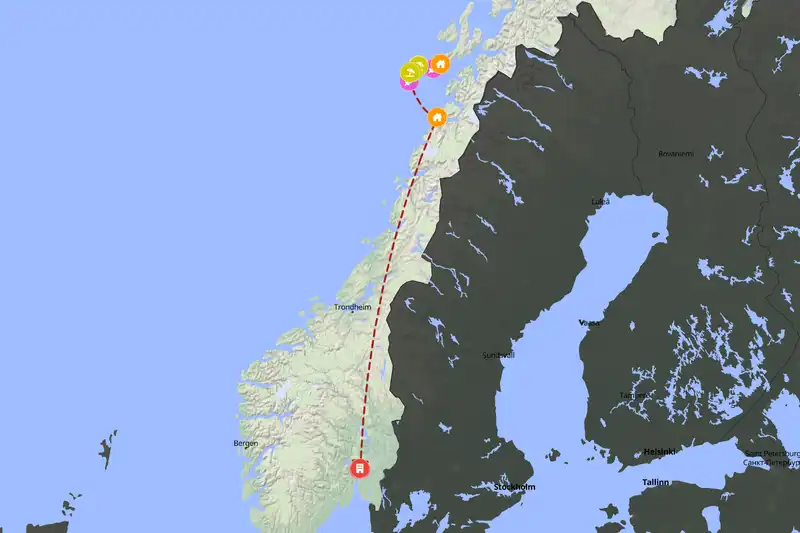
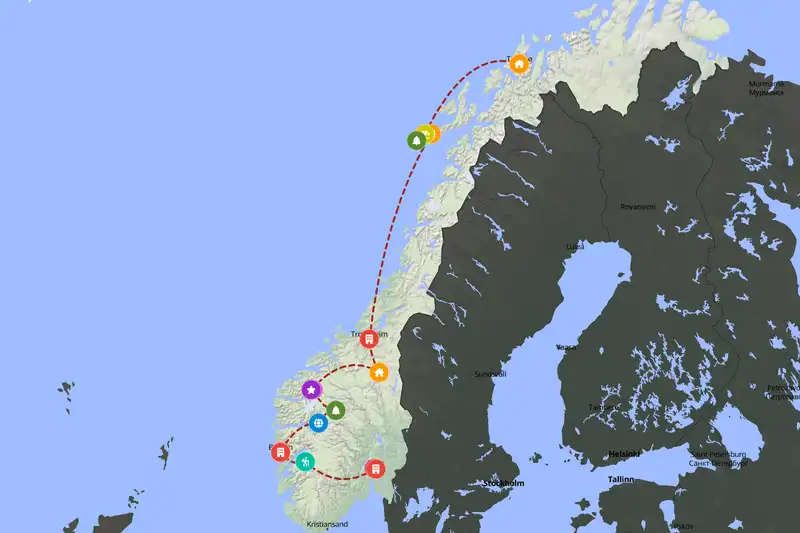
This 15-day route suits travelers who want Norway’s headline fjords, its capital and its old royal city strung together by rail and water, with proper hiking days built in. The pace is steady but relaxed: two or three nights per stop, one serious travel day every three or four days, and a night aboard a coastal ship that covers distance while you sleep. You’ll use long-distance trains (the Bergen Line, the Flåm Railway, the Rauma Line and the Dovre Line), a fjord boat, regional buses and one overnight coastal express sailing. Run it between mid-June and late August, when the seasonal mountain-road buses operate.
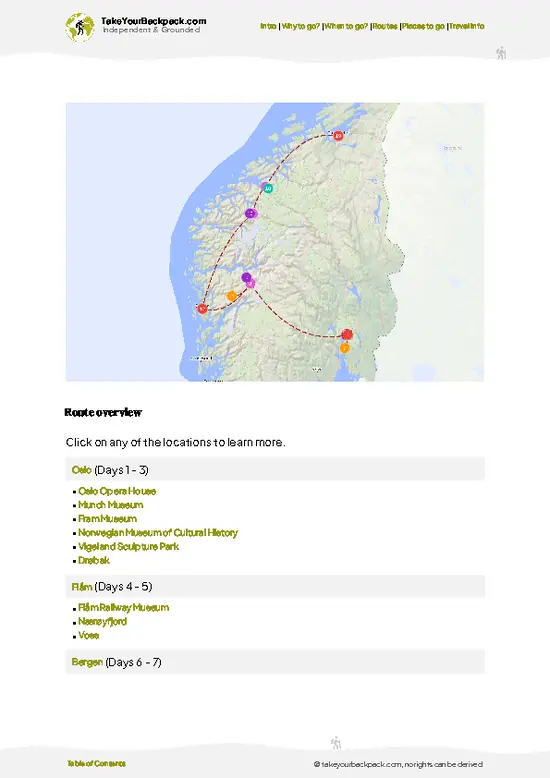
Days 1-3: Oslo
Start in
Oslo because it is the easiest international arrival and because its museums are best seen before you trade cities for mountains. Spend day one on the waterfront: walk up the sloping white roof of the
Oslo Opera House (free, open at all hours), then cross to the
Munch Museum, where the different versions of The Scream are shown in rotation, so check the display …
read more 👉This 15-day route suits travelers who want Norway’s headline fjords, its capital and its old royal city strung together by rail and water, with proper hiking days built in. The pace is steady but relaxed: two or three nights per stop, one serious travel day every three or four days, and a night aboard a coastal ship that covers distance while you sleep. You’ll use long-distance trains (the Bergen Line, the Flåm Railway, the Rauma Line and the Dovre Line), a fjord boat, regional buses and one overnight coastal express sailing. Run it between mid-June and late August, when the seasonal mountain-road buses operate.
Days 1-3: Oslo
Start in Oslo because it is the easiest international arrival and because its museums are best seen before you trade cities for mountains. Spend day one on the waterfront: walk up the sloping white roof of the Oslo Opera House (free, open at all hours), then cross to the Munch Museum, where the different versions of The Scream are shown in rotation, so check the display times before you go. Day two belongs to the Bygdøy peninsula, reached by summer ferry from the City Hall pier or bus 30. Board the polar ship inside the Fram Museum, then give the open-air Norwegian Museum of Cultural History a good three hours for its farmhouses and the Gol stave church. Finish at Vigeland Sculpture Park in the evening light, when the granite figures around the Monolith throw long shadows and entry is free.
On day three, take the bus or, in summer, the boat from Aker Brygge to Drøbak, about an hour south. Its white wooden houses face the narrow sound where the Oscarsborg fortress sank the German cruiser Blücher in April 1940, which bought the royal family time to escape.Days 4-5: Flåm
Day four is your first big travel day, and a scenic one. The Bergen Line climbs from Oslo onto the Hardangervidda plateau, passes Finse at 1,222 meters (the line’s highest station) and reaches Myrdal in about 4 hours 45 minutes. Book Minipris fares early and you can pay NOK 300 to 500 (US$28 to 47). At Myrdal, switch to the Flåm Railway, which drops 866 meters over 20 kilometers in roughly an hour, past the Kjosfossen waterfall. A one-way ticket runs NOK 600 to 900 (US$55 to 85).
Spend two nights in Flåm so the second day can stay slow. The free Flåm Railway Museum beside the station explains how the line was blasted through the mountainside, and the steep path up to Brekkefossen gives you a valley view in under an hour each way.Days 6-8: Nærøyfjord and Bergen
Leave Flåm on the morning boat to Gudvangen, a two-hour run through the Nærøyfjord, which narrows to roughly 250 meters between walls over 1,000 meters high. From Gudvangen, a bus climbs to Voss in about an hour; stretch your legs by the lake there, then take the train to Bergen (around 1 hour 15 minutes).
In Bergen, go to Bryggen first thing in the morning, before the cruise crowds, and wander the tilted timber passages behind the painted gables. Then walk to Bergenhus Fortress and Håkon’s Hall, a 13th-century royal banqueting hall built in stone. On day eight, keep your bags at the hostel and spend the day in town, because the northbound coastal express ship leaves in the evening. A cabin is worth booking: you wake up rested and halfway up the coast.Days 9-10: Geiranger
The ship reaches Ålesund the next morning, and a bus takes about three hours to Geiranger, including a short car-ferry crossing and the descent down the Eagle Road’s hairpins. Two nights here give you one full day on the Geirangerfjord. Ride the sightseeing boat past the Seven Sisters waterfalls, or take a boat drop-off and hike up to the abandoned Skageflå farm, perched about 250 meters above the water. Stay late: once the cruise ships sail out in the evening, the village goes quiet.Days 11-12: Åndalsnes and Romsdalseggen
The summer bus from Geiranger to Åndalsnes is a sightseeing tour in itself: back over the Eagle Road, across the fjord by ferry, and then down the 11 bends of Trollstigen, in about three hours total. Åndalsnes is small and practical, with an outdoor shop, a supermarket and a station. Use your full day for the Romsdalseggen Ridge. A seasonal shuttle takes you to the Vengedalen trailhead, and the ridge walk back into town covers about 10 kilometers over 6 to 8 hours, with sections of exposed rock where you’ll want proper boots and a clear forecast.Days 13-15: Trondheim
The Rauma Line climbs out of Romsdalen to Dombås in about 1 hour 40 minutes, then the Dovre Line crosses the Dovrefjell plateau to Trondheim in roughly 2.5 hours. That is a long but easy train day after the ridge. In Trondheim, give the Nidaros Cathedral an unhurried morning. It was built over the grave of Saint Olav, it has drawn pilgrims for centuries, and its west front holds rows of carved figures. Afterward, cross the Old Town Bridge into the wooden lanes of Bakklandet for coffee. On day fifteen, the airport train to Værnes takes about 35 minutes, or you can continue north on the Nordland Line if you have more time.
If I were sending a friend along this route, I’d tell them to walk the 4 kilometers from Flåm to the Otternes farm cluster above the Aurlandsfjord in the evening, when the boat passengers have left and the old wooden buildings have the hillside to themselves.





 Best Backpacking