×
Angola🇦🇴 | 21 days itinerary

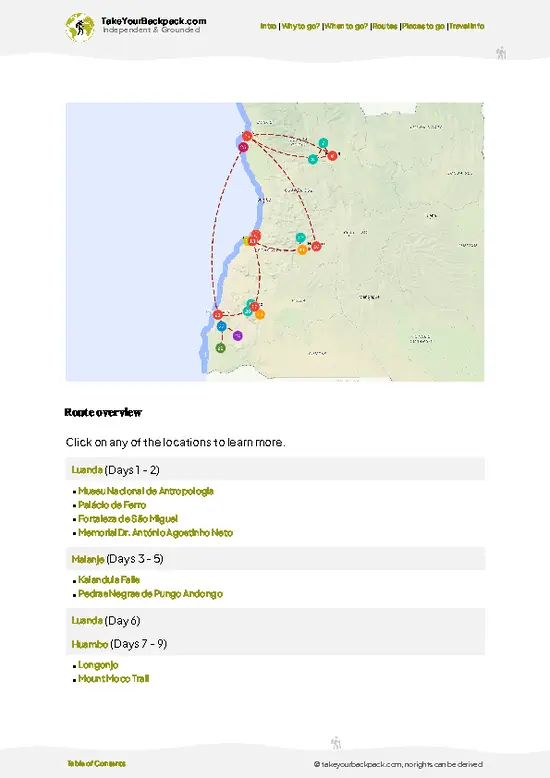
How to Spend 21 Days in Angola

By Johan Kruseman 🇳🇱 | Updated May 8, 2026
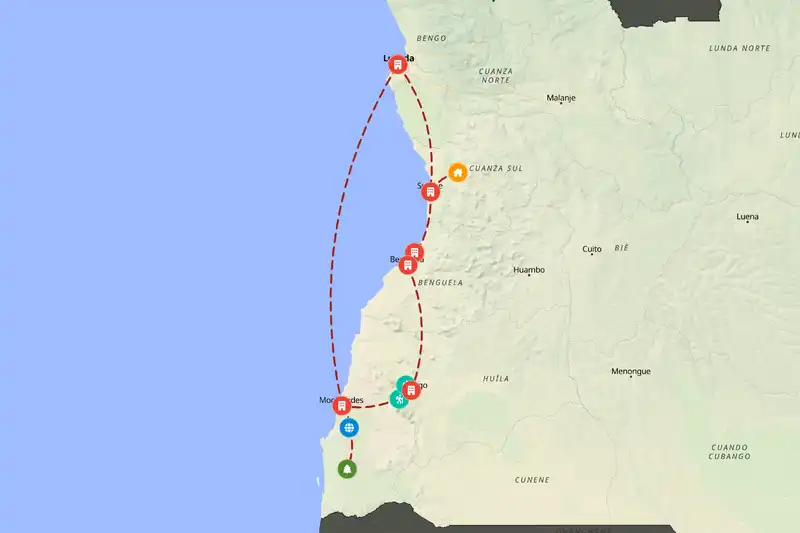
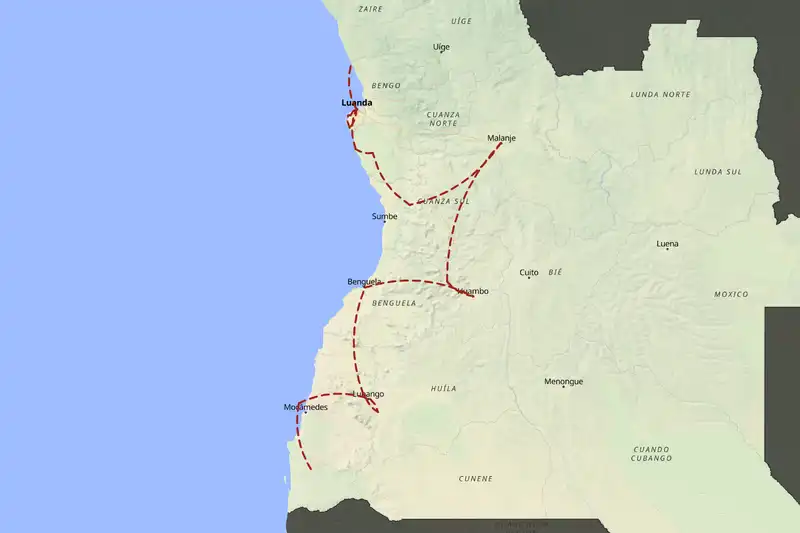
This 21-day route is for travelers who want to go all-in on Angola: coastlines, deserts, highland cliffs, waterfalls, and a serious dose of history, with enough downtime baked in that you don’t finish the trip wrecked. You’ll mix domestic flights with a few big but well-spaced road legs, using private cars or hired drivers where needed so you can focus on the landscapes instead of white-knuckling the steering wheel for three weeks straight.

Days 1-4: Luanda deep dive and coastal warm-up

Base yourself in Luanda for four nights to anchor the whole journey. Use your first two full days to work through the city’s heavy hitters at a humane pace: Fortaleza de São Miguel for the big-picture view and military history, the Museu Nacional da Escravatura for a sobering look at the slave trade, and the Museu Nacional de Antropologia and Museu da Moeda to connect Angola’s cultural diversity and economic story. On day three, take a boat out to the Complexo Turístico da Ilha do Mussulo and Praia do Mussuloread more 👉
This 21-day route is for travelers who want to go all-in on Angola: coastlines, deserts, highland cliffs, waterfalls, and a serious dose of history, with enough downtime baked in that you don’t finish the trip wrecked. You’ll mix domestic flights with a few big but well-spaced road legs, using private cars or hired drivers where needed so you can focus on the landscapes instead of white-knuckling the steering wheel for three weeks straight.

Days 1-4: Luanda deep dive and coastal warm-up

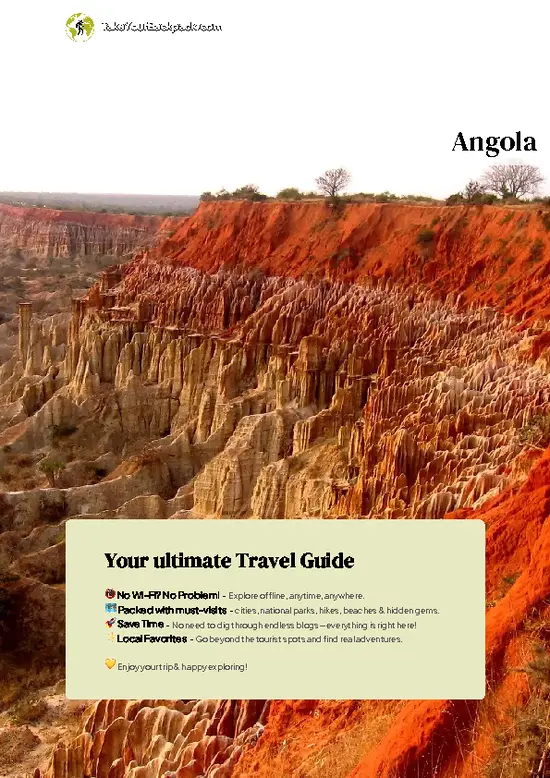
Base yourself in Luanda for four nights to anchor the whole journey. Use your first two full days to work through the city’s heavy hitters at a humane pace: Fortaleza de São Miguel for the big-picture view and military history, the Museu Nacional da Escravatura for a sobering look at the slave trade, and the Museu Nacional de Antropologia and Museu da Moeda to connect Angola’s cultural diversity and economic story. On day three, take a boat out to the Complexo Turístico da Ilha do Mussulo and Praia do Mussulo for a full reset day of swimming and seafood, then on day four head south along the coast to catch sunset at the Miradouro da Lua Viewpoint Complex, letting the eroded cliffs and Atlantic backdrop mark the moment your trip shifts from city to wild spaces.

Days 5-7: Quiçama wildlife and Kwanza River

Continue down to Quiçama National Park for three nights, giving yourself time to feel the rhythm of the savanna instead of treating it as a quick photo stop. Alternate morning and afternoon game drives with a boat trip on the Kwanza River, watching for birdlife and the way the light changes over the baobabs and open plains. With a full three days, you can build in a genuine rest afternoon at your lodge between drives, avoiding the classic safari burnout that hits when you try to cram dawn-to-dusk activities into every single day.

Days 8-11: Benguela, Lobito, and central coast

Head south along the Atlantic to Benguela, your base for four nights of coastal wandering. Spend one day exploring Benguela itself and nearby Catumbela, another day up in Lobito walking its long sandspit and watching port life, and a third day pushing farther down the coast to Praia de Cabo Ledo for a change of beach scenery and, if conditions line up, some of Angola’s best surf breaks. The extra night here is your flex day: use it to revisit your favorite stretch of coast, recover from a long drive, or simply sit in a café and watch daily life roll by without feeling like you’re “wasting” a travel day.

Days 12-15: Lubango highlands, Tundavala, and Serra da Leba

From the coast, climb inland to Lubango, where cooler air and mountain views reset the tone of the trip. Over four nights, you’ll have time to hike the Tundavala Gap and stand at the edge of the Tundavala Fissure, looking out over a sheer drop that feels like the continent has been sliced open, then drive the switchbacks of the Serra da Leba Pass, stopping at viewpoints to watch the road coil below you. Use your remaining days for shorter walks on the plateau and slow evenings in town, letting the highland rhythm sink in instead of racing from one viewpoint to the next in a single exhausting day.

Days 16-18: Namibe Desert and Iona National Park

Drop down from the highlands toward the coast again, this time aiming for the arid landscapes around Namibe. Base yourself here for three nights so you can spend a full day exploring the Namibe Desert, with its stark rock formations and hardy desert flora, and another day pushing into Iona National Park, where desert, dunes, and Atlantic meet in a way that feels almost otherworldly. The extra time lets you work around rough roads and variable conditions without stacking long drives back-to-back, and gives you the chance to catch both sunrise and sunset over the desert if you’re up for early starts.

Days 19-21: Central plateau and Huambo wind-down

Turn inland one last time to the central highlands and the city of Huambo, trading desert heat for cooler evenings and a more lived-in, everyday Angola. Two full days here give you space to wander local markets, sample highland food, and take a day trip out toward the countryside, where rolling fields and small villages close the loop on the different landscapes you’ve crossed. On your final day, travel back to Luanda—by road or flight depending on your energy and logistics—for a last evening along the bay, where the city lights and harbor cranes feel less chaotic now that you’ve seen so much of the country beyond them.

For a future return when you’re chasing something truly remote, keep the idea of a rough expedition out to the little-visited Serra da Neve plateau in your back pocket, where cold nights, star-heavy skies, and lonely trails reward those willing to trade comfort for raw adventure.
Loading the map 🌍
film
0
0
0a
Luanda
film
1
1
1a
Fortaleza de São Miguel
film
2
2
2a
Museu Nacional da Escravatura
film
3
3
3a
Museu Nacional de Antropologia
film
4
4
4a
Museu da Moeda
film
5
5
5a
Complexo Turístico da Ilha do Mussulo
film
6
6
6a
Praia do Mussulo
film
7
7
7a
Miradouro da Lua Viewpoint Complex
film
8
8
8a
Quiçama
film
9
9
9a
Kwanza River
film
10
10
10a
Praia de Cabo Ledo
film
11
11
11a
Lubango
film
12
12
12a
Tundavala Gap
film
13
13
13a
Tundavala Fissure
film
14
14
14a
Serra da Leba Pass
film
15
15
15a
Namibe Desert
film
16
16
16a
Iona
film
17
17
17a
Huambo

✈️ The backpacker research shortcutAngola Travel Guide

An offline-friendly backpacking guide with optimized travel routes, ranked highlights, transport advice, and the best areas to stay.
example page 0 from our offline Travel Guide for Angolaexample page 1 from our offline Travel Guide for Angolaexample page 2 from our offline Travel Guide for Angolaexample page 3 from our offline Travel Guide for Angolaexample page 4 from our offline Travel Guide for Angolaexample page 5 from our offline Travel Guide for Angola
The digital guide (296 pages) contains:
91 highlights, ranked by travel appeal
Optimized 7, 14 & 21-day travel routes
Best neighborhoods to stay
How to get around
Offline-friendly for travel without Wi-Fi
👉 See all 30+ guide features

📅 Plan smarter in minutes, not weeks
Month by month travel advice
Festivals & national holidays
Budget expectations

🗺️ Go to the right places, skip the overrated ones
Honest pros & cons of destinations
Top hikes, parks & viewpoints
Lesser-known places most travelers miss
Clear “worth it vs skip it” guidance

🛏️ Travel smoothly without rookie mistakes
Best areas to stay
Transport systems explained simply
Common scams & safety advice
SIM cards, money & practical tips

🌍 Understand the country, not just visit it
Culture & traditions
52 Essential phrases & customs
Festivals worth planning around
Traveler-friendly historical context
Insights that make places more meaningful

📱 Built for real travel conditions
Fully downloadable PDF
Works completely offline
Optimized for phone use
Useful in remote areas & buses
Everything in one place
Save weeks of stressful planning
Get instant access to the full guide directly. 30-day money-back guarantee.


Sent to your inbox immediately after payment • 100% Secure Checkout
Best Backpacking Travel Advisor 2025 tourism awardBest Backpacking
Travel Advisor
2025
What others say about Take Your Backpack Guides:
⭐⭐⭐⭐⭐
Fantastic, amazing amount of information!
⭐⭐⭐⭐⭐
My goodness this is amazing, it's what I've been looking for hats off too you!
⭐⭐⭐⭐⭐
I think this is absolutely BRILLIANT
⭐⭐⭐⭐
Very complete and informative. It's still missing places, but I gotta to commend you
⭐⭐⭐⭐⭐
This is truly amazing, thank you, can't wait to explore it with my kids!
⭐⭐⭐⭐⭐
Awesome resource, thank you!
⭐⭐⭐⭐⭐
This is amazing! Can't wait to explore the ones I haven't seen
⭐⭐⭐⭐
I love this! Well done, great idea.
⭐⭐⭐⭐⭐
Thanks for taking the time to make this gem!
⭐⭐⭐⭐⭐
This might be the best website I've ever seen.
⭐⭐⭐⭐⭐
Congratulations, and thank you so much for your work; it's incredibly valuable.
⭐⭐⭐⭐
In all seriousness I think you did a great job pointing out the important spots
⭐⭐⭐⭐⭐
10/10 very good
⭐⭐⭐⭐⭐
As someone who's only just starting to visit regularly this is awesome, thank you.
⭐⭐⭐⭐
Thank you very much! I'm going to visit my dad, it's going to be very useful!
⭐⭐⭐⭐⭐
This is really cool! We'll be travelling for the first time and this definitely come in handy.
⭐⭐⭐⭐⭐
You are now our minister of culture, congratulations 👨‍💼
⭐⭐⭐⭐⭐
Just wanted to tell you that this is a pearl! Going to follow your recommendations.
⭐⭐⭐⭐⭐
This is so cool. I'll definitely be using the resource for my travels soon.
⭐⭐⭐⭐⭐
This is very impressive! Good work.
⭐⭐⭐⭐⭐
This is an amazing and informative site. Very well done!

🧭 RouteChoose Your Itinerary

Travel Angola your way — from a quick highlights trip to a slow-paced adventure.

🙋 FAQFrequently Asked Questions

Short version: Angola is not an “easy” backpacking country, but it’s absolutely doable if you’ve already handled places like DRC, Mozambique, or rural Central America. It rewards patience and flexibility more than tight planning.

The main challenges are bureaucracy, language, and distances. Visas can be fussy, police checkpoints are common, and Portuguese is the working language almost everywhere. English is rare outside Luanda and a few business hotels, so a basic Portuguese phrase list on your phone is worth more than a fancy backpack.

Infrastructure is improving but still patchy. You won’t find a classic Southeast Asia hostel circuit. In most towns you’re looking at simple guesthouses, family-run pensões, or basic city hotels. They’re usually safe but can be overpriced for what you get, so budget travelers need to accept that Angola is more “value in experience” than “value in price.”

Independent backpacking works best if you:
- Keep your itinerary loose and build in buffer days for transport delays.
- Are comfortable with informal arrangements: shared taxis, negotiating prices, asking locals for help.
- Stay low-key at checkpoints: be polite, have your passport and visa copies handy, and avoid taking photos of government or military sites.

If this is your first time outside very organized countries, Angola will feel intense. If you already enjoy offbeat, slightly chaotic travel, it’s a challenging but very rewarding playground.
For a budget traveler, the sweet spot is 2–3 weeks. Less than 10 days and you’ll spend most of your time in transit or stuck in Luanda traffic; more than a month and costs start to bite unless you’re very disciplined.

Rough timing guidelines:
- 7–10 days: Focus on one region plus Luanda. Example: Luanda + Benguela/Lobito coast, or Luanda + Huambo highlands. You’ll get a taste, not a full picture.
- 2 weeks: Enough to combine Luanda, the coastal strip (Benguela/Lobito), and at least one inland area like Huambo or Lubango. This is the minimum for a “real” sense of the country.
- 3 weeks: Ideal for backpackers. You can move slower, chase cheaper transport, and add side trips like Serra da Leba viewpoints, Tundavala, or Kalandula Falls without rushing.

Angola is big and overland travel is slow. A bus ride that looks like 4 hours on the map can easily be 7–10 with stops and roadworks. Build in at least one buffer day per week of travel so a delayed bus or full chapa doesn’t wreck your whole route.

If you’re on a tight budget, more time helps you save money: you can wait for cheaper shared transport instead of paying for private cars, and you can shop around for better-value guesthouses instead of grabbing the first option in the dark.
You can get around Angola without your own car, but it takes patience and a bit of grit. Think “African overland style,” not “European rail pass.”

Between cities and major towns you’ll mostly use:
- Intercity buses and minibuses: Larger companies run between big hubs like Luanda, Benguela, Lubango, and Huambo. They’re usually affordable and reasonably safe, but departures can be early and tickets may sell out around holidays.
- Shared taxis (candongueiros): Vans or cars that leave when full. Cheap and common, but cramped. Great for short to medium hops between towns and villages.

Inside cities:
- Local minibuses and moto-taxis: Very cheap but chaotic. Good for short hops if you’re comfortable with basic Portuguese and crowds.
- Ride-hailing apps in Luanda (when available): Useful if you want to avoid haggling or late-night street taxis.

Trains exist on some routes (like the Benguela line), but schedules and reliability vary. If you catch one, it’s a fun, slow, very local experience, not a high-speed solution.

Travel without a car works best if you:
- Travel light enough to carry your pack comfortably through bus stations and chaotic taxi ranks.
- Start early in the day; many routes don’t run late, and you don’t want to arrive in a new town after dark hunting for a cheap room.
- Accept that sometimes paying a bit more for a semi-private ride is worth it to avoid being stranded.

If you’re extremely short on time and have some budget, mixing one or two domestic flights with buses can save days of overland slog.
For backpackers, the must-visits are the places that mix character, landscapes, and local life without demanding a luxury budget.

Luanda (1–3 days): Not because it’s cheap (it isn’t), but because it’s the country’s heartbeat. Walk the Marginal, explore the old fort area, check out street life and markets, and grab simple local food in no-frills eateries. Stay in a budget guesthouse in a central but safe neighborhood to cut transport costs.

Benguela and Lobito (3–4 days): This coastal duo is where Angola starts to feel relaxed. Benguela has colonial-era streets, local markets, and a slower pace; Lobito has a long peninsula with beaches and casual bars. For backpackers, this is one of the best places to linger: you can find mid-range-on-a-budget rooms, eat cheaply at local restaurants, and use chapas to move around.

Lubango and Serra da Leba / Tundavala (3–4 days): Lubango is a great base for highland scenery. The Serra da Leba road is one of the most dramatic drives in the region, and the Tundavala viewpoint gives you huge cliffs dropping to the plains. Even if you need to hire a local driver for a day, it’s one of the few “worth-the-splurge” experiences in Angola.

Kalandula Falls (2–3 days including travel): One of Africa’s more impressive waterfalls by volume, especially in the rainy season. Getting there on a budget can be a bit of a mission, but if you’re already heading inland and you like big natural sights, it’s a strong candidate. Aim to stay nearby rather than trying to rush it as a day trip from a distant city.

Huambo (2–3 days): A cooler, highland city with a more laid-back feel than Luanda. Good for seeing everyday Angolan life, trying local food, and breaking up long journeys between coast and interior.

If you’re choosing just a few: Luanda for context, Benguela/Lobito for coast and downtime, and Lubango/Serra da Leba for landscapes make a very solid first trip.
If you’re short on time or cash, skip anything that eats days of transit for a single sight or demands heavy logistics.

What many backpackers can skip:
- Deep southern desert expeditions (Namibe desert and very remote areas) if you’re on a tight budget. They’re beautiful but often require private 4x4s, guides, and fuel costs that add up fast. Great if you have money and time; skippable if you don’t.
- Long detours to very remote tribal areas. These trips can be fascinating but are often expensive, staged, or rushed when done quickly. If you only have two weeks, you’ll get more value from coast and highlands than from a forced “culture show” day trip.
- Over-ambitious cross-country loops. Trying to cram Luanda, Benguela, Lubango, Huambo, Kalandula, and the far south into 10–14 days means you’ll spend most of your time in buses. Better to cut one region and actually enjoy the others.
- High-end Luanda nightlife. Cover charges, drinks, and taxis can burn a backpacker’s weekly budget in one night. If you want a taste of the scene, pick one night and set a firm budget, or stick to more local bars and street food.
- Shopping malls and imported-chain restaurants. Prices are high and the experience is generic. For budget travelers, they’re mainly useful for ATMs and occasional Wi‑Fi, not as destinations.

If you’re really squeezed for time, a strong minimalist route is: Luanda (1–2 days) → Benguela/Lobito (3–4 days) → Lubango and Serra da Leba/Tundavala (3–4 days), and then back. That keeps travel manageable and focuses on places that deliver the most character per day and per dollar.

🇦🇴 AngolaExplore Angola

Ready to build a truly unique trip? Predefined routes are perfect for first-time visitors, but there is so much more to discover. Whether you are chasing a city trip, pristine national parks, local food scenes, or quiet beaches, pick a category to design your own path.