×
Guinea🇬🇳 | 15 days itinerary

A Complete 15-Day Plan for Guinea

By Johan Kruseman 🇳🇱 | Updated May 9, 2026
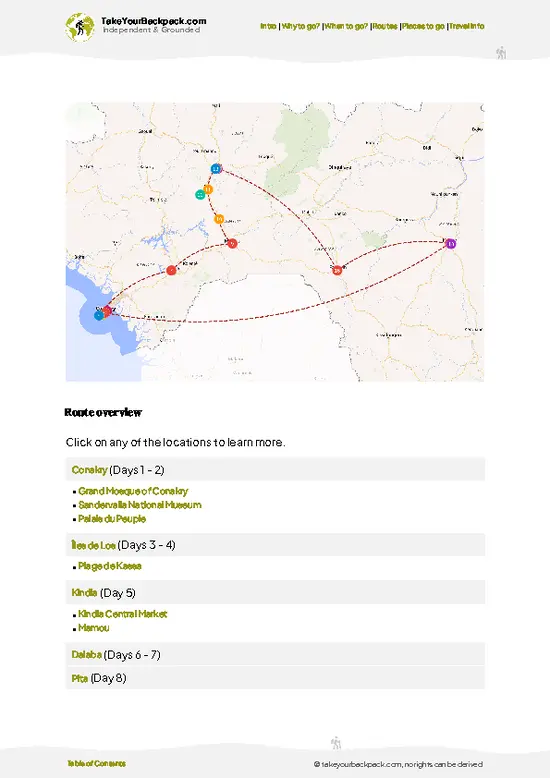
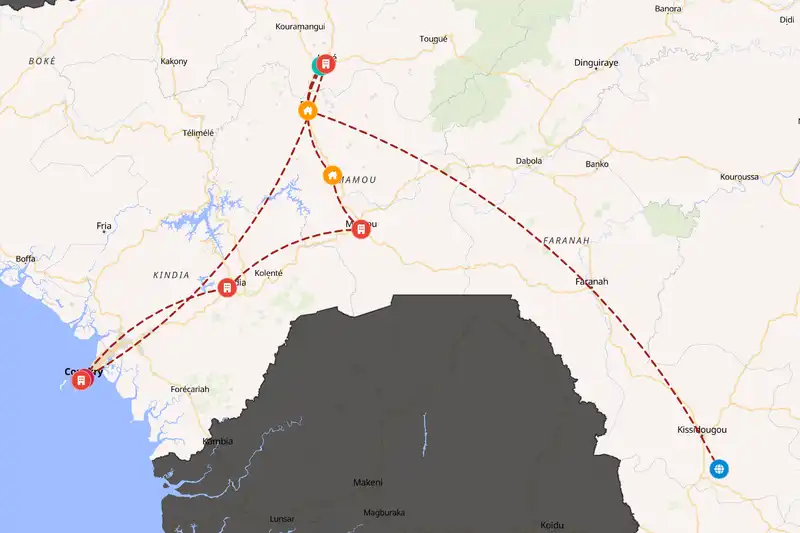
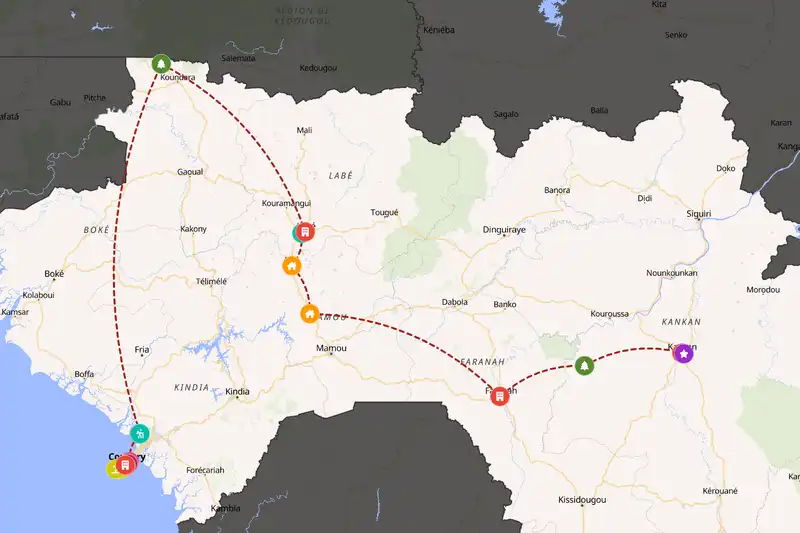
This 15-day route is for travelers who want to go deep into Guinea—coast, highlands, forests, and river country—with a backpacker’s curiosity but a grown-up respect for rest days: it’s a medium-slow circuit using shared taxis, occasional private hires, and one or two long hauls broken up by multi-night stays. You’ll start in Conakry, swing through the Fouta Djallon, cut across the interior via Faranah and Kankan, then drop into the forested southeast around Lola and the Nimba Mountains Biosphere Reserve before looping back toward the coast.

Days 1-3: Coastal capital and island reset

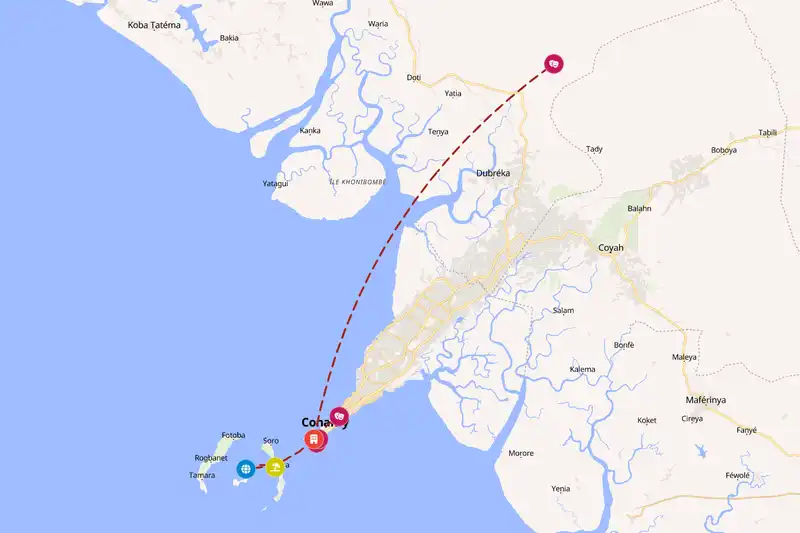
Give yourself three nights in and around Conakry to ease into Guinea instead of bolting inland on day one. Start with a full city day: visit the Sandervalia National Museum for context, then walk between the Grand Mosque of Conakry, Cathédrale Sainte-Marie de Conakry, and Palais du Peuple to feel how politics, religion, and public life share the same streets. In the late afternoon, wander the Conakry Fishing read more 👉
This 15-day route is for travelers who want to go deep into Guinea—coast, highlands, forests, and river country—with a backpacker’s curiosity but a grown-up respect for rest days: it’s a medium-slow circuit using shared taxis, occasional private hires, and one or two long hauls broken up by multi-night stays. You’ll start in Conakry, swing through the Fouta Djallon, cut across the interior via Faranah and Kankan, then drop into the forested southeast around Lola and the Nimba Mountains Biosphere Reserve before looping back toward the coast.

Days 1-3: Coastal capital and island reset

Give yourself three nights in and around Conakry to ease into Guinea instead of bolting inland on day one. Start with a full city day: visit the Sandervalia National Museum for context, then walk between the Grand Mosque of Conakry, Cathédrale Sainte-Marie de Conakry, and Palais du Peuple to feel how politics, religion, and public life share the same streets. In the late afternoon, wander the Conakry Fishing Port and Fish Market and, if timing allows, drop into the Centre Culturel Franco-Guinéen for a show or exhibit. On day two, head out on Îles de Loos Boat Excursions and Island-Hopping to the Îles de Los, focusing on Plage de Kassa for a proper swim and a lazy seafood lunch before returning to Conakry for the night. Day three is your inland teaser: take a day trip to the Soumba Waterfall Recreation Area and nearby Soumba Waterfalls, getting your first taste of the plateau landscapes without yet committing to a full relocation.

Days 4-6: Into the Fouta Djallon via Kindia, Dalaba, and Pita

On day four, move to Kindia for a night, using the afternoon to explore the Kindia Central Market and Craft Stalls and adjust to the slower, greener feel of the interior. The next morning, continue up into the Fouta Djallon, basing yourself in Dalaba for two nights so you can take unhurried walks, talk with locals about Peul traditions, and enjoy cool evenings that feel a world away from the coast. From Dalaba, make a day trip to Pita and the Kambadaga Falls, where you can hike along the canyon edges and watch the water carve through the plateau; return to Dalaba for a second night so you’re not constantly packing and unpacking.

Days 7-9: Highland hub of Labé and river country around Faranah

Travel on to Labé for two nights, giving yourself a full day to dive into the Labé Central Market and Artisan Quarter, where traders from across the highlands converge and workshops hum with metalwork, weaving, and carving. Use spare time for short walks into the surrounding hills or simply sit in tea stalls watching the city’s rhythm. On day nine, drop down toward the interior plains and settle in Faranah for a night or two, focusing on the Faranah Riverside Cultural and Market Area, where life revolves around the river: fishermen mending nets, kids swimming at dusk, and traders moving goods by boat and truck. This phase shifts you from highland cool to lowland heat, so keep your schedule light and your afternoons shady.

Days 10-12: Eastern crossroads of Kankan and Haut Niger National Park

From Faranah, continue to Kankan, one of the country’s key inland cities, and give it two nights so you can see more than just the taxi park. Visit Kankan’s Grand Mosque, a major religious landmark that anchors the city’s spiritual life, and wander the Kankan Traditional Market and Cloth-Dyeing Area to watch dyers at work over steaming vats of indigo and bright pigments. If you want a quieter nature day, take a relaxed walk along the Kankan River Walk, which offers a softer, more local side of the city. Use one full day for an excursion into Haut Niger National Park, where gallery forests and savanna meet along the river; this is your best shot at seeing Guinea’s wilder side in the interior, even if wildlife sightings are hit-or-miss.

Days 13-15: Forested southeast and Nimba Mountains finale

On day thirteen, make the long but worthwhile journey to Lola, your base for exploring the far southeast. Spend your first afternoon getting a feel for town and, if time allows, dipping into the Lola Wildlife Reserve to see how forest and village life intersect. Over the next day and a half, focus on the Mount Nimba Strict Nature Reserve within the broader Nimba Mountains Biosphere Reserve, where you can arrange guided hikes into montane forest and along ridges that look out over Guinea, Côte d’Ivoire, and Liberia. This is the wild, end-of-the-road payoff for making it this far: cooler air, bird calls, and a sense that you’ve reached the edge of the map. Use your final day to begin the journey back toward Conakry or onward to your next country, carrying the memory of both city noise and mountain silence with you.

As a final bonus, if you ever push deeper into this corner, aim for the tiny forest hamlet of Sérédou, where footpaths thread through cocoa groves and evenings are lit by kerosene lamps instead of streetlights.
Loading the map 🌍
film
0
0
0a
Sandervalia National Museum
film
1
1
1a
Cathédrale Sainte-Marie de Conakry
film
2
2
2a
Palais du Peuple
film
3
3
3a
Conakry Fishing Port and Fish Market
film
4
4
4a
Centre Culturel Franco-Guinéen
film
5
5
5a
Îles de Los
film
6
6
6a
Soumba Waterfall Recreation Area
film
7
7
7a
Haut Niger

✈️ The backpacker research shortcutGuinea Travel Guide

An offline-friendly backpacking guide with optimized travel routes, ranked highlights, transport advice, and the best areas to stay.
example page 0 from our offline Travel Guide for Guineaexample page 1 from our offline Travel Guide for Guineaexample page 2 from our offline Travel Guide for Guineaexample page 3 from our offline Travel Guide for Guineaexample page 4 from our offline Travel Guide for Guineaexample page 5 from our offline Travel Guide for Guinea
The digital guide (243 pages) contains:
67 highlights, ranked by travel appeal
Optimized 5, 10 & 15-day travel routes
Best neighborhoods to stay
How to get around
Offline-friendly for travel without Wi-Fi
👉 See all 30+ guide features

📅 Plan smarter in minutes, not weeks
Month by month travel advice
Festivals & national holidays
Budget expectations

🗺️ Go to the right places, skip the overrated ones
Honest pros & cons of destinations
Top hikes, parks & viewpoints
Lesser-known places most travelers miss
Clear “worth it vs skip it” guidance

🛏️ Travel smoothly without rookie mistakes
Best areas to stay
Transport systems explained simply
Common scams & safety advice
SIM cards, money & practical tips

🌍 Understand the country, not just visit it
Culture & traditions
52 Essential phrases & customs
Festivals worth planning around
Traveler-friendly historical context
Insights that make places more meaningful

📱 Built for real travel conditions
Fully downloadable PDF
Works completely offline
Optimized for phone use
Useful in remote areas & buses
Everything in one place
Save weeks of stressful planning
Get instant access to the full guide directly. 30-day money-back guarantee.


Sent to your inbox immediately after payment • 100% Secure Checkout
Best Backpacking Travel Advisor 2025 tourism awardBest Backpacking
Travel Advisor
2025
What others say about Take Your Backpack Guides:
⭐⭐⭐⭐⭐
Fantastic, amazing amount of information!
⭐⭐⭐⭐⭐
My goodness this is amazing, it's what I've been looking for hats off too you!
⭐⭐⭐⭐⭐
I think this is absolutely BRILLIANT
⭐⭐⭐⭐
Very complete and informative. It's still missing places, but I gotta to commend you
⭐⭐⭐⭐⭐
This is truly amazing, thank you, can't wait to explore it with my kids!
⭐⭐⭐⭐⭐
Awesome resource, thank you!
⭐⭐⭐⭐⭐
This is amazing! Can't wait to explore the ones I haven't seen
⭐⭐⭐⭐
I love this! Well done, great idea.
⭐⭐⭐⭐⭐
Thanks for taking the time to make this gem!
⭐⭐⭐⭐⭐
This might be the best website I've ever seen.
⭐⭐⭐⭐⭐
Congratulations, and thank you so much for your work; it's incredibly valuable.
⭐⭐⭐⭐
In all seriousness I think you did a great job pointing out the important spots
⭐⭐⭐⭐⭐
10/10 very good
⭐⭐⭐⭐⭐
As someone who's only just starting to visit regularly this is awesome, thank you.
⭐⭐⭐⭐
Thank you very much! I'm going to visit my dad, it's going to be very useful!
⭐⭐⭐⭐⭐
This is really cool! We'll be travelling for the first time and this definitely come in handy.
⭐⭐⭐⭐⭐
You are now our minister of culture, congratulations 👨‍💼
⭐⭐⭐⭐⭐
Just wanted to tell you that this is a pearl! Going to follow your recommendations.
⭐⭐⭐⭐⭐
This is so cool. I'll definitely be using the resource for my travels soon.
⭐⭐⭐⭐⭐
This is very impressive! Good work.
⭐⭐⭐⭐⭐
This is an amazing and informative site. Very well done!

🧭 RouteOther Route Options

Travel Guinea your way — from a quick highlights trip to a slow-paced adventure.

🙋 FAQFAQ: Backpacking Guinea

Short version: Guinea is doable to backpack independently if you already have some West Africa experience or you’re patient and flexible. It’s not an ideal first-country for brand‑new travelers.

The good news: people are generally welcoming, costs are low, and there’s very little mass tourism, so you get real daily life instead of a curated show. You can move around with shared taxis and minibuses, find cheap guesthouses in most towns, and eat at street stalls for a few dollars.

The hard parts: infrastructure is rough. Roads can be brutal, especially in the rainy season (roughly May–October). Power cuts are normal, running water isn’t guaranteed, and schedules are more of a suggestion than a promise. French is extremely useful; outside Conakry and a few hubs, English won’t get you far. You need to be okay with delays, dust, and plans changing.

Safety is mostly about petty theft, bad roads, and occasional political tension. Keep travel days flexible, avoid moving at night, and ask locals or guesthouse staff about current no‑go areas before long bus rides. ATMs exist in bigger towns but can be unreliable, so carry backup cash in euros or dollars.

If you’ve traveled in places like Sierra Leone, Guinea-Bissau, or rural parts of Ghana, Guinea will feel like a logical next step. If your comfort zone is Europe hostels and Southeast Asia night buses, you can still do it, but you’ll enjoy it more if you treat Guinea as an adventure, not a checklist country.
For a tight backpacker trip that still feels worthwhile, aim for 10–14 days. That gives you time to see more than Conakry without spending your whole trip in transit.

Rough breakdowns that actually work on the ground:

7–10 days (fast but feasible)
- 1–2 days: Conakry and Îles de Los (quick city intro + beach/island decompression).
- 3–4 days: Fouta Djallon (base in Labé or Dalaba; day hikes to waterfalls and villages).
- 2–3 days: Extra time in Fouta or a quick hop to Kindia/Télimélé area for more nature.

2–3 weeks (sweet spot for backpackers)
- 2–3 days: Conakry + Îles de Los.
- 6–8 days: Fouta Djallon (multi‑day treks, homestays, more remote waterfalls and canyons).
- 4–6 days: Forested Guinea around Nzérékoré (sacred forests, mask traditions, more humid, green landscapes).
- 2–3 days: Buffer for slow transport, breakdowns, or a bonus stop like Kindia.

1 month+
- You can start traveling slower: stay longer in villages, do multi‑day hikes without rushing back, and explore less‑visited corners like the far east around Kankan and Siguiri.

Because transport is slow and weather can wreck roads, always build in at least 1–2 buffer days. If you only have a week, focus on Conakry + Îles de Los + a slice of Fouta Djallon and accept that you’re getting a sampler, not the full spread.
Yes, you can get around Guinea without your own car, but you trade money savings for time and comfort.

How people actually move:
- Shared taxis (taxis-brousse): Old sedans crammed with people and luggage, running fixed routes between towns. They leave when full, not on a timetable. Cheap, slow, and very common.
- Minibuses and bush vans: Used on busier routes. Slightly more space, same idea: they depart when full. Expect frequent stops and long loading times.
- Motos (motorbike taxis): Essential in smaller towns and for the last stretch to villages, waterfalls, and trailheads. Negotiate the price before hopping on and wear a helmet if you can get one.
- City taxis in Conakry: Shared or private. Shared taxis run set routes and are very cheap but crowded; private hires cost more but are still reasonable if you split with other travelers.

What this means for you:
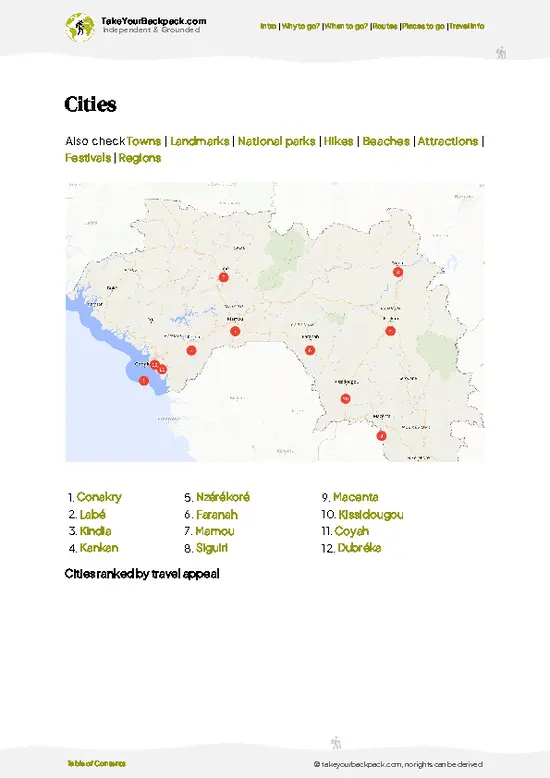
- You can reach all the main backpacker areas (Conakry, Labé, Dalaba, Pita, Kindia, Nzérékoré) by public transport.
- Getting to specific waterfalls, viewpoints, or remote villages usually requires a moto or arranging a local guide with a vehicle.
- Travel days are long. A 200 km trip can easily eat most of a day once you factor in waiting, loading, and bad roads.

If you’re short on time and have some budget, occasionally hiring a private car for a day (through a guesthouse or local contact) for side trips can save you a lot of frustration. If you’re on a strict budget and long, dusty days don’t scare you, the shared taxis and motos will get you where you need to go.
For a first-time backpacker trip to Guinea, these are the places that earn their bus rides:

1. Fouta Djallon Highlands (Labé, Dalaba, Pita area)
This is the heart of a good Guinea trip. Cool climate, rolling plateaus, deep valleys, and a ridiculous number of waterfalls. You can do day hikes from towns or multi‑day treks between villages. Homestays and simple guesthouses make it easy to keep costs low while actually meeting people instead of just passing through.

2. Îles de Los (off Conakry)
Quick boat ride from Conakry, and suddenly you’re on sandy beaches with simple guesthouses and grilled fish for dinner. It’s the easiest place in the country to just exhale, swim, and reset after chaotic bus rides. Great first or last stop.

3. Forested Guinea (around Nzérékoré)
If you have time to push south, this region feels different from the rest of the country: denser forests, more humidity, and strong mask and initiation traditions. You can visit sacred forests, small villages, and local markets that see almost no foreign visitors. It’s more effort to reach, but it gives you a deeper sense of how varied Guinea actually is.

4. Kindia and surroundings
Closer to Conakry than Fouta or Nzérékoré, Kindia is a good compromise if you’re short on time. You get hills, waterfalls, and rural scenery without committing to a multi‑day bus odyssey. It’s not as dramatic as Fouta, but it’s a solid nature hit.

5. Conakry (1–2 days, max)
Not a classic tourist city, but it’s your entry/exit point and worth a short look. Street food, markets, and the general controlled chaos of a West African capital are part of the experience. Use it to sort SIM cards, cash, and onward transport, then escape to the highlands or islands.
If you’re short on time or patience for long, rough rides, it’s completely fine to be selective. Guinea rewards depth more than breadth.

1. Deep interior towns just to “tick them off”
Places like Kankan or Siguiri can be interesting if you have a specific reason (history, personal connections, research), but for most backpackers they’re long, hot detours without standout sights. If you only have 1–2 weeks, put that time into Fouta Djallon or the islands instead.

2. Trying to see all of Guinea in one trip
The country is big, the roads are slow, and you’ll burn days just sitting in shared taxis. It’s better to choose two regions (for example, Conakry + Îles de Los + Fouta Djallon, or Conakry + Kindia + Forested Guinea) and actually enjoy them instead of racing around.

3. Extended time in Conakry
Use Conakry as a logistics base and a short intro to urban life, not the main event. After 1–2 days, the traffic, noise, and heat start to outweigh the rewards for most budget travelers. Move on to the highlands or islands as soon as your errands are done.

4. Overly remote waterfalls or villages if you’re on a tight schedule
In Fouta Djallon and Forested Guinea, there’s always “one more” waterfall or village that’s another half‑day of motos and walking away. If you’re short on time, stick to a few well‑placed bases (Labé, Dalaba, Pita, Nzérékoré) and do day trips instead of chasing every far‑flung spot.

5. Cross‑country overland marathons
If your trip is short, avoid planning routes that zigzag the entire country (for example, Conakry → Nzérékoré → Kankan → Labé in one loop). You’ll spend more time in transit than actually being anywhere. Pick a logical line or a simple out‑and‑back and save the rest for another trip.

🇬🇳 GuineaExpand Your Journey

Ready to build a truly unique trip? Predefined routes are perfect for first-time visitors, but there is so much more to discover. Whether you are chasing a city trip, pristine national parks, local food scenes, or quiet beaches, pick a category to design your own path.