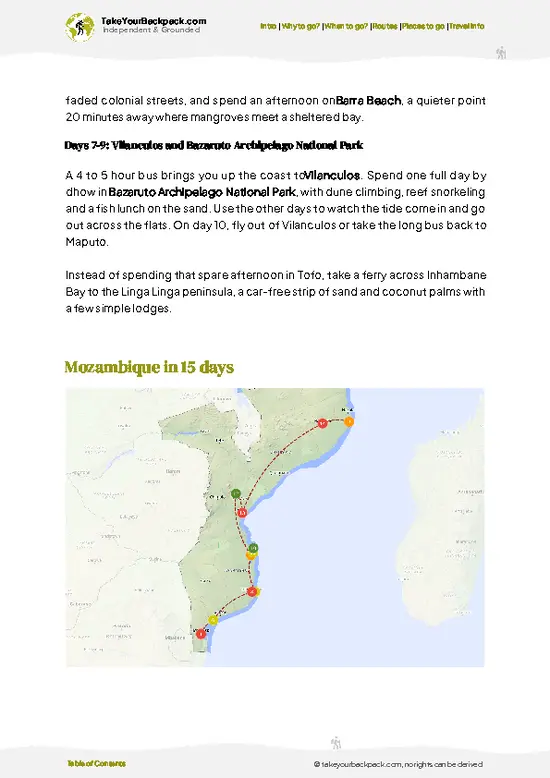
This fifteen-day line runs from the capital to the old Swahili-Portuguese island of the north, and it suits travelers who want Mozambique’s big names plus the quieter stretches between them. The pace is relaxed, with two or three nights in most places and one unscheduled day before the longest ride. You will ride long-distance buses down the EN1, local chapas for short hops, a dhow out to the islands, one domestic flight from Beira to Nampula, and a final chapa across the bridge to the island.
Days 1-3: Maputo and Praia do Bilene
Two nights in
Maputo give you time to see the city’s colonial architecture and its revolutionary politics. Start at the
Maputo Central Railway Station, a 1916 Beaux-Arts building with a copper dome, wrought-iron platforms and a small jazz café inside. Then spend a morning at the
Museum of the Revolution on Avenida 24 de Julho, where four floors of photos and weapons trace FRELIMO’s war of independence. In the evening, check the program at
Teatro Avenida, home of …
read more 👉This fifteen-day line runs from the capital to the old Swahili-Portuguese island of the north, and it suits travelers who want Mozambique’s big names plus the quieter stretches between them. The pace is relaxed, with two or three nights in most places and one unscheduled day before the longest ride. You will ride long-distance buses down the EN1, local chapas for short hops, a dhow out to the islands, one domestic flight from Beira to Nampula, and a final chapa across the bridge to the island.
Days 1-3: Maputo and Praia do Bilene
Two nights in Maputo give you time to see the city’s colonial architecture and its revolutionary politics. Start at the Maputo Central Railway Station, a 1916 Beaux-Arts building with a copper dome, wrought-iron platforms and a small jazz café inside. Then spend a morning at the Museum of the Revolution on Avenida 24 de Julho, where four floors of photos and weapons trace FRELIMO’s war of independence. In the evening, check the program at Teatro Avenida, home of the Mutumbela Gogo company, and stop by the Núcleo de Arte Cooperative Gallery, where working artists sell straight from their studios.
On day 3, a chapa or bus covers the roughly 3 hours north to Praia do Bilene. Its Uembje lagoon is shallow, warm and almost wave-free. The point of this stop is to break the long road north into two sane halves, and an afternoon floating in the lagoon does that well.Days 4-6: Tofo Beach and Inhambane
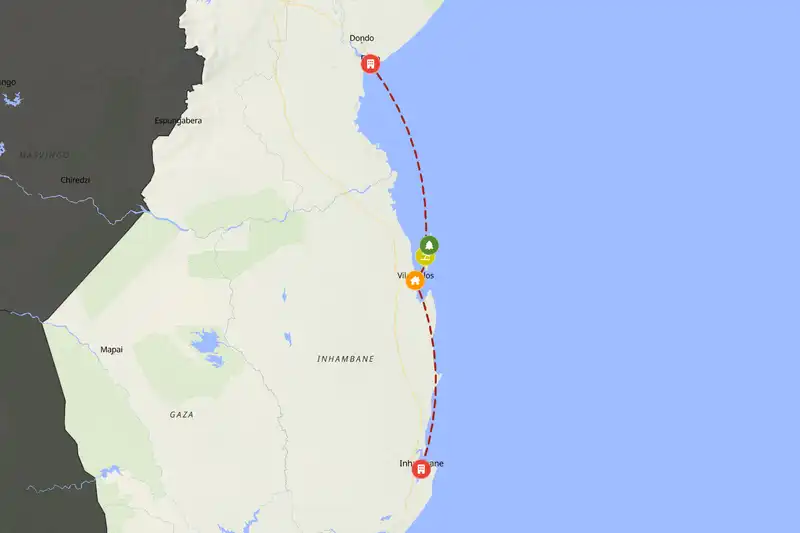
A 5 to 6 hour ride brings you to Tofo Beach, a surf-and-dive village on a curve of pale sand. Book an ocean safari here (around US$40 to 60, about MZN 2,500 to 3,800) to snorkel with whale sharks. Divers come for the manta ray cleaning stations at the offshore reefs. On one afternoon, ride a chapa 30 to 40 minutes to Inhambane, a sleepy colonial town with a waterfront cathedral and an 1840s mosque, then catch the evening light from the jetty.Days 7-9: Vilanculos and the Bazaruto Archipelago
The 4 to 5 hour hop north lands you in Vilanculos, the jumping-off point for the Bazaruto Archipelago. Give one full day to a dhow trip out to Bazaruto Island’s big sand dunes and the reef off Two Mile. Use a second day for Benguerra Island, where inland freshwater lakes hold crocodiles and the channel between the islands is shallow enough to wade in places. Day 9 is unscheduled on purpose. Before the hardest ride of the trip, you will want a hammock and a plate of grilled prawns.Days 10-12: Gorongosa National Park and Beira
Day 10 is the long one: a bus to the junction at Inchope (6 to 7 hours), then about an hour north toward Gorongosa National Park. Arrange your pickup with Chitengo camp in advance. Two nights let you do morning and evening game drives around the Lake Urema floodplain. The park’s restoration since the civil war has brought back elephants, lions and huge herds of waterbuck. On day 12, it is an easier 3 to 4 hours to Beira, where the gutted Grande Hotel and the rusting wreck off Macuti beach make a strange, memorable evening walk.Days 13-15: Ilha de Moçambique
Fly from Beira to Nampula, then ride a chapa 3 to 4 hours to the coast and across the 3.5 km bridge onto Ilha de Moçambique, the country’s old colonial capital. Two nights are enough to walk the coral-stone lanes of the Island of Mozambique Stone Town and then the reed-roofed Macuti town to the south. Climb the ramparts of Fort São Sebastião, begun in 1558, and finish at its tip at the Chapel of Nossa Senhora de Baluarte. Built in 1522, it is often called the oldest European building in the southern hemisphere. On day 15, head back to Nampula for your flight out.
If you can squeeze in a spare morning on the island, take a dhow across the bay to Cabaceira Pequena, where Swahili ruins sit among mangroves and fishing hamlets.

 Best Backpacking