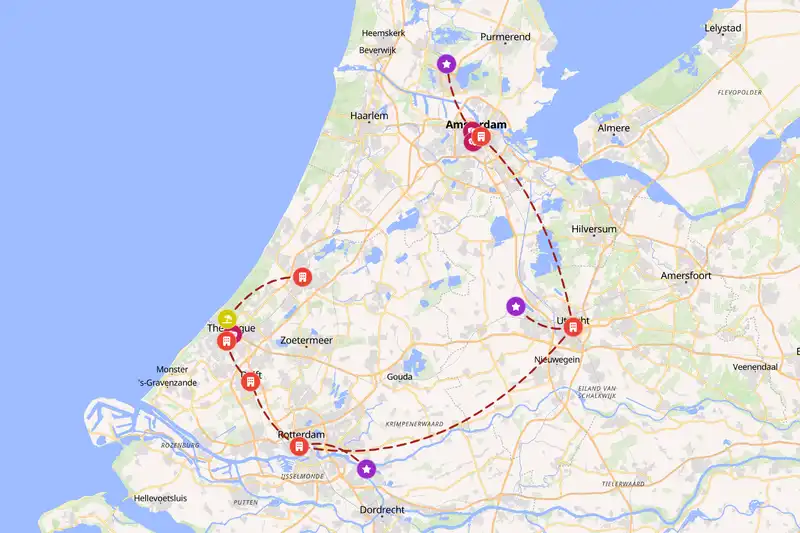
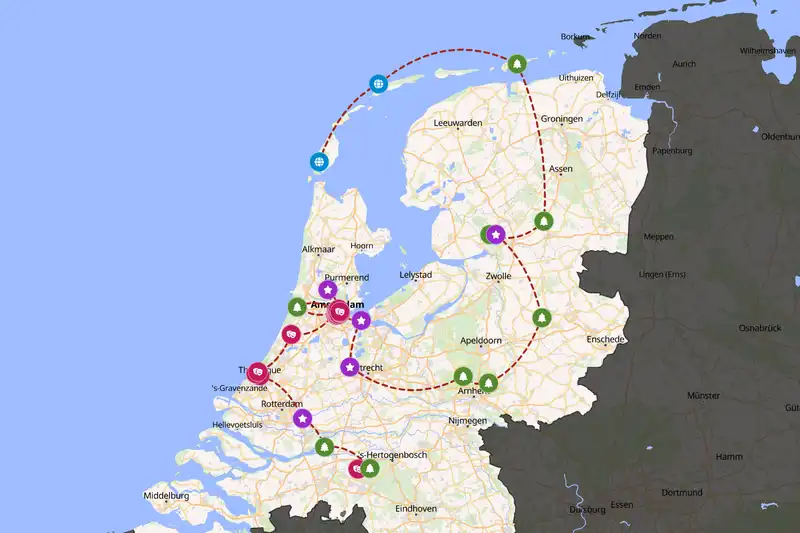
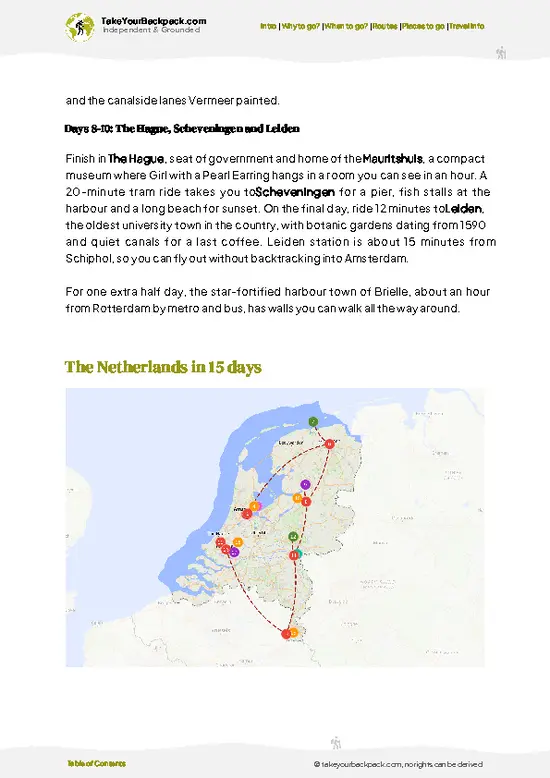
This 15-day loop is for travelers who have a little Dutch experience, or plenty of curiosity, and want to see how different the north, east and south feel from the canal-ring postcard. The pace is moderate: six bases, two or three nights each, and no transfer longer than about 2.5 hours. You need intercity and regional trains, regional buses, one Wadden ferry and a rental bike for at least two of the days.
Days 1-3: Amsterdam and Waterland
Arrive, drop your bag and give your first full day to Museumplein. The
Rijksmuseum takes a morning (around €25, book a timed slot), and the
Van Gogh Museum next door takes an afternoon (around €22, online only). Doing both in one day is tiring but frees up day three for the countryside.
On day three, rent a bike, take the free ferry behind Amsterdam Centraal to Noord and pedal roughly 16 km through the Waterland polders, where cows graze below sea level and the bike path runs on top of the dike.
Monnickendam is the lunch stop: a working harbour with smokehouses …
read more 👉This 15-day loop is for travelers who have a little Dutch experience, or plenty of curiosity, and want to see how different the north, east and south feel from the canal-ring postcard. The pace is moderate: six bases, two or three nights each, and no transfer longer than about 2.5 hours. You need intercity and regional trains, regional buses, one Wadden ferry and a rental bike for at least two of the days.
Days 1-3: Amsterdam and Waterland
Arrive, drop your bag and give your first full day to Museumplein. The Rijksmuseum takes a morning (around €25, book a timed slot), and the Van Gogh Museum next door takes an afternoon (around €22, online only). Doing both in one day is tiring but frees up day three for the countryside.
On day three, rent a bike, take the free ferry behind Amsterdam Centraal to Noord and pedal roughly 16 km through the Waterland polders, where cows graze below sea level and the bike path runs on top of the dike. Monnickendam is the lunch stop: a working harbour with smokehouses and far fewer visitors than its neighbours. Continue along the causeway to Marken and its wooden houses on mounds, then ride or bus back to the city.Days 4-5: Groningen and Schiermonnikoog
The direct train to Groningen takes about 2 hours 15 minutes. Roughly a quarter of the population are students, so the bars around the Grote Markt stay full on weeknights and prices sit noticeably below Amsterdam’s. Climb the Martinitoren for a view across flat farmland.
Day five belongs to Schiermonnikoog. A regional bus reaches the Lauwersoog ferry in about an hour, and the crossing takes 45 minutes (around €20 return). Visitors cannot bring cars, so you rent a bike at the pier and ride through dunes and salt marsh to a beach that stretches for kilometres. Check the last sailing before you leave the harbour.Days 6-7: Zwolle, Giethoorn and Kampen
An hour south by train, Zwolle makes a calm, affordable base inside its star-shaped old town moat. From here, Giethoorn is a short train ride to Steenwijk plus a 20-minute bus. Go early or late, rent an electric whisper boat or a canoe, and steer off the main canal into the side channels where thatched farmhouses sit on their own islands. On the second day, the little local train covers the 11 minutes to Kampen, a Hanseatic river town whose medieval gates and IJssel waterfront see a fraction of Giethoorn’s crowds.Days 8-9: Nijmegen and De Hoge Veluwe
Head to Nijmegen (about 1.5 hours, usually with a change in Arnhem), which claims to be the oldest city in the country and has a riverside promenade along the Waal that fills with drinkers on warm evenings. For De Hoge Veluwe, take the train to Ede-Wageningen and the regional bus to the Otterlo entrance. Inside, free white bikes take you across heath and sand drift to the Kröller-Müller Museum, which holds one of the largest Van Gogh collections anywhere (park plus museum around €26). Save the second afternoon for the Ooijpolder, a floodplain east of the city where you walk or cycle past wild Konik horses and old river arms.Days 10-11: Maastricht and Valkenburg
The regional line down the Maas valley gets you to Maastricht in about two hours. Limburg looks and eats differently: hills, marl stone, Burgundian lunches that run long, and terraces on the Vrijthof square. Day eleven is a 10-minute train to Valkenburg, where you tour the man-made marl caves under the hills and walk up to the ruined castle above town.Days 12-15: Rotterdam, Kinderdijk, Gouda and Delft
Travel to Rotterdam (about 2.5 hours via Eindhoven), the city rebuilt after its centre was bombed in 1940, which now means a skyline of experimental towers and a food hall under a horseshoe arch. Use it as your final base for three nights. Ride the Waterbus to Kinderdijk, where 19 windmills line the drainage canals, then spend a day in Gouda (20 minutes by train) for its Gothic town hall, stained-glass church and Thursday cheese market in summer. Close with Delft, 15 minutes away, for blue pottery and the Vermeer streets, then catch the Intercity Direct to Schiphol in about 25 minutes on departure day.
If you can squeeze in one more stop between Rotterdam and Brabant, the fortified river town of Heusden, with its restored ramparts and windmills on the walls, sees hardly any foreign visitors.
 Best Backpacking