×
Philippines🇵🇭 | 21 days itinerary

The Perfect 21-Day Route for Philippines

By Johan Kruseman 🇳🇱 | Updated May 4, 2026
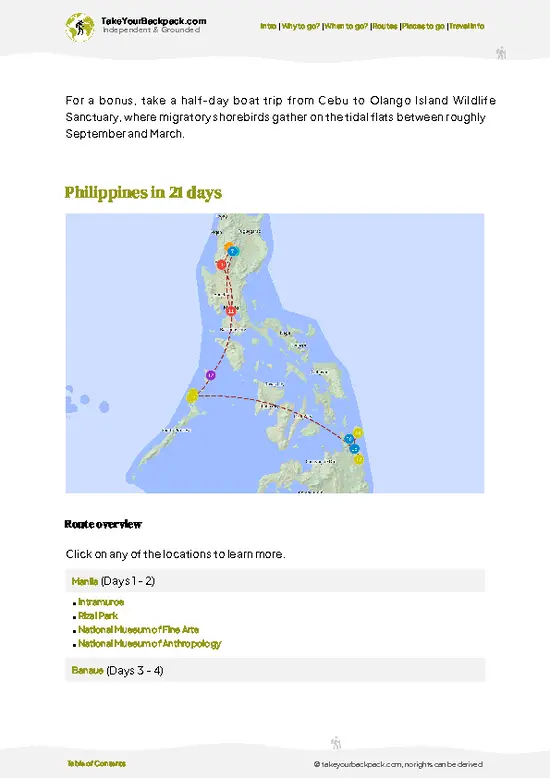
This 21-day route is for travelers who want to go deep: a full-spectrum Philippines journey that threads together history, mountains, reefs, and laid-back islands without feeling like a backpacker boot camp. The pace is steady but not slow, using a combination of domestic flights, long-distance buses, vans, and ferries, with most stops getting two to three nights so you can actually unpack and breathe.

Days 1-4: Manila & North Luzon - History, Highlands, and Rice Terraces

Begin in Manila with two nights to get oriented and dive into the country’s past: walk Intramuros with time for Fort Santiago, San Agustin Church and Museum, and a reflective stroll through Rizal Park and Rizal Monument, then add either the Ayala Museum or the National Museum of Anthropology to understand the layers of culture you’ll see later. On Day 3, head north by bus to Baguio, using the afternoon to enjoy cooler air and local food rather than rushing onward. Day 4 is your jump-off into the highlands: continue deeper … read more 👉
This 21-day route is for travelers who want to go deep: a full-spectrum Philippines journey that threads together history, mountains, reefs, and laid-back islands without feeling like a backpacker boot camp. The pace is steady but not slow, using a combination of domestic flights, long-distance buses, vans, and ferries, with most stops getting two to three nights so you can actually unpack and breathe.

Days 1-4: Manila & North Luzon - History, Highlands, and Rice Terraces

Begin in Manila with two nights to get oriented and dive into the country’s past: walk Intramuros with time for Fort Santiago, San Agustin Church and Museum, and a reflective stroll through Rizal Park and Rizal Monument, then add either the Ayala Museum or the National Museum of Anthropology to understand the layers of culture you’ll see later. On Day 3, head north by bus to Baguio, using the afternoon to enjoy cooler air and local food rather than rushing onward. Day 4 is your jump-off into the highlands: continue deeper into the Rice Terraces of the Philippine Cordilleras region with a day focused on the Banaue Rice Terraces, walking viewpoints and short trails instead of trying to cram in every village, then overnight in or around Banaue to soak up the mountain quiet.

Days 5-7: Sagada & Mt. Pulag - Caves, Clouds, and Mountain Town Life

Travel from Banaue to Sagada and give yourself two nights in this small town so you can explore at a human pace: hanging coffins, cave systems, and misty walks that feel worlds away from Manila’s traffic. Keep one day flexible for either more hiking or simply lingering in cafés and watching the weather roll over the hills. On Day 7, loop back toward the Mount Pulag National Park area for a carefully paced visit to Mt. Pulag, timing your hike for sunrise above the cloud sea if conditions allow, then rest nearby or back toward Baguio rather than forcing an overnight bus immediately after a big hike.

Days 8-11: Cebu, Moalboal & Kawasan Falls - Urban Energy and Reef Adventures

Fly from Luzon down to Cebu and spend a night in the city to reset, explore its historic core, and enjoy the food scene. Then head to Moalboal for three nights, using it as your base for snorkeling with sardine balls and turtles, and for a full day at Kawasan Falls where you can choose between adrenaline-heavy canyoneering or a gentler swim-and-picnic day. This stretch gives you a solid block of warm-water time after the cool highlands, without stacking too many long travel days back-to-back.

Days 12-15: Bohol & Panglao - Hills, Forests, and Easy Beach Days

Catch a ferry to Bohol and settle in for three nights, splitting your time between inland exploration and coastal downtime. Dedicate one day to the classic inland loop with Bohol’s Chocolate Hills and the shaded drive through the Bilar Man-Made Forest, plus side stops as your energy allows. Use your remaining days to enjoy Alona Beach and the wider Panglao area at a relaxed pace, with optional snorkeling or boat trips if you still have adventure in your legs, or just long lunches and sunset walks if you’re leaning into the slow life.

Days 16-21: Palawan - Puerto Princesa, Underground River, El Nido & Nacpan

Fly onward to Puerto Princesa and give yourself a night in town before heading out, using the time to reset and enjoy a low-key dinner. Take a day trip to Puerto Princesa Subterranean River National Park, drifting into the cave system and back in time for an easy evening, then travel by van up to Puerto Princesa’s northern star, El Nido, for a three-night finale. From El Nido, spend one full day island-hopping through Bacuit Bay, another day focused on the long, laid-back stretch of Nacpan Beach, and keep a final flexible day to revisit your favorite spot or simply sit still and let the whole three-week journey sink in before you fly out.

My favorite memory from this route is that first early-morning boat ride out of El Nido, when the limestone cliffs of Bacuit Bay rise out of the mist and you realize just how much variety you’ve packed into three weeks.
Loading the map 🌍
film
0
0
0a
Rice Terraces of the Philippine Cordilleras
film
1
1
1a
Banaue Rice Terraces
film
2
2
2a
Kawasan Falls
film
3
3
3a
Alona Beach
film
4
4
4a
Panglao
film
5
5
5a
El Nido

✈️ The backpacker research shortcutPhilippines Travel Guide

An offline-friendly backpacking guide with optimized travel routes, ranked highlights, transport advice, and the best areas to stay.
example page 0 from our offline Travel Guide for Philippinesexample page 1 from our offline Travel Guide for Philippinesexample page 2 from our offline Travel Guide for Philippinesexample page 3 from our offline Travel Guide for Philippinesexample page 4 from our offline Travel Guide for Philippinesexample page 5 from our offline Travel Guide for Philippines
The digital guide (434 pages) contains:
144 highlights, ranked by travel appeal
Optimized 7, 14 & 21-day travel routes
Best neighborhoods to stay
How to get around
Offline-friendly for travel without Wi-Fi
👉 See all 30+ guide features

📅 Plan smarter in minutes, not weeks
Month by month travel advice
Festivals & national holidays
Budget expectations

🗺️ Go to the right places, skip the overrated ones
Honest pros & cons of destinations
Top hikes, parks & viewpoints
Lesser-known places most travelers miss
Clear “worth it vs skip it” guidance

🛏️ Travel smoothly without rookie mistakes
Best areas to stay
Transport systems explained simply
Common scams & safety advice
SIM cards, money & practical tips

🌍 Understand the country, not just visit it
Culture & traditions
52 Essential phrases & customs
Festivals worth planning around
Traveler-friendly historical context
Insights that make places more meaningful

📱 Built for real travel conditions
Fully downloadable PDF
Works completely offline
Optimized for phone use
Useful in remote areas & buses
Everything in one place
Save weeks of stressful planning
Get instant access to the full guide directly. 30-day money-back guarantee.


Sent to your inbox immediately after payment • 100% Secure Checkout
Best Backpacking Travel Advisor 2025 tourism awardBest Backpacking
Travel Advisor
2025
What others say about Take Your Backpack Guides:
⭐⭐⭐⭐⭐
Fantastic, amazing amount of information!
⭐⭐⭐⭐⭐
My goodness this is amazing, it's what I've been looking for hats off too you!
⭐⭐⭐⭐⭐
I think this is absolutely BRILLIANT
⭐⭐⭐⭐
Very complete and informative. It's still missing places, but I gotta to commend you
⭐⭐⭐⭐⭐
This is truly amazing, thank you, can't wait to explore it with my kids!
⭐⭐⭐⭐⭐
Awesome resource, thank you!
⭐⭐⭐⭐⭐
This is amazing! Can't wait to explore the ones I haven't seen
⭐⭐⭐⭐
I love this! Well done, great idea.
⭐⭐⭐⭐⭐
Thanks for taking the time to make this gem!
⭐⭐⭐⭐⭐
This might be the best website I've ever seen.
⭐⭐⭐⭐⭐
Congratulations, and thank you so much for your work; it's incredibly valuable.
⭐⭐⭐⭐
In all seriousness I think you did a great job pointing out the important spots
⭐⭐⭐⭐⭐
10/10 very good
⭐⭐⭐⭐⭐
As someone who's only just starting to visit regularly this is awesome, thank you.
⭐⭐⭐⭐
Thank you very much! I'm going to visit my dad, it's going to be very useful!
⭐⭐⭐⭐⭐
This is really cool! We'll be travelling for the first time and this definitely come in handy.
⭐⭐⭐⭐⭐
You are now our minister of culture, congratulations 👨‍💼
⭐⭐⭐⭐⭐
Just wanted to tell you that this is a pearl! Going to follow your recommendations.
⭐⭐⭐⭐⭐
This is so cool. I'll definitely be using the resource for my travels soon.
⭐⭐⭐⭐⭐
This is very impressive! Good work.
⭐⭐⭐⭐⭐
This is an amazing and informative site. Very well done!

🧭 RouteOther Route Options

Travel Philippines your way — from a quick highlights trip to a slow-paced adventure.

🙋 FAQFAQ: Backpacking Philippines

Short version: yes, the Philippines is absolutely doable as an independent backpacker, but it’s more like island-hopping chess than a simple point‑to‑point trip. English is widely spoken, people are generally warm and helpful, and hostels/guesthouses are common in backpacker hubs like Manila, Cebu, Siargao, Bohol, Palawan, and some northern Luzon towns. That makes it easy to ask for help, negotiate prices, and improvise.

The catch is logistics. The country is an archipelago, so you’re stitching together boats, minibuses, and flights instead of just hopping on one long-distance train. Weather can cancel ferries and flights, especially during typhoon season (roughly June–November), so you need buffer days and a flexible mindset. Booking domestic flights a bit in advance usually saves money and stress, but you can still travel spontaneously within each island.

For budget travelers, street food, carinderias (local eateries), and public transport keep costs low. You can sleep in dorms, fan rooms, or simple homestays and still be close to the action. Safety-wise, petty theft is the main concern in big cities and crowded buses; use a money belt or hidden pouch, avoid flashing tech, and take metered or reputable taxis/Grab at night in Manila and Cebu. Most backpackers never encounter serious issues if they use normal city smarts.

If you’re new to solo travel, start with a simple route like Manila → Banaue/Batad → back to Manila → Palawan or Cebu/Bohol. If you’re experienced, you can comfortably wing it, just always check ferry schedules locally and assume at least one transport hiccup per week.
If you want a realistic, not-rushed backpacking trip, think in blocks:

1–2 weeks (fast sampler)
You can do either North Luzon mountains or one island cluster, not both properly.
• Option A: Manila → Banaue/Batad rice terraces → Sagada → back to Manila.
• Option B: Manila or Cebu → Bohol (Panglao + interior) → Siquijor or Cebu’s south (Moalboal/Oslob area, though I’d skip Oslob whale sharks) → fly out.
• Option C: Manila → Puerto Princesa (skip city) → Port Barton → El Nido or Coron.
You’ll be moving a lot, but it’s doable.

3 weeks (sweet spot for most backpackers)
This is where the Philippines starts to feel fun instead of rushed. You can combine mountains + islands:
• North Luzon (Banaue/Batad + Sagada): 4–5 days.
• Palawan (Port Barton + El Nido or Coron): 7–9 days.
• Cebu/Bohol/Siargao: remaining days depending on flights.
You’ll still have to choose between Siargao and a full Cebu/Bohol loop, but you get a good mix of culture, beaches, and underwater stuff.

4–6 weeks (slow and satisfying)
You can actually breathe: add Siargao, more remote islands (Romblon, Camiguin, Apo Island), or spend longer in places like El Nido, Coron, and Siargao without feeling guilty. This is ideal if you want to surf, dive, or just hang out in one spot for a week.

For tight budgets, longer trips can be cheaper per day because you can chase off‑peak flights, stay in cheaper monthly rooms, and avoid last‑minute transport. The main rule: every new island usually costs you at least half a day and some cash in transfers, so it’s better to do fewer islands well than to collect passport stamps on your ferry tickets.
You can absolutely get around the Philippines without a car; in fact, most backpackers do. The transport web looks chaotic at first, but it works if you accept that schedules are more like suggestions.

Between islands
Domestic flights: Fastest way between major hubs (Manila, Cebu, Davao, Puerto Princesa, Coron, Siargao, etc.). Book ahead for cheaper fares, especially around holidays and weekends.
Ferries: RORO (roll-on/roll-off) and fast ferries connect many islands (e.g., Cebu–Bohol, Batangas–Mindoro, Mindoro–Boracay route via Caticlan, Cebu–Negros–Siquijor). They’re cheaper than flights but slower and more weather-dependent.

On each island
Jeepneys: The classic local transport. Cheap, crowded, and fun if you’re not in a rush. Great for short hops between towns or around cities.
Vans and minibuses: Common for routes like Puerto Princesa–El Nido, Cebu City–Moalboal, or Manila–Banaue (overnight buses instead of vans there). They’re faster than jeepneys but can be cramped.
Buses: More comfortable than vans on longer routes, with air‑con options. Good for Luzon (e.g., Manila to Banaue, Baguio, La Union, etc.).
Tricycles and habal‑habal (motorbike taxis): For short distances, beach to town, or remote villages. Always agree on the price before you hop on.
Motorbike rental: In places like Siargao, Bohol, Cebu, and Palawan, renting a scooter is the best way to explore on your own. It’s cheap, but only do it if you’re comfortable riding and always wear a helmet.

In cities
Grab/taxis: In Manila and Cebu, Grab (ride‑hailing) or metered taxis are the easiest way to avoid scams and confusion, especially with luggage.

For budget travelers, the main trade‑off is time vs. comfort. Jeepneys and ferries are cheapest but slow; flights and private transfers save time but cost more. You don’t need a car, and in many places driving one would just add stress, parking headaches, and extra costs.
You can’t do everything, so think in themes: mountains, beaches, underwater, and culture. These are the places that consistently feel worth the effort and money for backpackers.

1. Banaue & Batad (Ifugao rice terraces, North Luzon)
Terraced mountains that look like they were carved by a patient god with a tiny spoon. Batad especially feels remote and rewarding. Great for multi‑day hikes, homestays, and seeing rural life. Go if you like trekking and don’t mind basic comforts.

2. Sagada (North Luzon)
Cool mountain air, caves, hanging coffins, and chill cafés. It pairs perfectly with Banaue/Batad and gives you a break from the heat and beaches.

3. Palawan: El Nido and/or Coron
Karst cliffs, lagoons, island‑hopping, and some of the clearest water in the country. El Nido is more backpacker‑social, Coron has better wreck diving and slightly more rugged vibes. If you only pick one, El Nido is easier for first‑timers; Coron is gold for divers.

4. Port Barton (Palawan)
Sleepier than El Nido, cheaper, and with a more low‑key backpacker crowd. Great for chilled island‑hopping, turtles, and hammocks. If you want Palawan without the full tour‑machine feel, this is your spot.

5. Bohol (Panglao + interior)
Panglao for beaches and budget‑friendly hostels, the interior for Chocolate Hills, tarsiers (visit ethical sanctuaries only), waterfalls, and motorbike loops. Easy to reach from Cebu by ferry and good for first‑time backpackers.

6. Siargao
Surf town energy, palm‑lined roads, island‑hopping, lagoons, and a strong backpacker community. Even if you don’t surf, it’s a great place to stay a week, rent a scooter, and fall into a lazy routine of cafés, swims, and sunsets.

7. Cebu (especially the south)
Moalboal for sardine runs and turtles, plus easy access to waterfalls and canyoneering (Kawasan and beyond). Cebu is a major flight hub, so it’s a practical and fun anchor for a budget route.

8. Apo Island or Camiguin (if you have extra time)
Apo Island: tiny, laid‑back, with excellent turtle snorkeling and diving. Camiguin: waterfalls, hot and cold springs, volcano hikes, and a slower pace. Both are great if you want fewer crowds and more nature.

If you’re short on time, prioritize one mountain area (Banaue/Batad + Sagada) and one or two island clusters (Palawan, Cebu/Bohol, or Siargao) instead of trying to touch everything once.
For a tight itinerary and backpacker budget, it’s less about places being bad and more about what’s not worth your limited days and pesos compared to stronger options.

1. Manila as a long stay
Use it as a transit hub, not a destination, unless you’re really into big Asian cities. One or two nights to adjust, see Intramuros or a museum, then move on. The traffic and smog eat time and energy you could spend on beaches or mountains.

2. Overdeveloped or party‑only beach strips
Boracay: Beautiful sand, but it’s pricier and more resort‑oriented. If you’re on a strict budget or short on time, Palawan, Siargao, or Bohol usually give you more character per dollar.
• Generic beach towns near big cities: If locals say “it’s nice for a weekend from Manila,” that usually means it’s fine, not essential for a once‑off backpacking trip.

3. Oslob whale shark tours (Cebu)
They’re famous, but the feeding practices are controversial and the experience feels like a crowded queue in the ocean. If you care about marine life and want a more natural encounter, skip Oslob and focus on Moalboal, Apo Island, or other snorkeling/diving spots.

4. Puerto Princesa city (Palawan)
Use it as a jump‑off point only. The Underground River is heavily marketed; it’s interesting, but if you’re short on time, most backpackers find Port Barton and El Nido/Coron more rewarding. Don’t burn two days here if you only have a couple of weeks.

5. Trying to do both Palawan and Siargao on a 2‑week trip
This is the classic time trap. The flights and transfers eat days, and you end up barely seeing either. If you’re short on time, pick one major island cluster and do it well instead of collecting airport stamps.

6. Too many city stops
Cebu City, Davao, and other big cities are useful for flights and ferries, but not essential for most backpackers. Transit through, grab a good meal, maybe one night, then head to the coast or mountains.

If you’re really squeezed, your best skip strategy is: minimize big‑city days, avoid overhyped animal attractions, and don’t chase every famous island. Focus on 2–3 regions and give yourself time to actually enjoy them instead of living on buses and boats.

🇵🇭 PhilippinesExpand Your Journey

Ready to build a truly unique trip? Predefined routes are perfect for first-time visitors, but there is so much more to discover. Whether you are chasing a city trip, pristine national parks, local food scenes, or quiet beaches, pick a category to design your own path.