×

Uganda🇺🇬 | best townsDiscover the 10 Best towns Across Uganda

Uganda’s towns are working places first and tourist stops second, and that is exactly why they reward independent travel. Expect red-dirt roads, boda-boda swarms, roadside grills and markets where nobody is selling you a postcard. The southwest is cool, green and hilly, with easy access and steady visitor traffic. The east and north run hotter and quieter, with rougher roads and fewer foreign faces. Around Lake Victoria and the Nile, towns lean on water, fish and adventure sports. Costs stay low almost everywhere, but distances are slow, so pick your kind of town and go.

By Johan Kruseman 🇳🇱 | Updated October 23, 2026
Explore the best landmarks in Uganda

Why go?Understanding Their Importance

Uganda packs an unusual range into a country about the size of Great Britain. It sits on the equator but climbs to roughly 1,000 to 2,000 meters across most of its plateau, so towns feel mild rather than scorching. Highland air, volcanic soil and two rainy seasons make the landscape farm-green almost year-round, and market days pull in people from every direction.

History shapes the map too. The old kingdoms, Buganda most visibly, left royal sites, clan identities and strong local pride. British colonial planning, followed by decades of upheaval, left towns that grew around trade, administration and railways instead of polished heritage centers. Over 40 languages are spoken, and English plus Luganda or Swahili phrases carry you far.

Before choosing Uganda for its towns, know the trade-offs. … read more 👉
Uganda packs an unusual range into a country about the size of Great Britain. It sits on the equator but climbs to roughly 1,000 to 2,000 meters across most of its plateau, so towns feel mild rather than scorching. Highland air, volcanic soil and two rainy seasons make the landscape farm-green almost year-round, and market days pull in people from every direction.

History shapes the map too. The old kingdoms, Buganda most visibly, left royal sites, clan identities and strong local pride. British colonial planning, followed by decades of upheaval, left towns that grew around trade, administration and railways instead of polished heritage centers. Over 40 languages are spoken, and English plus Luganda or Swahili phrases carry you far.

Before choosing Uganda for its towns, know the trade-offs. Public transport means shared minibuses (matatus) that leave when full, and buses on main corridors run on loose schedules. Roads vary from smooth tarmac to potholed gravel, and a 100-kilometer hop can swallow three hours. Towns are best used as bases for lakes, forests and wildlife, and sightseeing within them is modest. Cash and mobile money matter, since ATMs thin out fast beyond regional centers.
Behind the Scenes of Selection
The list of best towns in Uganda is created based on charm, local culture, atmosphere, hidden gems, and visitor appeal. If you feel a town is missing in this list, please let us know.

When to go?Optimal Periods for Travel

Best months for towns: December to February and June to August are the best months for towns in Uganda, because these are the two drier seasons when dirt roads stay firm and the skies stay mostly clear. Temperatures hover around 24 to 28°C by day in most central and southwestern towns, dropping to 12 to 17°C at night in the highlands. The north and northeast run hotter, often 30 to 35°C, especially from December to February.
Wet and shoulder seasons: The long rains fall from March to May and the shorter rains from September to November. Monthly rainfall in the south and west can reach 100 to 200 millimeters in the wettest stretches, and downpours tend to arrive in the afternoon. Mornings often stay usable. Unpaved routes in hilly southwestern districts turn slick and slow, so bus journeys can … read more 👉
Best months for towns: December to February and June to August are the best months for towns in Uganda, because these are the two drier seasons when dirt roads stay firm and the skies stay mostly clear. Temperatures hover around 24 to 28°C by day in most central and southwestern towns, dropping to 12 to 17°C at night in the highlands. The north and northeast run hotter, often 30 to 35°C, especially from December to February.
Wet and shoulder seasons: The long rains fall from March to May and the shorter rains from September to November. Monthly rainfall in the south and west can reach 100 to 200 millimeters in the wettest stretches, and downpours tend to arrive in the afternoon. Mornings often stay usable. Unpaved routes in hilly southwestern districts turn slick and slow, so bus journeys can stretch by an hour or more. The north has a single longer rainy season, roughly April to October, with a dry spell from November to March.
Crowds and prices: Peak season, June to August plus the December holidays, brings the most visitors, and guesthouses and transport in popular hubs fill sooner. Rates for budget rooms shift modestly, often by US$3 to 10 a night, but tour and guide costs move more. Wet-season months give cheaper rooms, empty streets and more bargaining room, at the cost of slower roads.

town hoppingHow to Combine towns Into One Trip

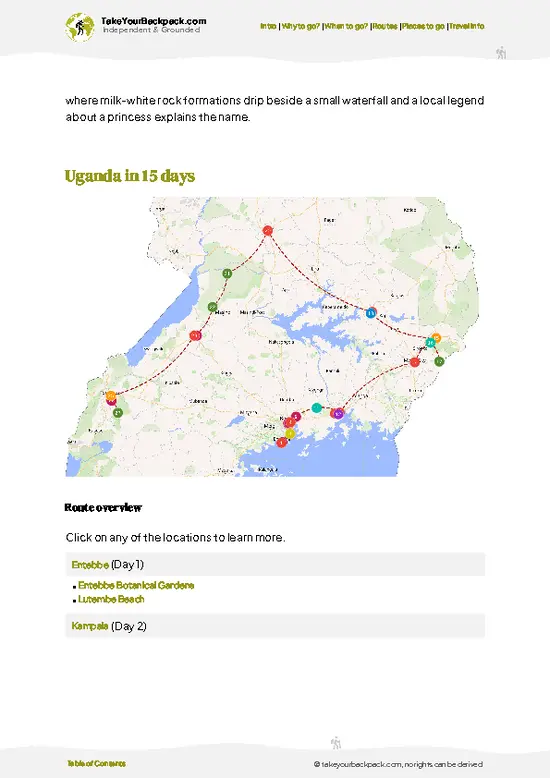
How long to allow: A trip linking several towns in Uganda needs 10 to 16 days to feel unhurried. Anything under a week turns into a blur of minibus seats. Loop the country in a rough circle, starting from Kampala or Entebbe, the main transport hub and the airport gateway.
Regions and direction: Group stops by region. The east (Jinja, Mbale area) pairs with Kampala in a half-day hop. The southwest (Kabale, Kisoro, Mbarara side) clusters tightly, and the west (Fort Portal and the crater lakes) links to it by road. Travel clockwise or counterclockwise and avoid doubling back through Kampala, since its traffic can add two hours or more to any exit. Going east first, then north to west, then south, then returning on the Mbarara to Kampala highway keeps the circuit clean.
Pacing and transfers: Give … read more 👉
How long to allow: A trip linking several towns in Uganda needs 10 to 16 days to feel unhurried. Anything under a week turns into a blur of minibus seats. Loop the country in a rough circle, starting from Kampala or Entebbe, the main transport hub and the airport gateway.
Regions and direction: Group stops by region. The east (Jinja, Mbale area) pairs with Kampala in a half-day hop. The southwest (Kabale, Kisoro, Mbarara side) clusters tightly, and the west (Fort Portal and the crater lakes) links to it by road. Travel clockwise or counterclockwise and avoid doubling back through Kampala, since its traffic can add two hours or more to any exit. Going east first, then north to west, then south, then returning on the Mbarara to Kampala highway keeps the circuit clean.
Pacing and transfers: Give each stop 2 to 3 nights, with a night extra where you plan a side trip. Typical transfers run 3 to 4 hours between neighboring regions, and Kampala to the far southwest takes 7 to 9 hours. Buses are cheaper, shared taxis faster, and both leave from crowded parks, so start before 8 a.m.
Planning mistakes: Travelers cram two long transfers into a single day, then arrive after dark. Spread them out. Many also treat map distances as reliable, yet rain, trucks and roadworks change everything. Build one buffer day per week, and book nothing rigid after a long drive.

The ListHighly Recommended towns of Uganda

1 Fort Portal

Tooro palace hill, botanical gardens, cathedral skyline

Climb Kabarole Hill for rooftop views, stroll the shaded botanical gardens, and browse the central market's piles of matoke, pineapples and tea.

2 Kisoro

Virunga skyline, Fossey-era hotel, border market

Watch Muhabura, Gahinga and Sabinyo line up behind the rooftops, then take afternoon tea in a colonial hotel once used by Dian Fossey.

uganda-city-kisoro
© Google |

3 Kabale

Terraced Kigezi hills, potato market, small museum

Browse stalls of potatoes and passion fruit, learn Bakiga history at the museum, and walk uphill roads for terrace views toward the Virungas.

4 Kapchorwa

Elgon escarpment, Arabica farms, Sebei culture

Look out over the plains from the edge of the escarpment, tour hand-roasted coffee farms, and arrange Mount Elgon climbs at the park office.

5 Moroto

Granite peak, Karamojong herders, bead markets

Hike Mount Moroto with a guide, wander a market of beads and sandals, and visit homesteads where herds return in the evening.

uganda-city-moroto
© Google |

6 Rukungiri

Kigezi tea hills, taxi-park grills, Nyamusingiri wetlands

Walk out among tea terraces and banana groves, bird the papyrus edges at dawn, and eat goat skewers beside the taxi park.

7 Kitgum

Acholi crafts, war memorials, Pece Hill

Trace the war years at local memorials, climb Pece Hill over tin roofs and plains, and buy woven baskets from women's groups.

8 Nebbi

Alur farmland, Lake Albert fish, dusk braziers

Taste charcoal-grilled tilapia at dusk, haggle with farmers over cassava and dried fish, and climb a hillside above iron roofs and mango trees.

uganda-city-nebbi
© Google |

9 Kanungu

Cult memorial, hill footpaths, Bwindi launch point

Visit the hilltop memorial where a church burned in 2000, then follow footpaths through terraced banana farms above the trading center.

10 Kamwenge

Kibale's quiet side, matooke market, dusk goat skewers

Stock up on fruit at the morning market, eat charcoal-grilled goat on the main street, and use the town as a base for forest-edge walks.

11 Amuria

Ateso hymns, ox-plow farmland, rolex stands

Wander a farming town of cassava piles and tailors' kiosks, then ride a boda out to granaries and oxen working the fields.

12 Bundibugyo

Cocoa and vanilla farms, Bwamba dance, Rwenzori foothills

Follow farmers through cocoa pods and vanilla vines, meet Bwamba performers, and look up to the Rwenzori slopes from the valley floor.

uganda-city-bundibugyo
© Google |

13 Bukedea

Teso granaries, wetland birds, evening grills

Walk lanes of thatched granaries, scan reedy wetlands at first light for herons and kingfishers, and finish at charcoal stalls on the main road.

14 Kotido

Karimojong beadwork, goat trade, manyatta visits

Watch goats and cattle change hands on the town edge, buy beadwork from the makers, and visit a thorn-fenced manyatta with a local guide.

15 Nakapiripirit

Pian Upe gateway, Tuesday livestock market, Karimojong plains

Meet traders at the weekly market, arrange permits for Pian Upe's roan antelope and ostrich, and watch herders pass along the main street.

16 Pader

Acholi kitchens, church choirs, rock outcrops

Eat malakwang and sesame paste at small kitchens, hear drumming and choirs on Sunday, and ride a boda past rock outcrops and farmland.

17 Buliisa

Lake Albert landings, dried fish, escarpment views

Catch canoes unloading on the Lake Albert shore, sample grilled tilapia with groundnut sauce, and watch the rift escarpment fall toward the water.

18 Kaberamaido

Kyoga papyrus shores, dugout canoes, Iteso homesteads

Reach papyrus-lined landing sites at dawn to see dugouts launch, then ride village tracks past cotton, millet and ox-plowed plots.

19 Kayunga

Pineapple farms, Bugerere farmland, rolex main street

Walk through pineapple rows, taste fresh fruit straight from farmers, and watch mosque and church quarters share the same quiet streets.

20 Kyenjojo

Highway bus stage, muchomo grills, tea-country produce

Pause at a busy crossroads of minibuses and vendors, eat skewers of grilled goat at dusk, and buy fresh matoke before moving on.

21 Yumbe

Muslim-majority district, murram hill tracks, chapati tea stalls

Sip sweet milky tea beside the taxi park, see the central mosque from outside, and ride red tracks toward views over the plains.

22 Mayuge

Wakawaka landing, Victoria island boats, smoked perch

Arrive at dawn as fishermen mend nets and load tilapia, then hire a wooden boat across Lake Victoria to island communities.

23 Zombo

West Nile highlands, Alur homesteads, ridge footpaths

Follow footpaths between banana plots and coffee gardens to ridge views, then learn how Alur neighbors prepare millet bread and groundnut paste.

24 Amudat

Livestock market, Pokot beadwork, dry-plains viewpoint

Watch herders trade cattle, goats and camels at dawn, then visit Pokot homesteads and climb the hospital hill for views across the plains.

Think you know Uganda?

Prove you’re a true local — uncover 14 lesser-known towns in Uganda that locals tend to keep to themselves.
Loading the map 🌍

Expert viewTips and Advice from Travelers

How many towns to visit: Aim for four to six towns on a two-week trip. Roads are slow, and each region needs a couple of nights for the area around it to make the journey pay off. Seven or more means you spend more hours on minibus benches than in town. Short on time, three well-chosen stops beat six rushed ones.
Choosing by travel style: Match the kind of town to your interest. Lakeside and river towns suit adventure seekers who want rafting, boat trips and easy nightlife with other travelers. Highland towns in the southwest and west suit hikers and wildlife seekers, because they sit near forests, crater lakes and gorilla and chimpanzee areas. Northern and eastern towns suit those who prefer fewer foreigners and more local rhythm, though transport is thinner and English less common. Culture-focused … read more 👉
How many towns to visit: Aim for four to six towns on a two-week trip. Roads are slow, and each region needs a couple of nights for the area around it to make the journey pay off. Seven or more means you spend more hours on minibus benches than in town. Short on time, three well-chosen stops beat six rushed ones.
Choosing by travel style: Match the kind of town to your interest. Lakeside and river towns suit adventure seekers who want rafting, boat trips and easy nightlife with other travelers. Highland towns in the southwest and west suit hikers and wildlife seekers, because they sit near forests, crater lakes and gorilla and chimpanzee areas. Northern and eastern towns suit those who prefer fewer foreigners and more local rhythm, though transport is thinner and English less common. Culture-focused travelers should weight towns near royal and clan sites in central Uganda.
What it costs: Budget travelers can manage US$25 to 40 a day on dorms or basic guesthouses (US$6 to 15), local meals (US$2 to 5), and shared transport. Mid-range comfort runs US$50 to 90. Boda-bodas inside towns cost roughly US$0.50 to 2 per ride, and minibus fares between regional centers often run US$3 to 12. Entry fees and guides add up fast: a village walk or crater-lake hike may cost US$10 to 30, while park permits, including gorilla and chimp tracking, run into the hundreds of dollars and should be budgeted separately. Agree prices before a ride starts, since fares for foreigners start high and drop with a calm counteroffer.
Safety on the ground: Towns are generally welcoming, but petty theft happens in crowded taxi parks and markets. Keep phones out of reach of open windows, carry only the cash you need, and use registered boda drivers or app rides such as SafeBoda in Kampala. Helmets are often missing, so ask for one, since road traffic is the biggest real risk. Avoid walking alone after dark in unlit areas, as streetlights are patchy.
Cultural considerations: Greetings matter. Start every exchange with a handshake and a proper hello, and ask permission before photographing people, markets or officials. Uganda’s laws on same-sex relations are harsh, so LGBTQ+ travelers should keep a low profile. Dress modestly, especially in rural and Muslim-majority areas, and carry small notes of Ugandan shillings, since mobile money (MTN, Airtel) is the norm and change can be scarce.

✈️ The backpacker research shortcutUganda Travel Guide

An offline-friendly backpacking guide with optimized travel routes, ranked highlights, transport advice, and the best areas to stay.
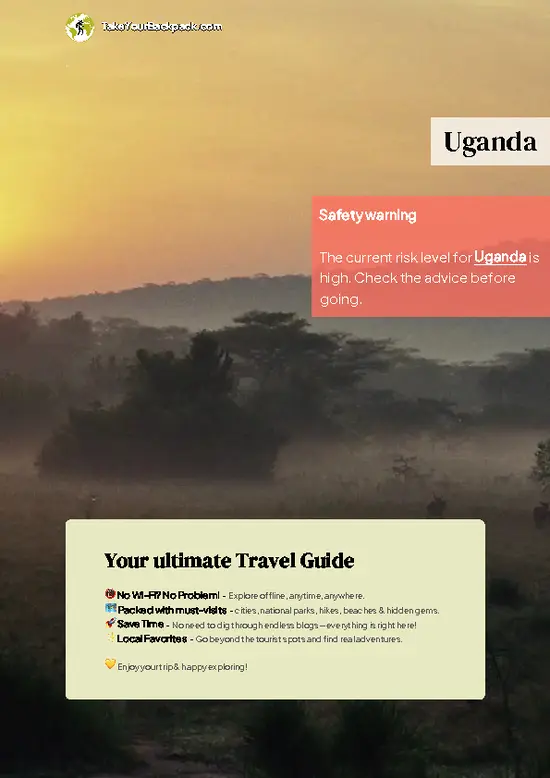
example page 0 from our offline Travel Guide for Uganda
example page 1 from our offline Travel Guide for Uganda
example page 2 from our offline Travel Guide for Uganda
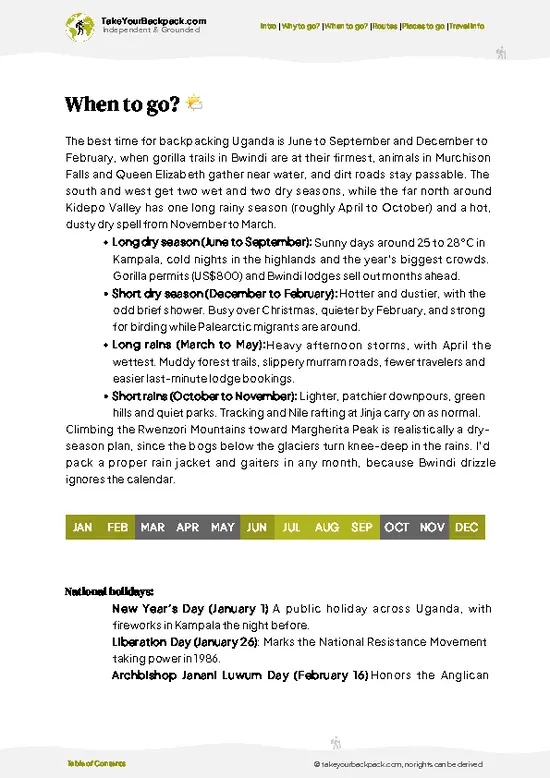
example page 3 from our offline Travel Guide for Uganda
example page 4 from our offline Travel Guide for Uganda
example page 5 from our offline Travel Guide for Uganda
example page 6 from our offline Travel Guide for Uganda
example page 7 from our offline Travel Guide for Uganda
The digital guide (372 pages) contains:
✅ 96 highlights, ranked by travel appeal
✅ Optimized 5, 10 & 15-day travel routes
✅ Cities, national parks, landmarks, beaches
✅ How to get around
✅ Offline-friendly for travel without Wi-Fi
👉 Click to see all 30+ guide features

📅 Plan smarter in minutes, not weeks
✅ Month by month travel advice
✅ Festivals & national holidays
✅ Budget expectations

🗺️ Go to the right places, skip the overrated ones
✅ Honest pros & cons of destinations
✅ Top hikes, parks & viewpoints
✅ Lesser-known places most travelers miss
✅ Clear “worth it vs skip it” guidance

🛏️ Travel smoothly without rookie mistakes
✅ Best areas to stay
✅ Transport systems explained simply
✅ Common scams & safety advice
✅ SIM cards, money & practical tips

🌍 Understand the country, not just visit it
✅ Culture & traditions
✅ 52 Essential phrases & customs
✅ Festivals worth planning around
✅ Traveler-friendly historical context
✅ Insights that make places more meaningful

📱 Built for real travel conditions
✅ Fully downloadable PDF
✅ Works completely offline
✅ Optimized for phone use
✅ Useful in remote areas & buses
✅ Everything in one place
Stop searching, start planning
Get instant access to your full guide. 30‑day money-back guarantee.
+ Add another guide for just

By proceeding you agree to our terms.
Sent to your inbox immediately after payment • 100% Secure Checkout
Best Backpacking Travel Advisor 2025 tourism awardBest Backpacking
Travel Advisor
2025
What others say about Take Your Backpack Guides:
⭐⭐⭐⭐⭐
Fantastic, amazing amount of information!
⭐⭐⭐⭐⭐
My goodness this is amazing, it's what I've been looking for hats off too you!
⭐⭐⭐⭐⭐
I think this is absolutely BRILLIANT
⭐⭐⭐⭐
Very complete and informative. It's still missing places, but I gotta to commend you
⭐⭐⭐⭐⭐
This is truly amazing, thank you, can't wait to explore it with my kids!
⭐⭐⭐⭐⭐
Awesome resource, thank you!
⭐⭐⭐⭐⭐
This is amazing! Can't wait to explore the ones I haven't seen
⭐⭐⭐⭐
I love this! Well done, great idea.
⭐⭐⭐⭐⭐
Thanks for taking the time to make this gem!
⭐⭐⭐⭐⭐
This might be the best website I've ever seen.
⭐⭐⭐⭐⭐
Congratulations, and thank you so much for your work; it's incredibly valuable.
⭐⭐⭐⭐
In all seriousness I think you did a great job pointing out the important spots
⭐⭐⭐⭐⭐
10/10 very good
⭐⭐⭐⭐⭐
As someone who's only just starting to visit regularly this is awesome, thank you.
⭐⭐⭐⭐
Thank you very much! I'm going to visit my dad, it's going to be very useful!
⭐⭐⭐⭐⭐
This is really cool! We'll be travelling for the first time and this definitely come in handy.
⭐⭐⭐⭐⭐
You are now our minister of culture, congratulations 👨‍💼
⭐⭐⭐⭐⭐
Just wanted to tell you that this is a pearl! Going to follow your recommendations.
⭐⭐⭐⭐⭐
This is so cool. I'll definitely be using the resource for my travels soon.
⭐⭐⭐⭐⭐
This is very impressive! Good work.
⭐⭐⭐⭐⭐
This is an amazing and informative site. Very well done!

🛏️ Where to stay?Accommodation Highlights

Uganda has a solid network of hostels and budget guesthouses, with dorm beds typically running UGX 35,000 to 70,000 (about US$10 to 20) and simple private rooms from roughly UGX 75,000 (US$20). In Kampala, Kabalagala and Kansanga along Ggaba Road put you closest to the city’s liveliest bar strip, though weekends get loud, while leafy Kololo and Bukoto are quieter and feel safer after dark but cost more and sit farther from cheap street food. Outside the capital, Entebbe is the calm pick for first and last nights near the airport, Jinja clusters its backpacker lodges on the Nile near the rafting operators, and Fort Portal works well as a cheap base for the crater lakes and Kibale.

If you enjoy … read more 👉
Uganda has a solid network of hostels and budget guesthouses, with dorm beds typically running UGX 35,000 to 70,000 (about US$10 to 20) and simple private rooms from roughly UGX 75,000 (US$20). In Kampala, Kabalagala and Kansanga along Ggaba Road put you closest to the city’s liveliest bar strip, though weekends get loud, while leafy Kololo and Bukoto are quieter and feel safer after dark but cost more and sit farther from cheap street food. Outside the capital, Entebbe is the calm pick for first and last nights near the airport, Jinja clusters its backpacker lodges on the Nile near the rafting operators, and Fort Portal works well as a cheap base for the crater lakes and Kibale.

If you enjoy meeting fellow travelers, consider choosing hostels with high ratings for atmosphere. On the other hand, if you prefer having your own space, a hotel might be a better option.

UgandaSee More of Uganda

👋 Meet the founderWho’s Behind Take Your Backpack?

Johan, backpacker and founder of TakeYourBackpackHi, I’m Johan (Netherlands 🇳🇱), the creator of TakeYourBackpack. Over the past 3 decades, I’ve backpacked through 90+ countries across six continents, gaining extensive experience with independent travel, long-term trips, and overland routes.

This site is built on a combination of firsthand travel experience and carefully curated insights from other backpackers. Many guides are based on places I’ve personally visited, while others bring together tips, observations, and practical advice shared by trusted travelers I’ve met along the way.

The goal is to provide realistic, experience-driven guidance — not generic itineraries — so you can explore destinations with better context, clearer expectations, and more confidence.