×
Uzbekistan🇺🇿 | 15 days itinerary

Uzbekistan in 15 Days

By Johan Kruseman 🇳🇱 | Updated May 6, 2026
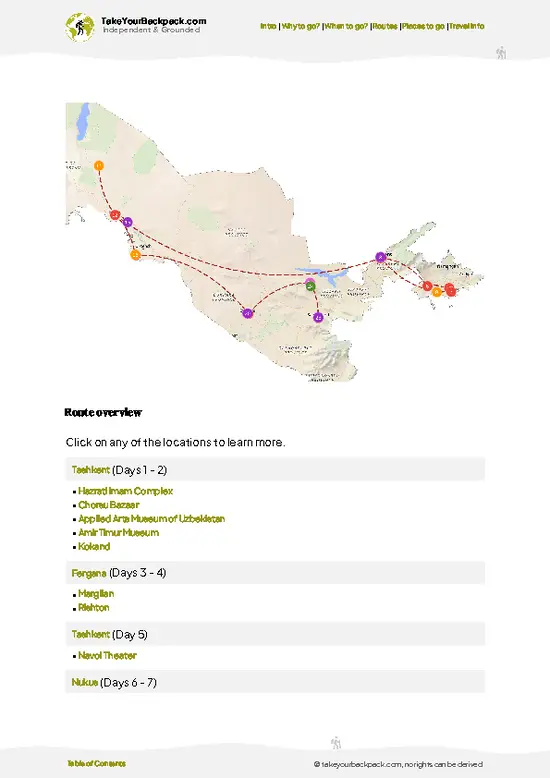
This 15-day route is for travelers who want to feel like they’ve actually crossed Uzbekistan, not just sampled it, with a mix of big-name Silk Road cities, desert relics, mountain air, and a few odd corners that most itineraries skip. The pace is steady but not frantic, using a combination of high-speed trains, one domestic flight or long overnight train, and shared taxis or marshrutkas to reach smaller towns and nature reserves.

Days 1-3: Tashkent & Western Tien-Shan Foothills

Begin in Tashkent, using two nights to get over the travel lag and tune into the country’s modern side before heading into the mountains. Ride the Tashkent Metro as both transport and sightseeing, then spend time at the Hazrati Imam Complex to see how religious life fits into this big, planned city. Balance that with the Applied Arts Museum of Uzbekistan and the State Museum of History of Uzbekistan, which together give you enough context that the rest of the trip feels like walking through a story you already half-know. … read more 👉
This 15-day route is for travelers who want to feel like they’ve actually crossed Uzbekistan, not just sampled it, with a mix of big-name Silk Road cities, desert relics, mountain air, and a few odd corners that most itineraries skip. The pace is steady but not frantic, using a combination of high-speed trains, one domestic flight or long overnight train, and shared taxis or marshrutkas to reach smaller towns and nature reserves.

Days 1-3: Tashkent & Western Tien-Shan Foothills

Begin in Tashkent, using two nights to get over the travel lag and tune into the country’s modern side before heading into the mountains. Ride the Tashkent Metro as both transport and sightseeing, then spend time at the Hazrati Imam Complex to see how religious life fits into this big, planned city. Balance that with the Applied Arts Museum of Uzbekistan and the State Museum of History of Uzbekistan, which together give you enough context that the rest of the trip feels like walking through a story you already half-know. On day three, head out toward the Chimgan Mountains and into Ugam-Chatkal National Park, where you can do short hikes, ride chairlifts, or just sit with a pot of tea looking at ridgelines instead of traffic lights.

Days 4-5: Zaamin National Park & Zomin Town - High Pines & Quiet Streets

Travel south to Zaamin National Park, one of the country’s best places for mountain walking without technical gear, and base yourself nearby for two nights. Days here are for hiking through juniper and pine forests, picnicking by streams, and watching shepherds move flocks across slopes that feel a world away from the capital. Drop into the small town of Zomin for supplies and a sense of everyday provincial life; the contrast between the park’s clean air and the town’s low-key bustle keeps this segment grounded and not just a nature escape bubble.

Days 6-7: Samarkand - The Classic Core

Head to Samarkand by road or train and give yourself two nights to hit the essentials with fresh eyes after your time in the hills. Start with the Registan Ensemble, then weave through Shah-i-Zinda Necropolis, the Gur-e-Amir Mausoleum, and the Bibi-Khanym Mosque, using your mountain-hardened legs to walk between them instead of hopping taxis. A visit to the Ulugh Beg Observatory rounds out the picture, reminding you that this was a place of astronomy and scholarship as much as imperial swagger, and the evenings are for slow dinners and people-watching rather than rushing to the next city.

Days 8-9: Nurata, Sentyab Village & Nuratau-Kyzylkum Biosphere Reserve

Leave the main rail line and head to Nurata, where the ruins and sacred spring mark the edge between settled lands and the steppe. Continue into the hills to stay in Sentyab Village, using it as a base to explore the Nuratau-Kyzylkum Biosphere Reserve with its mix of traditional villages, semi-wild landscapes, and trails that link orchards, streams, and viewpoints. This is where you slow down: walking between guesthouses, sharing meals with families, and getting a feel for how people actually live in the mountains instead of just passing through for a photo stop.

Days 10-11: Aydarkul Lake & Kyzylkum Desert Edge

From the foothills, drop down to Aydarkul Lake, where the waterline meets the Kyzylkum Desert and the horizon suddenly opens up. Spend a night or two in simple lakeside or yurt-style accommodation, using the days for walks along the shore, short camel rides if you want them, and long, quiet evenings under big skies. This segment is less about specific sights and more about giving your brain a break between history-heavy cities, so that when you move on, the mosques and madrasas feel sharp again instead of blending together.

Days 12-13: Bukhara & Gijduvan - Deep Silk Road Texture

Travel on to Bukhara and settle in for two nights in the old town, starting with the Ark of Bukhara to get your bearings from above. Wander down to the Po-i-Kalyan Ensemble, where the minaret and mosque define the skyline, then spend evenings around the Lyabi-Hauz Ensemble, letting the poolside scene and madrasa facades soak in slowly. Make time for Bukhara’s Samanid Mausoleum, whose intricate brick patterns reward close inspection, then take a side trip to Gijduvan to see ceramics being made in workshops that are more about craft than show. This combination of fortress, religious complex, subtle mausoleum, and working town gives you a layered sense of how Bukhara’s influence spread beyond its walls.

Days 14-15: Karakalpakstan, Nukus & Moynaq - Aral Sea Ghosts

Finish with a big swing northwest into Karakalpakstan, either by overnight train or a domestic flight to Nukus. Spend time in the Savitsky Karakalpakstan State Art Museum, where avant-garde Soviet art and regional pieces ended up far from Moscow’s gaze, turning this quiet city into one of Central Asia’s most surprising cultural stops. Then push on to Moynaq, once a fishing port on the Aral Sea and now a haunting landscape of stranded ships and desert where water used to be; walking among the rusting hulls and visiting the small local museum gives you a visceral sense of environmental change that no statistic can match. It’s a heavy but important way to end the trip, grounding all the beauty you’ve seen in the reality of how landscapes and livelihoods can shift within a single lifetime.


As a final bonus, consider a future loop out to the crumbling desert fortresses of Ayaz Kala, where mud-brick walls still watch over the sands in almost total silence.
Loading the map 🌍
film
0
0
0a
Zaamin
film
1
1
1a
Samarkand
Pixabay
film
2
2
2a
Nurata
film
3
3
3a
Aydarkul Lake
film
4
4
4a
Bukhara’s Samanid Mausoleum

✈️ The backpacker research shortcutUzbekistan Travel Guide

An offline-friendly backpacking guide with optimized travel routes, ranked highlights, transport advice, and the best areas to stay.
example page 0 from our offline Travel Guide for Uzbekistanexample page 1 from our offline Travel Guide for Uzbekistanexample page 2 from our offline Travel Guide for Uzbekistanexample page 3 from our offline Travel Guide for Uzbekistanexample page 4 from our offline Travel Guide for Uzbekistanexample page 5 from our offline Travel Guide for Uzbekistan
The digital guide (339 pages) contains:
110 highlights, ranked by travel appeal
Optimized 5, 10 & 15-day travel routes
Best neighborhoods to stay
How to get around
Offline-friendly for travel without Wi-Fi
👉 See all 30+ guide features

📅 Plan smarter in minutes, not weeks
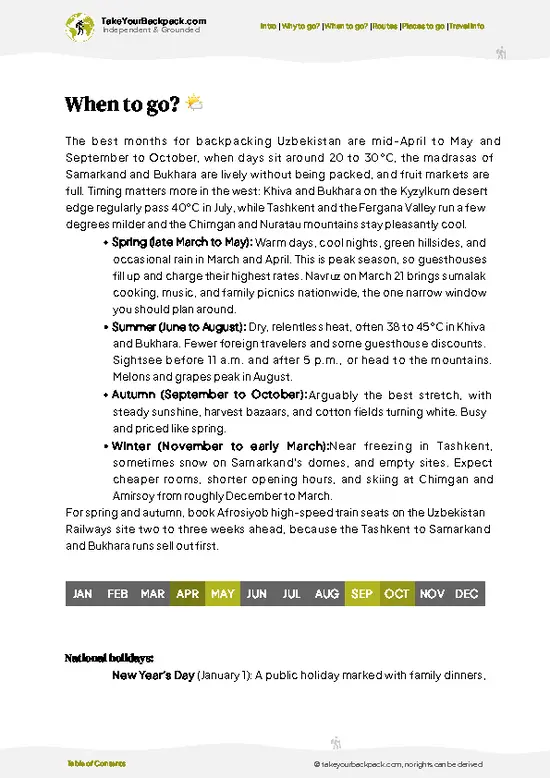
Month by month travel advice
Festivals & national holidays
Budget expectations

🗺️ Go to the right places, skip the overrated ones
Honest pros & cons of destinations
Top hikes, parks & viewpoints
Lesser-known places most travelers miss
Clear “worth it vs skip it” guidance

🛏️ Travel smoothly without rookie mistakes
Best areas to stay
Transport systems explained simply
Common scams & safety advice
SIM cards, money & practical tips

🌍 Understand the country, not just visit it
Culture & traditions
52 Essential phrases & customs
Festivals worth planning around
Traveler-friendly historical context
Insights that make places more meaningful

📱 Built for real travel conditions
Fully downloadable PDF
Works completely offline
Optimized for phone use
Useful in remote areas & buses
Everything in one place
Save weeks of stressful planning
Get instant access to the full guide directly. 30-day money-back guarantee.


Sent to your inbox immediately after payment • 100% Secure Checkout
Best Backpacking Travel Advisor 2025 tourism awardBest Backpacking
Travel Advisor
2025
What others say about Take Your Backpack Guides:
⭐⭐⭐⭐⭐
Fantastic, amazing amount of information!
⭐⭐⭐⭐⭐
My goodness this is amazing, it's what I've been looking for hats off too you!
⭐⭐⭐⭐⭐
I think this is absolutely BRILLIANT
⭐⭐⭐⭐
Very complete and informative. It's still missing places, but I gotta to commend you
⭐⭐⭐⭐⭐
This is truly amazing, thank you, can't wait to explore it with my kids!
⭐⭐⭐⭐⭐
Awesome resource, thank you!
⭐⭐⭐⭐⭐
This is amazing! Can't wait to explore the ones I haven't seen
⭐⭐⭐⭐
I love this! Well done, great idea.
⭐⭐⭐⭐⭐
Thanks for taking the time to make this gem!
⭐⭐⭐⭐⭐
This might be the best website I've ever seen.
⭐⭐⭐⭐⭐
Congratulations, and thank you so much for your work; it's incredibly valuable.
⭐⭐⭐⭐
In all seriousness I think you did a great job pointing out the important spots
⭐⭐⭐⭐⭐
10/10 very good
⭐⭐⭐⭐⭐
As someone who's only just starting to visit regularly this is awesome, thank you.
⭐⭐⭐⭐
Thank you very much! I'm going to visit my dad, it's going to be very useful!
⭐⭐⭐⭐⭐
This is really cool! We'll be travelling for the first time and this definitely come in handy.
⭐⭐⭐⭐⭐
You are now our minister of culture, congratulations 👨‍💼
⭐⭐⭐⭐⭐
Just wanted to tell you that this is a pearl! Going to follow your recommendations.
⭐⭐⭐⭐⭐
This is so cool. I'll definitely be using the resource for my travels soon.
⭐⭐⭐⭐⭐
This is very impressive! Good work.
⭐⭐⭐⭐⭐
This is an amazing and informative site. Very well done!

🧭 RouteGot More or Less Time?

Travel Uzbekistan your way — from a quick highlights trip to a slow-paced adventure.

🙋 FAQCommon Questions

Short answer: yes, Uzbekistan is one of the easier Central Asian countries to backpack independently, especially for first-timers to the region.

Why it’s doable:
- Visa: Many nationalities now get visa-free entry or easy e-visa, which removes the old bureaucratic headache.
- Safety: Streets in the main cities feel safe, even at night, and petty crime against tourists is relatively low compared with many popular backpacking regions.
- Clear route: The classic route (Tashkent – Samarkand – Bukhara – Khiva – Nukus/Aral Sea) is straightforward, with well-trodden transport links and hostels.
- Accommodation: Hostels and guesthouses are common in major stops, with dorms and simple privates that work for backpacker budgets.

What’s slightly tricky:
- Language: Russian and Uzbek dominate; English is limited outside hostels and tourist sights. Offline translation apps and screenshots of key phrases help a lot.
- Cash vs card: Cards are accepted more than they used to be, but you still want a good amount of cash. ATMs exist in cities but can be patchy; always withdraw when you see a reliable bank ATM.
- Train tickets: Popular trains (especially fast trains between Tashkent–Samarkand–Bukhara) can sell out. Buying a few days ahead, or being flexible with slower trains, keeps things smooth.

Backpacker-friendly tips:
- Travel with an offline map app and download city maps in advance.
- Book your first and last nights in each city; leave the middle flexible.
- Learn a handful of Russian or Uzbek words (numbers, directions, basic food) to make markets, marshrutkas, and homestays easier.
- Expect simple but hearty food and lots of bread and tea; vegetarians can manage but need to be a bit proactive.

If you’ve handled Southeast Asia or Eastern Europe independently, Uzbekistan will feel different but absolutely manageable with a bit of prep and patience.
For a solid backpacking trip that doesn’t feel rushed, 10–14 days is the sweet spot. You can do less, but you’ll be trading depth for checklists.

Rough timing guide:
- 5–7 days (fast track): Tashkent + Samarkand + Bukhara
- Tashkent: 1–2 days for markets, metro, and a soft landing.
- Samarkand: 2–3 days for the big monuments plus some quieter neighborhoods.
- Bukhara: 2 days wandering the old town and courtyards.
This works if you’re on a tight schedule or combining Uzbekistan with another country.

- 10–14 days (ideal classic route): Tashkent + Samarkand + Bukhara + Khiva (+ maybe Nukus)
- Tashkent: 1–2 days.
- Samarkand: 3 days (one full day just to wander without a checklist).
- Bukhara: 2–3 days.
- Khiva: 2–3 days, including at least one evening and early morning inside the old walls.
- Optional Nukus/Aral Sea: 2–3 days if you’re curious about Soviet-era art and environmental history.

- 2–3 weeks (slow and rich): Add side trips and smaller towns
- Fergana Valley (Kokand, Fergana, Margilan) for crafts and a more local feel.
- Mountain escapes near Tashkent (Chimgan/Charvak area) for day hikes.
- Extra time in each city to linger in chaikhanas (teahouses), bazaars, and backstreets.

If you’re a budget traveler, more time usually means better value: you can take slower, cheaper trains, negotiate longer stays in guesthouses, and avoid paying extra for rushed private transfers.
You can absolutely get around Uzbekistan without a car, and most backpackers do exactly that.

Main options:
- Trains: The backbone of a budget trip.
- High-speed trains (Afrosiyob) link Tashkent–Samarkand–Bukhara quickly and comfortably, but tickets can sell out.
- Slower trains are cheaper, more available, and a bit of an experience; they just take longer.
- Book in advance when possible, especially for weekends and holidays.

- Shared taxis (marshrutka-style cars):
- Fill up with passengers and leave when full; common between cities and to smaller towns.
- Cheap and frequent, but comfort varies; you trade legroom for flexibility.
- Good for routes like Bukhara–Khiva (via Urgench) or shorter hops where trains are inconvenient.

- Marshrutkas and city buses:
- Inside cities, these are the cheapest way to move around.
- Routes can be confusing without language skills, but hostel staff usually know the key numbers.

- Domestic flights:
- Sometimes useful for long jumps (e.g., Tashkent–Nukus) if you’re short on time and have a bit more budget.
- Not necessary for a classic overland route if you have 10+ days.

- Walking:
- Old towns in Samarkand, Bukhara, and Khiva are very walkable; you’ll mostly be on foot once you arrive.

Backpacker strategy:
- Use trains for the big hops, shared taxis for gaps, and your feet for the old towns.
- Keep small bills handy for local buses and marshrutkas.
- Download offline maps and pin train stations, shared taxi stands, and your accommodation in each city so you’re not negotiating directions every time.
If it’s your first time and you’re traveling on a backpacker budget, these are the places that earn their spot on almost every itinerary:

1. Tashkent
- Why go: It’s your entry point and a crash course in modern Uzbekistan: Soviet-era architecture, wide avenues, and big bazaars.
- Highlights for backpackers:
- Chorsu Bazaar for cheap eats and people-watching.
- The metro system with its elaborate stations.
- A mix of Soviet blocks and older mahallas if you wander beyond the main sights.

2. Samarkand
- Why go: This is the postcard city, and it actually lives up to the hype.
- Highlights:
- Registan at different times of day (especially early morning and evening).
- Shah-i-Zinda necropolis with its tilework and hillside views.
- Side streets and residential areas where daily life runs right up against the monuments.

3. Bukhara
- Why go: More compact and atmospheric than Samarkand, easier to explore slowly on foot.
- Highlights:
- Po-i-Kalyan complex and the surrounding lanes.
- Lyabi-Hauz area for evening tea and people-watching.
- Rooftop viewpoints (often from guesthouses) for sunset over the old town.

4. Khiva
- Why go: The old walled city feels like a living open-air museum, especially in the early morning and at night when day-trippers vanish.
- Highlights:
- Walking the city walls at sunset.
- Getting lost in the alleys inside the Itchan Kala.
- Climbing a minaret or tower for a 360-degree view of mud-brick roofs and desert horizon.

5. Optional but strong contenders if you have extra time:
- Nukus and the Aral Sea area
- For Soviet art at the Savitsky Museum and a sobering look at environmental disaster.
- Fergana Valley (Kokand, Margilan, Fergana)
- For crafts (especially silk in Margilan) and a more everyday, less tourist-focused slice of Uzbekistan.

If you’re short on time or money, prioritize Samarkand, Bukhara, and Khiva, then add Tashkent and one extra region if your schedule allows.
If you’re tight on time or cash, you don’t need to see everything. Focus on what Uzbekistan does best: historic Silk Road cities and a bit of local daily life. Here’s what you can reasonably skip or downsize:

1. Rushing every museum
- Many museums have similar artifacts and can feel repetitive if you’re not a hardcore history buff.
- Strategy: Pick one or two that genuinely interest you (for example, Savitsky Museum in Nukus if you go there, or one main history museum in a city) and skip the rest. Spend the saved time wandering bazaars and backstreets.

2. Overpriced tourist restaurants in old towns
- In Samarkand, Bukhara, and Khiva, some central restaurants charge a premium for location.
- Strategy: Eat one or two meals for the view if you want, then shift to simpler local places a few blocks away or near markets for better prices and more local atmosphere.

3. Extra nights in Tashkent
- Tashkent is interesting, but it’s not the main reason you came.
- Strategy: 1–2 nights is usually enough for most backpackers. If you’re short on time, don’t linger here; push that extra day to Bukhara or Khiva.

4. Trying to do both Fergana Valley and Nukus/Aral Sea on a short trip
- Both regions are worthwhile, but they’re in opposite directions and add big travel days.
- Strategy: With less than 12–14 days, pick one side trip or skip both and focus on the main Silk Road triangle (Samarkand–Bukhara–Khiva). You’ll save money on long transfers and avoid burnout.

5. Overcomplicating mountain trips
- Day trips to mountain areas near Tashkent can be fun, but they eat time with transport and often require private cars or tours.
- Strategy: If you only have a week, skip big mountain detours. Use that time to slow down in the cities instead of sprinting between landscapes.

If you’re really squeezed, the core that gives you the best sense of Uzbekistan on a backpacker budget is: a short stop in Tashkent, then Samarkand, Bukhara, and Khiva. Everything else is a bonus, not a requirement.

🇺🇿 UzbekistanWhere to Go Next

Ready to build a truly unique trip? Predefined routes are perfect for first-time visitors, but there is so much more to discover. Whether you are chasing a city trip, pristine national parks, local food scenes, or quiet beaches, pick a category to design your own path.