×
Guyana🇬🇾 | 15 days itinerary

Your 15-Day Guyana Itinerary

By Johan Kruseman 🇳🇱 | Updated May 7, 2026
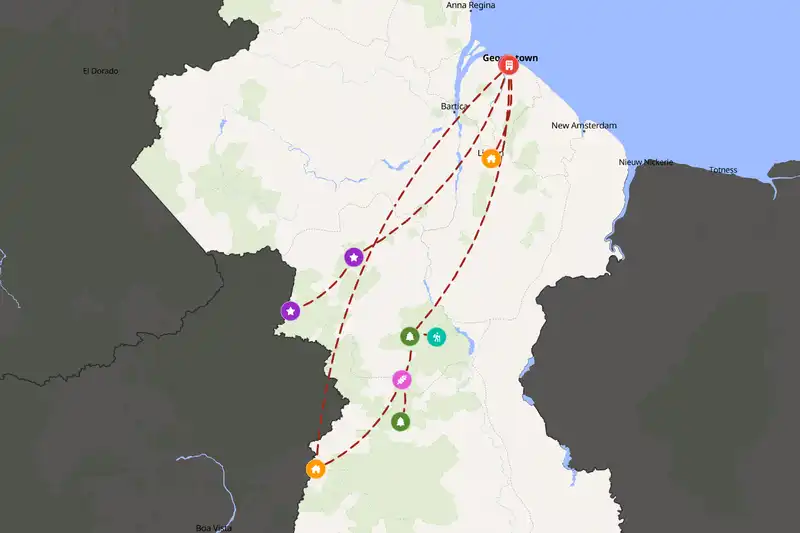
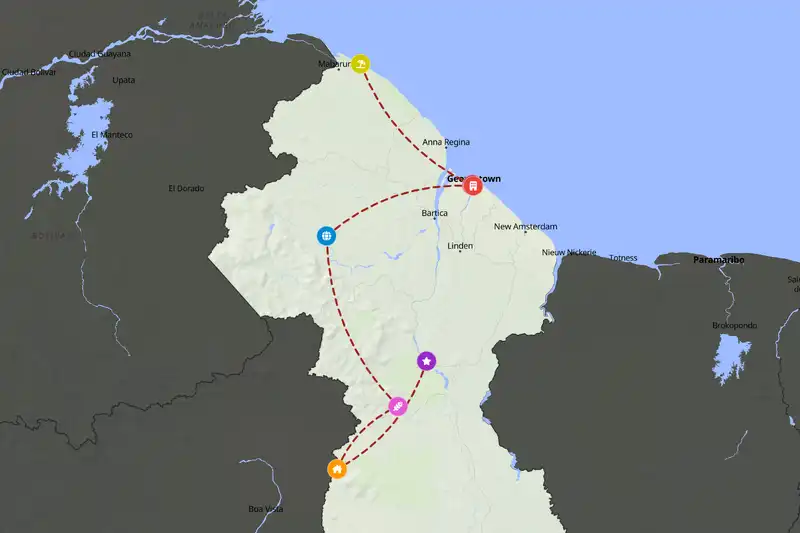
This 15-day route is for travelers who want to really sink into Guyana’s rhythm: rainforest, waterfalls, river villages, and wide-open savannahs, with enough time to recover between long travel days. You’ll mix domestic flights, 4x4 transfers, and river boats, but the itinerary is built around multi-night stays so you can unpack, breathe, and actually get to know each place.

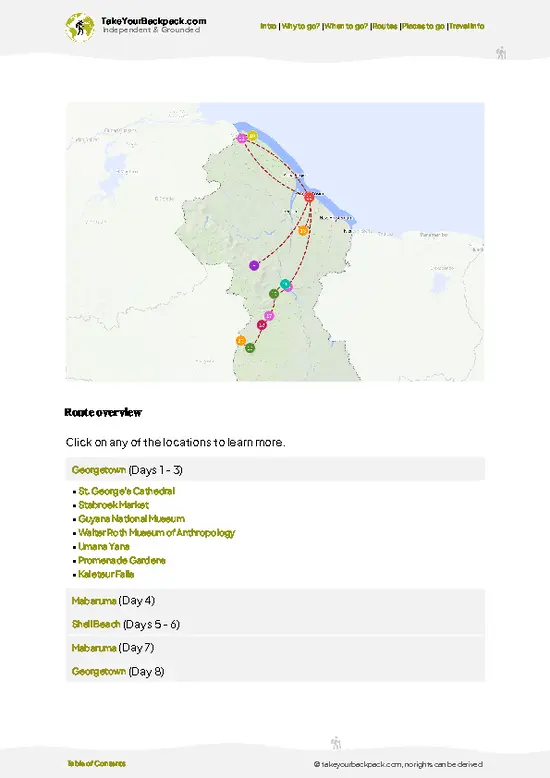
Days 1-3: Georgetown’s heritage and coastal culture

Start with three nights in Georgetown to adjust to the climate and get under the skin of the capital instead of just skimming it. Walk through St. George’s Cathedral, the Guyana National Museum, and the Walter Roth Museum of Anthropology to understand how Indigenous, African, Indian, and European threads all show up in daily life. Use cooler hours to wander Promenade Gardens, check out Umana Yana, and swing by the Parliament Building for a sense of the city’s colonial bones. If you’re curious about wildlife in a more controlled setting before heading inland, you can … read more 👉
This 15-day route is for travelers who want to really sink into Guyana’s rhythm: rainforest, waterfalls, river villages, and wide-open savannahs, with enough time to recover between long travel days. You’ll mix domestic flights, 4x4 transfers, and river boats, but the itinerary is built around multi-night stays so you can unpack, breathe, and actually get to know each place.

Days 1-3: Georgetown’s heritage and coastal culture

Start with three nights in Georgetown to adjust to the climate and get under the skin of the capital instead of just skimming it. Walk through St. George’s Cathedral, the Guyana National Museum, and the Walter Roth Museum of Anthropology to understand how Indigenous, African, Indian, and European threads all show up in daily life. Use cooler hours to wander Promenade Gardens, check out Umana Yana, and swing by the Parliament Building for a sense of the city’s colonial bones. If you’re curious about wildlife in a more controlled setting before heading inland, you can spend a short visit at the Guyana Zoo, then retreat to a breezy veranda with a cold drink and let the city’s rhythm sink in.

Days 4-5: Kaieteur and Orinduik - the waterfall arc

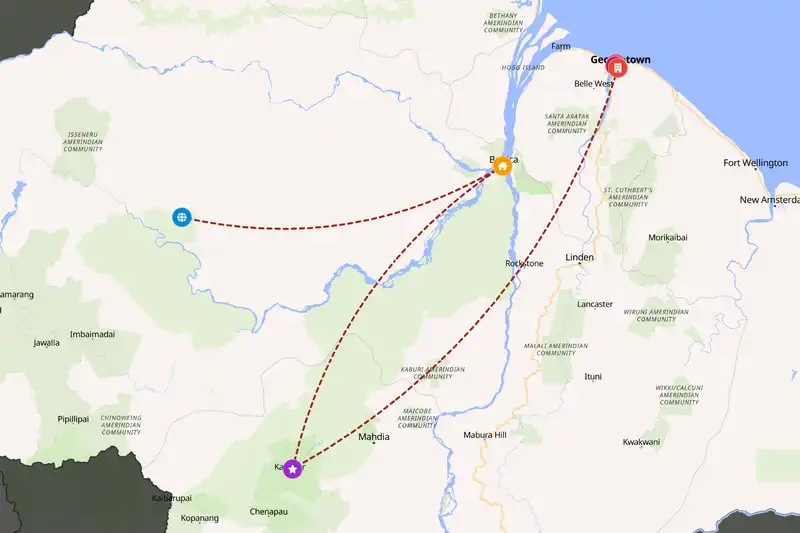
With your urban bearings set, pivot to Guyana’s headline natural showpieces: Kaieteur National Park and Kaieteur Falls, followed by Orinduik Falls. A small-plane flight from Georgetown drops you into the interior, where you’ll hike between Kaieteur’s viewpoints and feel the spray and low thunder of the falls without the overbuilt infrastructure you’d find in more famous destinations. Continue on to Orinduik Falls, where the terraced rock and gentler flow make it ideal for swimming and just lying in the water, then return to Georgetown with your first big interior hit under your belt.

Days 6-8: Iwokrama Forest, canopy life, and Surama

Head inland to the Iwokrama Forest Reserve for three nights, giving yourself time to experience the forest at different hours instead of rushing through. Spend one morning and evening on the Iwokrama Canopy Walkway Trail, watching the forest wake up and wind down from above the treeline, and another day exploring river channels and forest trails at ground level. Dedicate a full day to Surama Village, where community guides lead you through forest walks, wildlife spotting, and village life, and where you can see how tourism revenue feeds directly back into local schools and projects.

Days 9-11: Annai, Rupununi Savannah, and ranch life

Shift south into the Rupununi Savannah, basing yourself around Annai for a few days of big-sky landscapes and slower travel. Use your time here to explore the savannah by vehicle or on foot, watching the light change over termite mounds and gallery forests, and consider day visits to nearby ranches like Karanambu Ranch or Dadanawa Ranch if logistics and budgets line up, focusing on wildlife, river trips, or just the feel of remote ranch life. Keep the pace gentle: sunrise outings, long midday breaks, and late-afternoon walks when the heat eases and the sky starts to glow.

Days 12-15: Lethem, Kumu Falls, and border-town downtime

Continue south to Lethem, the main town in the region and your base for exploring the southern savannahs and nearby waterfalls. Spend a day cooling off at Kumu Falls, where you can swim, scramble over rocks, and picnic in the shade, then use another day to simply wander Lethem’s streets, markets, and viewpoints, soaking up the cross-border energy with Brazil. If you want one more taste of rural life, detour to Aishalton or another Wapishana community in the wider Rupununi Savannah region, then wrap the trip by flying or driving back toward Georgetown with a head full of forest, falls, and wide-open grasslands.


For an extra-deep future adventure once you’ve mastered this loop, consider a multi-day expedition to the remote Pakaraima Mountains, where tiny villages and cloud-wrapped ridges feel like a different country entirely.
Loading the map 🌍
film
0
0
0a
Georgetown
Abdelmajid Ouazine
film
1
1
1a
St. George’s Cathedral
film
2
2
2a
Guyana National Museum
film
3
3
3a
Walter Roth Museum of Anthropology
film
4
4
4a
Umana Yana
film
5
5
5a
Guyana Zoo
film
6
6
6a
Kaieteur
Jun Yokoyama
film
7
7
7a
Kaieteur Falls
Randolfo Santos
film
8
8
8a
Orinduik Falls
film
9
9
9a
Aishalton

✈️ The backpacker research shortcutGuyana Travel Guide

An offline-friendly backpacking guide with optimized travel routes, ranked highlights, transport advice, and the best areas to stay.
example page 0 from our offline Travel Guide for Guyanaexample page 1 from our offline Travel Guide for Guyanaexample page 2 from our offline Travel Guide for Guyanaexample page 3 from our offline Travel Guide for Guyanaexample page 4 from our offline Travel Guide for Guyanaexample page 5 from our offline Travel Guide for Guyana
The digital guide (179 pages) contains:
46 highlights, ranked by travel appeal
Optimized 5, 10 & 15-day travel routes
Best neighborhoods to stay
How to get around
Offline-friendly for travel without Wi-Fi
👉 See all 30+ guide features

📅 Plan smarter in minutes, not weeks
Month by month travel advice
Festivals & national holidays
Budget expectations

🗺️ Go to the right places, skip the overrated ones
Honest pros & cons of destinations
Top hikes, parks & viewpoints
Lesser-known places most travelers miss
Clear “worth it vs skip it” guidance

🛏️ Travel smoothly without rookie mistakes
Best areas to stay
Transport systems explained simply
Common scams & safety advice
SIM cards, money & practical tips

🌍 Understand the country, not just visit it
Culture & traditions
Local customs
Festivals worth planning around
Traveler-friendly historical context
Insights that make places more meaningful

📱 Built for real travel conditions
Fully downloadable PDF
Works completely offline
Optimized for phone use
Useful in remote areas & buses
Everything in one place
Save weeks of stressful planning
Get instant access to the full guide directly. 30-day money-back guarantee.


Sent to your inbox immediately after payment • 100% Secure Checkout
Best Backpacking Travel Advisor 2025 tourism awardBest Backpacking
Travel Advisor
2025
What others say about Take Your Backpack Guides:
⭐⭐⭐⭐⭐
Fantastic, amazing amount of information!
⭐⭐⭐⭐⭐
My goodness this is amazing, it's what I've been looking for hats off too you!
⭐⭐⭐⭐⭐
I think this is absolutely BRILLIANT
⭐⭐⭐⭐
Very complete and informative. It's still missing places, but I gotta to commend you
⭐⭐⭐⭐⭐
This is truly amazing, thank you, can't wait to explore it with my kids!
⭐⭐⭐⭐⭐
Awesome resource, thank you!
⭐⭐⭐⭐⭐
This is amazing! Can't wait to explore the ones I haven't seen
⭐⭐⭐⭐
I love this! Well done, great idea.
⭐⭐⭐⭐⭐
Thanks for taking the time to make this gem!
⭐⭐⭐⭐⭐
This might be the best website I've ever seen.
⭐⭐⭐⭐⭐
Congratulations, and thank you so much for your work; it's incredibly valuable.
⭐⭐⭐⭐
In all seriousness I think you did a great job pointing out the important spots
⭐⭐⭐⭐⭐
10/10 very good
⭐⭐⭐⭐⭐
As someone who's only just starting to visit regularly this is awesome, thank you.
⭐⭐⭐⭐
Thank you very much! I'm going to visit my dad, it's going to be very useful!
⭐⭐⭐⭐⭐
This is really cool! We'll be travelling for the first time and this definitely come in handy.
⭐⭐⭐⭐⭐
You are now our minister of culture, congratulations 👨‍💼
⭐⭐⭐⭐⭐
Just wanted to tell you that this is a pearl! Going to follow your recommendations.
⭐⭐⭐⭐⭐
This is so cool. I'll definitely be using the resource for my travels soon.
⭐⭐⭐⭐⭐
This is very impressive! Good work.
⭐⭐⭐⭐⭐
This is an amazing and informative site. Very well done!

🧭 RouteGot More or Less Time?

Travel Guyana your way — from a quick highlights trip to a slow-paced adventure.

🙋 FAQCommon Questions

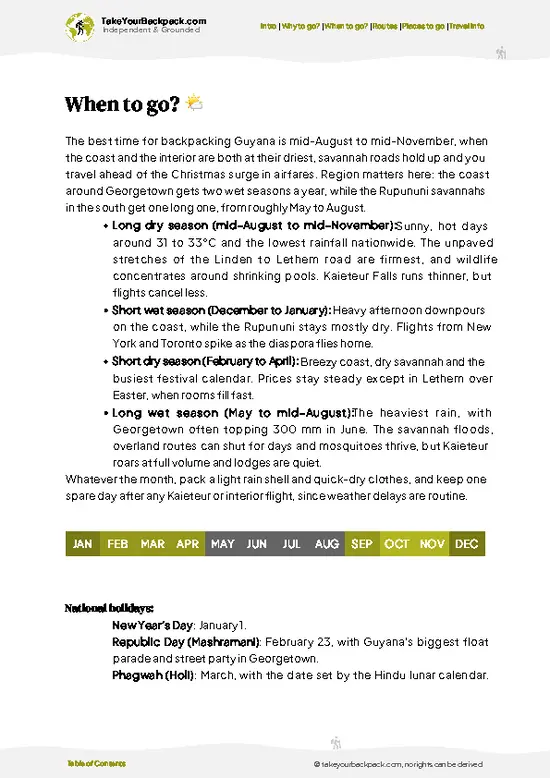
Short version: Guyana is doable to backpack independently, but it’s not an easy starter country. It’s more “frontier logistics puzzle” than “hop-on-hop-off Southeast Asia.”

The coast (especially Georgetown and along the main highway) is straightforward: English is the official language, people are helpful, and you’ll find minibuses, cheap guesthouses, and food stalls without much drama. This is where solo budget travel feels simple.

The interior is the challenge. Distances are huge, roads are rough laterite, and public transport is limited and informal. You’ll often rely on:
- Shared 4x4s and minibuses that leave when full, not on a fixed schedule.
- River boats in some areas.
- Small planes for certain routes if you’re short on time.

Independent doesn’t always mean “no tour” here. For deep rainforest, Amerindian villages, and big-ticket sights like Kaieteur Falls, you usually need to book a tour, charter a vehicle, or arrange things through a local lodge or community. You can still keep it budget-conscious by:
- Teaming up with other travelers to split 4x4 or boat costs.
- Using community-run lodges instead of high-end eco-resorts.
- Traveling slowly and being flexible with dates so you can catch shared transport instead of private hires.

Safety-wise, the main risks are road conditions, river travel, and being stuck somewhere with no onward ride, not violent crime. In Georgetown, use normal big-city street sense: avoid flashing valuables, be cautious at night, and use trusted taxis.

If you’re comfortable with uncertainty, rough roads, and basic infrastructure, backpacking Guyana independently is incredibly rewarding. If you need fixed schedules, easy ATMs, and constant Wi‑Fi, it will feel frustrating fast.
For a first-time backpacking trip, 10–14 days is the minimum that feels worthwhile; 3 weeks is the sweet spot if you want both coast and interior without rushing.

Rough breakdowns that actually work on a backpacker budget:

7 days (tight, but possible)
- 1–2 days: Georgetown and nearby day trips (markets, sea wall, maybe a cheap city tour).
- 1 day: Kaieteur Falls day trip by plane (expensive but world-class; this will likely be your big splurge).
- 3–4 days: One interior base, like Iwokrama / Surama area or Lethem / Rupununi savannah, reached by overnight bus or shared 4x4.
This is rushed and transport delays will hurt, but it’s enough to taste both city and interior.

10–14 days (solid first trip)
- 2–3 days: Georgetown + coastal villages (like Mahaica for wildlife or simple beach time at 63 Beach in Berbice if you’re curious).
- 1 day: Kaieteur Falls or another big nature day trip.
- 5–8 days: Interior loop: Iwokrama rainforest, Surama or another Amerindian village stay, maybe continue to Lethem and the Rupununi, then back.
This gives you time to wait for shared transport, deal with weather, and not sprint through every stop.

3 weeks (ideal for backpackers)
- 3–4 days: Coast and Georgetown, including markets, street food, and a couple of low-cost day trips.
- 10–12 days: Slow interior travel: Iwokrama, Surama, Annai, Rupununi savannah, maybe Karanambu or another wildlife-focused lodge if you can find a budget-friendly option.
- 2–3 days: Buffer for delays, extra time in a village you like, or a second attempt at a weather-dependent activity.

Because transport is slow and often leaves “when full,” you always want at least one buffer day in your itinerary. Guyana rewards people who can say, “Okay, the truck didn’t leave today, I’ll just stay one more night and go birdwatching instead.”
You can get around Guyana without renting a car, but you can’t treat it like a country with dense, predictable public transport. Think “network of shared rides” more than “bus system.”

On the coast
- Minibuses: Cheap, frequent, and the main way locals move between Georgetown and coastal towns. They leave when full, are often cramped, and drivers can be aggressive, but they’re very budget-friendly.
- Taxis: Essential in Georgetown, especially at night or with luggage. Agree on a price before you get in or use a known dispatcher.
- Walking: Fine in daylight in busy areas; at night, stick to taxis.

To and within the interior
- Shared 4x4s and minibuses: These run the Georgetown–Lethem road and some interior routes. They’re rough, overnight, and can be delayed by rain and road conditions, but they’re the cheapest way to cross big distances.
- Domestic flights: Small planes connect Georgetown with interior airstrips (e.g., for Kaieteur or some lodges). They’re pricey but save days of travel and are sometimes the only realistic option if you’re on a tight schedule.
- Boats: In river areas, you’ll use small motorized boats arranged through local operators or communities. These are usually organized as part of a lodge stay or tour, not as casual “public ferries.”

How to make it work on a backpacker budget
- Be flexible with dates so you can join existing vehicles instead of paying for private hires.
- Ask guesthouses, local shops, and police outposts about the next ride; word-of-mouth is often better than any schedule.
- Travel light so you can squeeze into whatever seat is available.

You absolutely do not need your own car, but you do need patience, a willingness to be uncomfortable on long rides, and a mindset that treats transport as part of the adventure, not just a chore.
For budget travelers, the must-visits in Guyana are the places that give you maximum nature, culture, and “only-in-Guyana” moments for each dollar and hour you spend.

1. Kaieteur Falls
If you splurge on one thing, make it this. It’s one of the most powerful single-drop waterfalls on Earth, and the experience is surprisingly low-key: no huge crowds, just a small group, a short walk, and raw jungle around you. The day trip by small plane from Georgetown isn’t cheap, but it’s a global-level sight that justifies the cost.

2. Iwokrama Rainforest
This is your gateway to serious jungle without needing a full expedition budget. Highlights for backpackers:
- Canopy walkway for wildlife and sunrise views.
- Night drives for spotting caimans and other creatures.
- River trips where you might see giant river otters and loads of birds.
You can often arrange more basic, cheaper accommodation or community options if you ask around instead of defaulting to the priciest lodge.

3. Surama or another Amerindian village stay
Staying in an indigenous community is one of the best-value experiences in Guyana. You usually get:
- Simple lodging (hammock or basic room).
- Home-cooked food.
- Guided walks, wildlife spotting, and cultural activities.
Money goes directly to the community, and you get a grounded sense of life in the interior.

4. Rupununi savannah (around Lethem)
The Rupununi feels like a wild, open frontier: wide skies, scattered ranches, and a mix of Brazilian and Guyanese culture. For backpackers:
- You can base yourself in Lethem (border town with Brazil) and do day trips or short stays at nearby ranches or villages.
- It’s a good place to link your Guyana trip with overland travel into Brazil.

5. Georgetown (1–2 days)
Not everyone falls in love with Georgetown, but it’s worth a short stay to understand the country:
- Stabroek Market and other local markets for food and people-watching.
- Colonial-era wooden architecture and churches.
- Sea wall walks in the late afternoon.
Keep your expectations realistic: it’s rough around the edges, but it’s where you feel the mix of Afro-Guyanese, Indo-Guyanese, and other communities that define the country.

If you hit Kaieteur, at least one interior rainforest area, one village stay, and give Georgetown a day or two, you’ve covered the core of what makes Guyana special.
If you’re short on time or money, skip anything that eats days of travel without giving you a new type of experience. Guyana is huge, and trying to “do it all” will just turn your trip into a transport marathon.

1. Multiple interior lodges that offer similar activities
If two places both offer jungle walks, canopy views, and river trips, pick one and do it well instead of bouncing between three different lodges. Each transfer is expensive and time-consuming.

2. Long, low-reward coastal detours
The coast outside of specific wildlife or cultural stops is mostly flat farmland, small towns, and muddy Atlantic shoreline. Unless you have a clear reason (like a known birding spot or visiting friends), you can skip long side trips up and down the coast and focus on:
- Georgetown + one or two targeted day trips instead of a full coastal tour.

3. Trying to see “all three Guianas” in one short trip
If you only have 1–2 weeks, don’t burn days on border crossings just to tick off Suriname and French Guiana. Each crossing involves paperwork, transport juggling, and extra costs. Better to go deep in Guyana than shallow in all three.

4. High-end eco-resorts that duplicate cheaper community experiences
Some luxury lodges are fantastic but can swallow half your budget in two nights. If you’re counting every dollar, skip the ultra-luxury spots and choose community-run or simpler lodges that still give you wildlife, river trips, and cultural contact.

5. Over-ambitious interior loops
Trying to cram Georgetown, Kaieteur, Iwokrama, Surama, Rupununi, and multiple far-flung villages into 7–10 days is a recipe for frustration. If you’re short on time:
- Prioritize: Kaieteur + one interior region (Iwokrama/Surama or Rupununi), plus a quick taste of Georgetown.
- Accept that you’ll miss some places now and leave them for a future, slower trip.

Cutting these lower-yield detours keeps your money and energy focused on the rainforest, savannah, and community stays that make Guyana feel truly special.

🇬🇾 GuyanaWhere to Go Next

Ready to build a truly unique trip? Predefined routes are perfect for first-time visitors, but there is so much more to discover. Whether you are chasing a city trip, pristine national parks, local food scenes, or quiet beaches, pick a category to design your own path.