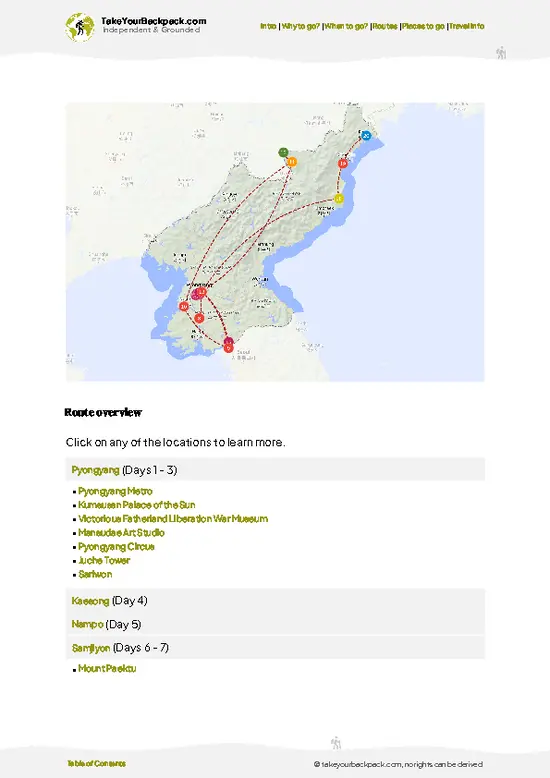
This fifteen-day route is for travelers who have already wondered what lies beyond Pyongyang’s showpiece avenues and want North Korea from the volcanic far north to the Chinese border. The pace is steady with built-in recovery days. You need two Air Koryo domestic charter flights (to Samjiyon and to Orang), a tour minibus with your guides for everything else, and an exit by road across the Tumen River into China, so you end in Jilin province instead of doubling back.
Days 1-3: Pyongyang, the Deep Dive
Three nights in
Pyongyang let you take the city in layers. Start underground on the
Pyongyang Metro, where Puhung and Yonggwang stations sit roughly 100 meters down under chandeliers and mosaics. The second day is the formal one: the
Kumsusan Palace of the Sun (collared shirt, no jeans, long silent travelators) followed by the
Victorious Fatherland Liberation War Museum, where the captured USS Pueblo is moored. Save the third day for the less scripted corners. The
Mansudae Art Studio sells …
read more 👉This fifteen-day route is for travelers who have already wondered what lies beyond Pyongyang’s showpiece avenues and want North Korea from the volcanic far north to the Chinese border. The pace is steady with built-in recovery days. You need two Air Koryo domestic charter flights (to Samjiyon and to Orang), a tour minibus with your guides for everything else, and an exit by road across the Tumen River into China, so you end in Jilin province instead of doubling back.
Days 1-3: Pyongyang, the Deep Dive
Three nights in Pyongyang let you take the city in layers. Start underground on the Pyongyang Metro, where Puhung and Yonggwang stations sit roughly 100 meters down under chandeliers and mosaics. The second day is the formal one: the Kumsusan Palace of the Sun (collared shirt, no jeans, long silent travelators) followed by the Victorious Fatherland Liberation War Museum, where the captured USS Pueblo is moored. Save the third day for the less scripted corners. The Mansudae Art Studio sells oil paintings and woodblock prints from the studios that produce the country’s monuments, and the Pyongyang Circus runs trapeze acts with very short safety margins. Ride the lift up the 170-meter Juche Tower at dusk to see where you have been.Days 4-5: Sariwon, Kaesong and Nampo
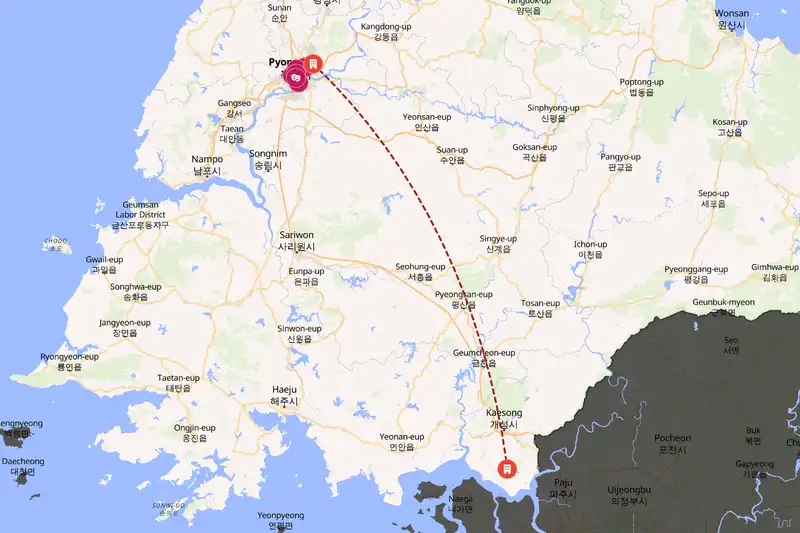
Head south down the Reunification Highway with a stop at Sariwon, whose folk street and hillside pavilions break up the drive. Sleep in Kaesong, the old Koryo capital, ideally in the folk hotel of tiled courtyard houses beside a stream. The morning belongs to Panmunjom, the northern side of the Demilitarized Zone, before you swing back north to Nampo for the night. The draw is the West Sea Barrage, an 8-kilometer dam and lock system across the Taedong estuary, and the slower port-town feel after two days of monuments. Nampo also puts you within an hour of Pyongyang’s airport for the next morning’s flight.Days 6-7: Samjiyon and Paektu Mountain
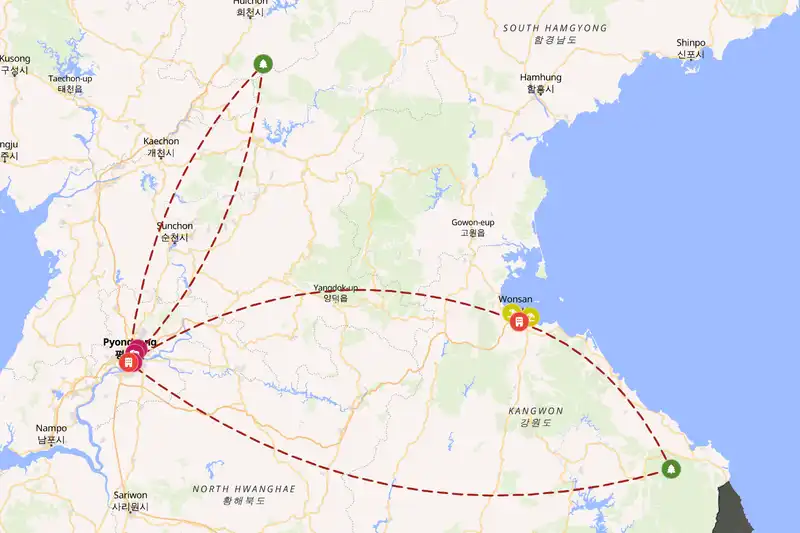
The charter flight north drops you into the rebuilt town of Samjiyon, all new apartment blocks and pine forest at around 1,400 meters. It is cold even in summer, and that is the point. Day seven is the big one: Paektu Mountain, the 2,744-meter volcano whose crater holds Lake Chon. A cable car runs toward the rim, and from there you walk down to the water if weather and guides allow. Go between July and September; snow lingers on the rim into June.Days 8-9: Pyongyang, the Quiet Side
Two nights back in Pyongyang are a deliberate pause between flights. Use them for the places a first visit skips: the thatched-roof Mangyongdae Native House of Kim Il Sung on the city’s western edge, an evening of rides and draft beer at Kaeson Youth Park, and a performance at the Pyongyang Grand Theatre if one is scheduled. This is also the stretch to do laundry and catch up on sleep.Days 10-11: Mount Chilbo and the Northeast Coast
Fly to Orang and drive into Mount Chilbo, where Inner, Outer and Sea Chilbo spread granite pinnacles from the hills down to the East Sea. Two nights here usually mean a village homestay, the most domestic scene you get anywhere in the country. Spend one afternoon at Chilbosan Beach, where rock stacks rise out of the surf and you can swim in August.Days 12-13: Chongjin
One night in Chongjin shows you industrial North Korea: steelworks, wide boulevards and a port that sees few foreign visitors. The value here is the contrast with the capital, and the road from here to the border is long enough that splitting it is the sensible choice.Days 14-15: Rason
Finish in Rason, the special economic zone pressed against China and Russia. Rajin market, where traders deal in Chinese yuan, is the closest thing to open commerce you will see in the country, and the coastline south of Rajin is lovely in the evening light. On day fifteen you cross the bridge over the Tumen River to Hunchun and continue on to Yanji for onward trains or flights.
I’d send a friend out to Pipa Island off Rason’s coast for the seal colony on the rocks; bring binoculars, because the boats keep their distance.v2.webp)
 Best Backpacking