×
Sudan🇸🇩 | 10 days itinerary

How to Spend 10 Days in Sudan

By Johan Kruseman 🇳🇱 | Updated May 10, 2026
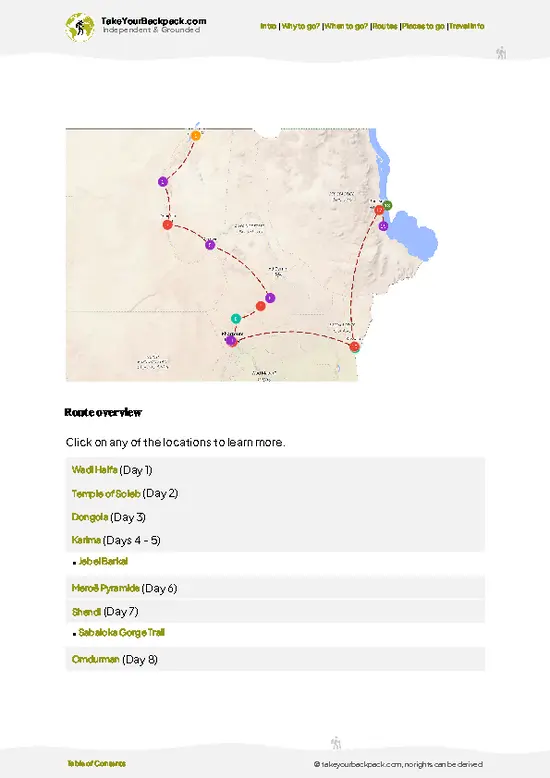
This 10-day route is for travelers who want a balanced mix of Nile archaeology, capital-city culture, and a taste of the Red Sea coast, moving at a moderate pace that still leaves room for long tea breaks and slow sunsets. You’ll rely on a mix of private cars, intercity buses, and one longer road leg toward the coast, trading a bit of transit time for a much richer sense of how Sudan’s landscapes change.

Days 1-3: Khartoum deep dive and Nile confluence

Base yourself in Khartoum for three nights to avoid constant packing and unpacking while you get your bearings. Spend a full day at the National Museum of Sudan and the Sudan Ethnographic Museum, pairing ancient temples and Nubian artifacts with the lived traditions of Sudan’s many communities. Use another day to explore the riverfront, detouring to the Khartoum War Cemetery for a quiet, shaded reminder of the region’s 20th-century conflicts, then cap an evening at the Al Fateh Tower Viewpoint to watch the city lights flicker on along the … read more 👉
This 10-day route is for travelers who want a balanced mix of Nile archaeology, capital-city culture, and a taste of the Red Sea coast, moving at a moderate pace that still leaves room for long tea breaks and slow sunsets. You’ll rely on a mix of private cars, intercity buses, and one longer road leg toward the coast, trading a bit of transit time for a much richer sense of how Sudan’s landscapes change.

Days 1-3: Khartoum deep dive and Nile confluence

Base yourself in Khartoum for three nights to avoid constant packing and unpacking while you get your bearings. Spend a full day at the National Museum of Sudan and the Sudan Ethnographic Museum, pairing ancient temples and Nubian artifacts with the lived traditions of Sudan’s many communities. Use another day to explore the riverfront, detouring to the Khartoum War Cemetery for a quiet, shaded reminder of the region’s 20th-century conflicts, then cap an evening at the Al Fateh Tower Viewpoint to watch the city lights flicker on along the Nile. If you want a softer landing day, wander through Al-Mogran Family Park for a low-key local hangout at the meeting of the Blue and White Nile.

Days 4-5: Omdurman’s markets and Mahdist history

Shift your focus across the river to Omdurman, using Khartoum as your sleeping base but dedicating two days to the old capital’s texture. Start with the Khalifa House Museum to anchor the Mahdist story, then let yourself get pleasantly lost in the Omdurman Souq, where you can hunt for incense, brassware, and fabrics without the hard sell you find in more tourist-saturated countries. Drop into the Great Mosque of Omdurman for a respectful look at daily worship, and if you have spare time, swing by the Al Kabir Mosque back in central Khartoum to compare architectural styles and atmospheres. Evenings are for tea on plastic chairs, watching the city’s social life unfold at street level.

Days 6-7: Meroë pyramids and Jebel Barkal’s sacred cliff

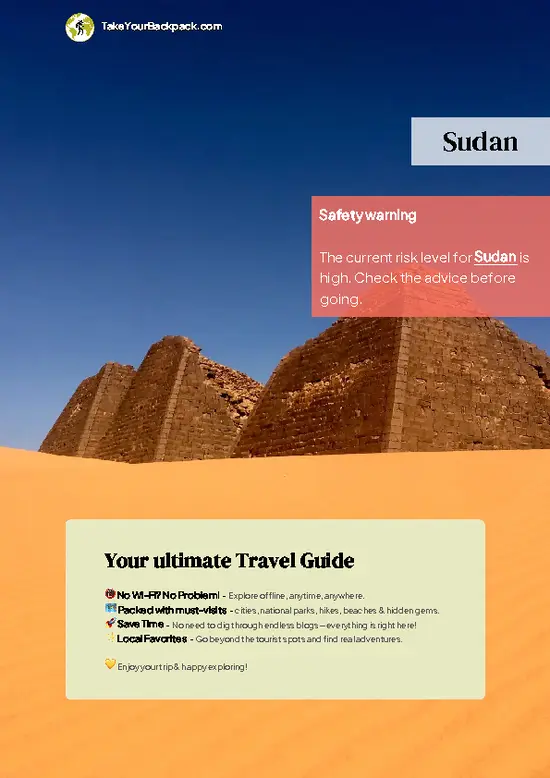
Head north along the Nile, breaking the journey with a stop in Shendi before reaching the Meroë Pyramids and the broader Archaeological Sites of the Island of Meroe. Give yourself time for both a sunset and a morning among the pyramids if possible, when the light is soft and the sand is cooler underfoot. Continue on to Karima, your base for exploring Jebel Barkal, where a sandstone mountain, ancient temples, and cliffside views combine into one of the most atmospheric corners of the Nile valley; climb for sunset if you’re comfortable with a short, steep hike. This phase gives you two very different flavors of ancient Nubia without turning the trip into a pure archaeology marathon.

Days 8-10: Dongola’s river life and return via the Nile

Travel further north to Dongola, trading pyramids for a slower, river-town rhythm and a chance to see everyday life along the Nile away from the capital. Use your time here to walk the riverbank, explore local neighborhoods, and soak up the contrast between desert horizons and irrigated green strips hugging the water. On your way back south, you can route via Wadi Halfa if you’re continuing overland toward Egypt, or simply return toward Khartoum by road, breaking the journey with a final night in Karima or Shendi rather than stacking two long driving days back-to-back. Wrap the trip with a last evening in Khartoum if time allows, revisiting a favorite café or viewpoint with the smug calm of someone who now knows the city’s rhythm.

The moment that sticks with me from this route is standing on top of Jebel Barkal at dusk, watching the Nile curve through the desert while the call to prayer drifts up from Karima below.
Loading the map 🌍

🛏️ Where to stay?The Route Breakdown

✈️ The backpacker research shortcutSudan Travel Guide

An offline-friendly backpacking guide with optimized travel routes, ranked highlights, transport advice, and the best areas to stay.
example page 0 from our offline Travel Guide for Sudanexample page 1 from our offline Travel Guide for Sudanexample page 2 from our offline Travel Guide for Sudanexample page 3 from our offline Travel Guide for Sudanexample page 4 from our offline Travel Guide for Sudanexample page 5 from our offline Travel Guide for Sudan
The digital guide (261 pages) contains:
72 highlights, ranked by travel appeal
Optimized 5, 10 & 15-day travel routes
Best neighborhoods to stay
How to get around
Offline-friendly for travel without Wi-Fi
👉 See all 30+ guide features

📅 Plan smarter in minutes, not weeks
Month by month travel advice
Festivals & national holidays
Budget expectations

🗺️ Go to the right places, skip the overrated ones
Honest pros & cons of destinations
Top hikes, parks & viewpoints
Lesser-known places most travelers miss
Clear “worth it vs skip it” guidance

🛏️ Travel smoothly without rookie mistakes
Best areas to stay
Transport systems explained simply
Common scams & safety advice
SIM cards, money & practical tips

🌍 Understand the country, not just visit it
Culture & traditions
52 Essential phrases & customs
Festivals worth planning around
Traveler-friendly historical context
Insights that make places more meaningful

📱 Built for real travel conditions
Fully downloadable PDF
Works completely offline
Optimized for phone use
Useful in remote areas & buses
Everything in one place
Save weeks of stressful planning
Get instant access to the full guide directly. 30-day money-back guarantee.


Sent to your inbox immediately after payment • 100% Secure Checkout
Best Backpacking Travel Advisor 2025 tourism awardBest Backpacking
Travel Advisor
2025
What others say about Take Your Backpack Guides:
⭐⭐⭐⭐⭐
Fantastic, amazing amount of information!
⭐⭐⭐⭐⭐
My goodness this is amazing, it's what I've been looking for hats off too you!
⭐⭐⭐⭐⭐
I think this is absolutely BRILLIANT
⭐⭐⭐⭐
Very complete and informative. It's still missing places, but I gotta to commend you
⭐⭐⭐⭐⭐
This is truly amazing, thank you, can't wait to explore it with my kids!
⭐⭐⭐⭐⭐
Awesome resource, thank you!
⭐⭐⭐⭐⭐
This is amazing! Can't wait to explore the ones I haven't seen
⭐⭐⭐⭐
I love this! Well done, great idea.
⭐⭐⭐⭐⭐
Thanks for taking the time to make this gem!
⭐⭐⭐⭐⭐
This might be the best website I've ever seen.
⭐⭐⭐⭐⭐
Congratulations, and thank you so much for your work; it's incredibly valuable.
⭐⭐⭐⭐
In all seriousness I think you did a great job pointing out the important spots
⭐⭐⭐⭐⭐
10/10 very good
⭐⭐⭐⭐⭐
As someone who's only just starting to visit regularly this is awesome, thank you.
⭐⭐⭐⭐
Thank you very much! I'm going to visit my dad, it's going to be very useful!
⭐⭐⭐⭐⭐
This is really cool! We'll be travelling for the first time and this definitely come in handy.
⭐⭐⭐⭐⭐
You are now our minister of culture, congratulations 👨‍💼
⭐⭐⭐⭐⭐
Just wanted to tell you that this is a pearl! Going to follow your recommendations.
⭐⭐⭐⭐⭐
This is so cool. I'll definitely be using the resource for my travels soon.
⭐⭐⭐⭐⭐
This is very impressive! Good work.
⭐⭐⭐⭐⭐
This is an amazing and informative site. Very well done!

🧭 RouteGot More or Less Time?

Travel Sudan your way — from a quick highlights trip to a slow-paced adventure.

🙋 FAQCommon Questions

Short version: Sudan is doable to backpack independently if you’re patient, flexible, and comfortable with rough edges. It is not a plug-and-play destination like Southeast Asia or Western Europe.

The big advantages for independent travelers are the people and the prices. Sudanese hospitality is legendary; you’ll constantly be offered tea, help, and sometimes a place to sleep. English is spoken more than you’d expect in cities and along main routes, and locals are usually thrilled to help you figure out buses, food, and directions. Daily costs for a bare-bones backpacker (local food, shared rooms, buses) can be very low compared to neighboring countries.

The challenges are bureaucracy, infrastructure, and safety awareness. Visas and permits have historically been a headache: you often need a visa in advance, and at times there have been registration requirements or travel permits for certain regions. These rules change, so you need to double-check requirements before you go and build in time for paperwork in Khartoum. Independent backpackers need to be comfortable with this kind of admin.

Transport and services can be slow and unpredictable. Buses leave when full, not on a tight schedule. Power cuts, patchy internet, and limited ATMs are normal, so you travel better here if you’re not dependent on constant connectivity or card payments. Carry more cash than you think you need, and keep it split in different hiding spots.

Security is the other major factor. Sudan has had periods of conflict and political instability, and some regions are off-limits or simply not worth the risk for a traveler. Independent backpackers need to be disciplined about sticking to safer areas, listening to locals, and avoiding any political gatherings or demonstrations. This is not the place to improvise in border regions or ignore checkpoints.

If you’re a first-time backpacker, Sudan is a tough starter country but not impossible if you join short local tours for remote areas and keep your route simple. If you’ve already handled places with weak infrastructure (rural Ethiopia, parts of Pakistan, Central Asia), Sudan will feel challenging but very rewarding. The key is to move slowly, stay humble, and accept that plans will change.
For a budget backpacker, the sweet spot for Sudan is about 2–3 weeks. That gives you time to handle admin in Khartoum, see the major archaeological sites, and still have slow days for tea, markets, and bus delays.

If you only have 7–10 days, you can still have a strong trip, but you’ll need to focus hard. A realistic short itinerary would be: Khartoum and Omdurman (markets, Nile, museums), then a loop north along the Nile to see the main pyramid and temple sites, then back to Khartoum. You’ll be moving a lot, but it’s doable if you accept long bus days.

With 2 weeks, you can:
- Spend 3–4 days in Khartoum and Omdurman getting your bearings, sorting permits if needed, and soaking up daily life.
- Take 5–7 days to travel the Nile corridor north (Meroe, Atbara area, then further to Karima and Dongola) to see pyramids, temples, and desert villages.
- Add 2–3 buffer days for slow transport, extra time at a site you love, or a rest day when the heat wipes you out.

With 3 weeks or more, you can travel slower and cheaper. You can:
- Break up long bus legs into shorter hops, which is easier on your body and your sanity.
- Spend extra nights in places like Karima or Dongola to actually hang out with locals instead of just ticking off ruins.
- Potentially add side trips that require more logistics, like additional desert areas or less-visited archaeological sites, if they’re safe and accessible at the time.

Sudan rewards slow travel. Distances are big, heat is intense, and buses are tiring. It’s better to see fewer places well than to try to cover the whole map. If you’re short on time, cut destinations, not rest days.
You can absolutely get around Sudan without a car, but you need to be comfortable with basic, sometimes chaotic public transport.

Between cities and larger towns, long-distance buses and minibuses are your main tools. They’re cheap, frequent on main routes, and usually leave when full rather than on a strict timetable. Expect early starts, crowded seats, and long, hot days. Buy water and snacks before you board, and keep your valuables on you, not in the hold.

Shared taxis and pickups fill the gaps between smaller towns and villages. These can be cramped but are often the only option for short hops or for reaching the main highway from a more remote settlement. Prices are usually negotiable but not outrageous; asking a bystander what they’d pay is a good way to avoid being wildly overcharged.

Inside cities like Khartoum and Omdurman, you’ll use a mix of minibuses, shared taxis, and sometimes rickshaws. Routes can be confusing at first, but locals are usually happy to point you to the right vehicle. This is where a few key place names written in Arabic on your phone or a scrap of paper help a lot.

For some archaeological sites, especially those off the main highway, public transport only gets you part of the way. From the nearest town, you may need to:
- Hire a local taxi or pickup for a half-day or full-day trip.
- Join forces with other travelers to split the cost.
- Walk a bit if the distance is short and the heat is manageable.

Hitchhiking is sometimes possible and can be safe if you’re cautious and conservative about which rides you accept, but it should be a backup, not your primary plan. Desert distances are long, and traffic can be sparse.

Renting your own car gives you more freedom but is expensive and adds stress with checkpoints, navigation, and breakdowns. For a budget backpacker, public transport plus occasional local taxis is usually the best balance of cost and experience.
For a budget backpacker, the must-visits in Sudan are the places where history, daily life, and desert landscapes all collide without requiring huge money or complex logistics.

Khartoum & Omdurman
You’ll likely start and end here, and it’s worth more than a quick overnight. Khartoum gives you museums, the Nile confluence, and a sense of modern Sudanese life. Omdurman brings the big market energy, Sufi gatherings (when they’re happening and safe to attend), and a more traditional feel. This is where you drink endless tea, ride crowded minibuses, and get used to the rhythm of the country.

Meroe Pyramids
If you see only one major archaeological site, make it Meroe. Rows of sharp-angled pyramids rising out of the sand, usually with almost no one else around. For a backpacker, the magic is in being able to wander quietly, climb nearby dunes, and watch the light change without fences and crowds. You can reach the area by bus along the main highway and then arrange local transport to the site.

Karima & Jebel Barkal
Karima is a relaxed Nile town that makes a great base. Jebel Barkal, the sandstone mountain just outside town, is ringed by temples and smaller pyramids. Climb it for sunrise or sunset if conditions allow; the view over the Nile and desert feels like a living history lesson. The town itself is friendly, walkable, and a good place to slow down for a couple of nights.

Old Dongola area
Further north, the Old Dongola region offers ruined churches, tombs, and desert villages along the Nile. It’s less visited than Meroe or Jebel Barkal, which means more improvisation but also more chances for real interaction with locals. This stretch of the Nile is where you really feel the contrast between green riverbanks and harsh desert.

Nile-side towns and villages between major sites
The spaces between the big-name ruins are just as important. Small Nile towns where you hop off the bus, find a basic guesthouse, and spend the evening drinking tea and chatting with whoever is curious about you. These stops cost almost nothing and give you the human side of Sudan that you’ll remember long after the ruins blur together.

If you have extra time and conditions allow, you can add more remote archaeological sites or desert areas, but for a first backpacking trip, that core triangle of Khartoum–Meroe–Karima/Dongola already delivers a lot of value.
If you’re short on time or money, the smartest move in Sudan is to skip anything that adds huge logistics or cost without giving you a clearly different experience from what you already have on your route.

Far-flung or multiple similar archaeological sites
Sudan is packed with pyramids, temples, and ruins. After Meroe and Jebel Barkal, many additional sites start to feel like variations on a theme unless you’re a serious archaeology nerd. If you’re tight on time, pick 2–3 major sites and skip the more remote ones that require expensive 4x4s or long detours.

Regions with current or recent conflict
Any area with security issues is an automatic skip for a backpacker on a short trip. Even if a place has interesting history or landscapes, it’s not worth the stress, the checkpoints, or the risk of getting stuck. Your time is better spent in safer, more accessible parts of the country where you can relax and actually enjoy being there.

Over-ambitious desert expeditions
Multi-day desert trips deep away from the Nile can be incredible, but they’re expensive, logistically heavy, and often require a private vehicle, guide, and extra gear. If you’re on a budget and a tight schedule, you’ll get plenty of desert atmosphere just by visiting Meroe, Jebel Barkal, and the stretches of road between Nile towns. Save the hardcore expeditions for a future, longer trip.

Trying to see both the far north and any distant secondary region in one short trip
Distances are big, buses are slow, and heat drains your energy. If you only have 7–10 days, don’t try to cram in every corner of the country. Focus on Khartoum plus the main Nile corridor north (Meroe, Karima, maybe Dongola) and skip any extra region that requires another full day of travel each way.

High-end hotels and imported restaurant scenes
If you’re backpacking, you don’t need the international-style hotels or pricey restaurants that could be anywhere in the world. They eat your budget and don’t add much to your understanding of Sudan. Stick to local guesthouses, simple eateries, and street food; you’ll save money and get a much better sense of the place.

In short, skip anything that demands big money, long detours, or extra risk for an experience that’s only slightly different from what you can already get along the main Khartoum–Nile route.

🇸🇩 SudanWhere to Go Next

Ready to build a truly unique trip? Predefined routes are perfect for first-time visitors, but there is so much more to discover. Whether you are chasing a city trip, pristine national parks, local food scenes, or quiet beaches, pick a category to design your own path.