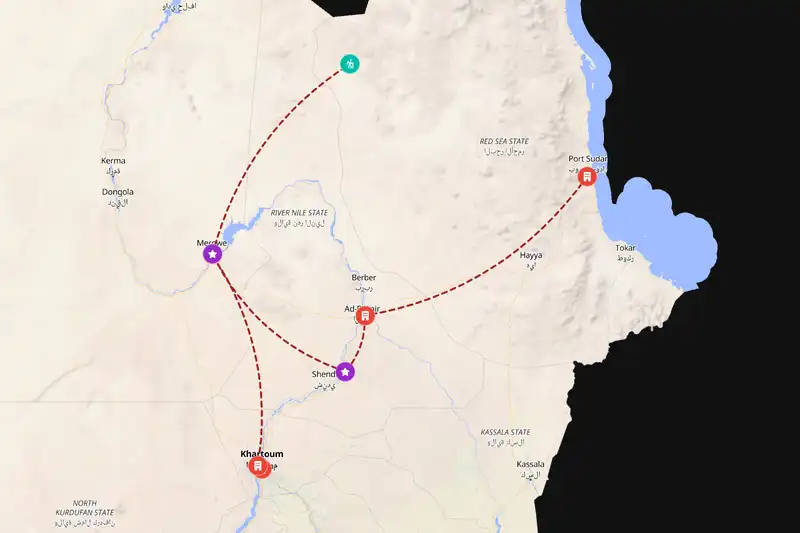
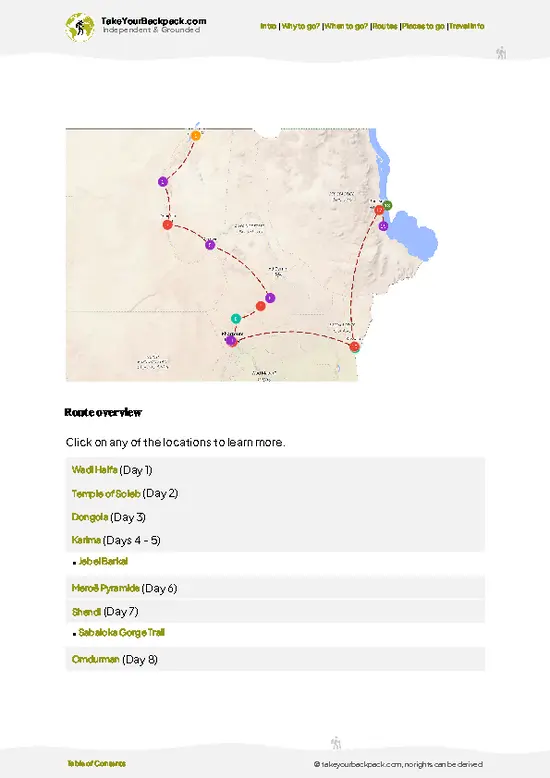
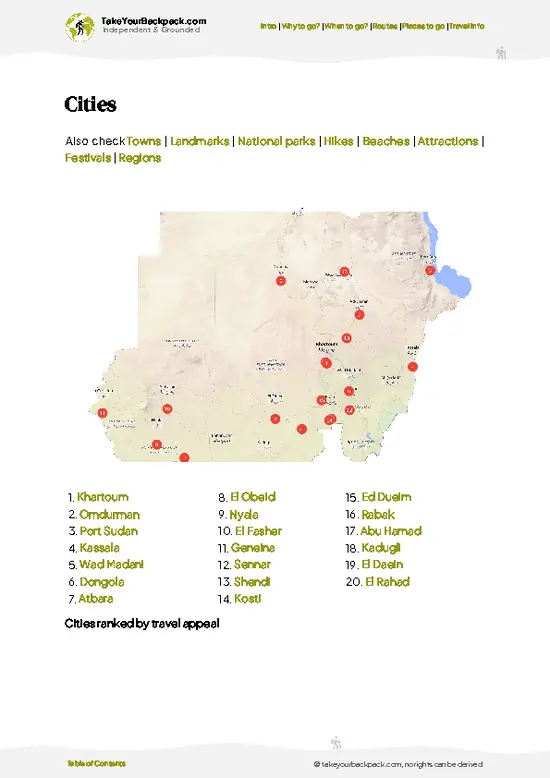
This fifteen-day overland journey through Sudan is for travelers with some rough-road experience who want to follow the Nile from the Egyptian border down to the capital, then cross east to the granite domes of Kassala and finish on the Red Sea. The pace is steady rather than rushed: most days involve a 2 to 4 hour transfer followed by an afternoon at a site, and the two long hauls in the second week are separated by a full rest day. You will rely on long-distance buses, shared minibuses and pickups, a hired car with driver for the pyramid fields and the Sabaloka detour, and a chartered boat for the reef at the end. The route stays in the north and east of the country.
Days 1-2: Wadi Halfa and the Temple of Soleb
Arriving overland from Egypt,
Wadi Halfa is your first night: a low, dusty town on the shore of Lake Nubia where border traffic, tea stalls and pickup drivers heading south all collide around the main market. Spend the evening sorting a SIM card and local currency, and let the first …
read more 👉This fifteen-day overland journey through Sudan is for travelers with some rough-road experience who want to follow the Nile from the Egyptian border down to the capital, then cross east to the granite domes of Kassala and finish on the Red Sea. The pace is steady rather than rushed: most days involve a 2 to 4 hour transfer followed by an afternoon at a site, and the two long hauls in the second week are separated by a full rest day. You will rely on long-distance buses, shared minibuses and pickups, a hired car with driver for the pyramid fields and the Sabaloka detour, and a chartered boat for the reef at the end. The route stays in the north and east of the country.
Days 1-2: Wadi Halfa and the Temple of Soleb
Arriving overland from Egypt, Wadi Halfa is your first night: a low, dusty town on the shore of Lake Nubia where border traffic, tea stalls and pickup drivers heading south all collide around the main market. Spend the evening sorting a SIM card and local currency, and let the first day stay small.
On day two, head south through Nubian country to the Temple of Soleb, built for Amenhotep III and the finest Egyptian-era temple in Sudan. Its papyrus-bundle columns stand almost alone on the Nile’s west bank, with palm groves and painted village doors as the only neighbors. Sleep in a Nubian guesthouse nearby so you can walk the ruins in the low evening light and again at dawn before the heat builds.Days 3-5: Dongola to Karima and Jebel Barkal
A morning drive brings you to Dongola, the regional capital of the north, a practical overnight with a riverside market, date palms in every direction and the first decent selection of restaurants since the border. It works as a reset day for laundry and cash.
From there it is 2 to 3 hours to Karima, where you stay two nights. The town sits beneath Jebel Barkal, a flat-topped sandstone mountain about 100 meters high that the Kushite kings and the Egyptians before them considered the home of Amun. Give one afternoon to the temple ruins at its base and the cluster of steep pyramids on its western side, then climb to the summit plateau (roughly 30 minutes on loose sand) for sunset over the Nile bend. The second day is yours to wander the riverbank and rest before the push south.Days 6-7: Meroë Pyramids and Shendi
The 4 to 5 hour drive from Karima to the Meroë Pyramids is one of the more comfortable transfers on the route. Plan to sleep at a desert camp near the site, because the point of staying is being among the northern cemetery’s dozens of narrow pyramids at sunrise, when the dunes are still cool and the camel handlers have not yet arrived.
Continue the next day to Shendi, about an hour south. The town is unpretentious and pleasantly normal: a big produce and livestock market, cheap ful and tamiya breakfasts, and Nile ferries crossing to the farms on the far bank. It breaks up the journey to the capital and gives you a look at everyday life in the river towns.Days 8-10: Sabaloka Gorge, Omdurman and Khartoum
On the way south, detour to the Sabaloka Gorge Trail at the Sixth Cataract, where the Nile forces its way through a ridge of dark granite roughly 80 kilometers north of the capital. A morning walk along the rocky banks is the only real hiking on this stretch of river, and it is quiet enough that you may share it only with fishermen.
Overnight in Omdurman, the older, more traditional half of the capital region. The Omdurman Souq is the reason to come: lanes of spice sellers, perfume oil merchants, leatherworkers and goldsmiths. Pair it with the Great Mosque of Omdurman and the shell-shaped modernist dome of the Al-Nilin Mosque near the White Nile bridge.
Cross the river for two nights in Khartoum. Stand on a bridge near the confluence to see the pale White Nile and the darker Blue Nile run side by side before they mix, and visit the Khartoum War Cemetery, the carefully tended Commonwealth graves from the Second World War. Parts of the city are still being rebuilt, so keep these days flexible and use the second one to rest before heading east.Days 11-12: Kassala, the Hills and the Taka Mountains
Day 11 is a long one: 7 to 9 hours by bus to Kassala, close to the Eritrean border. The payoff is the setting. The town sits right under the bare granite domes of the Taka range, and the markets fill with Beja and Rashaida traders, piles of bananas and guavas from the Gash river farms, and coffee brewed in clay jebena pots.
Use your full day for the Kassala Hills Trail in the cool early hours, scrambling up to viewpoints over the town and the plains, then walk the lower Taka Mountains Trail toward the Khatmiyya mosque at the foot of the rock and the Toteil spring, where local legend says anyone who drinks the water will come back to Kassala.Days 13-15: Port Sudan, Sanganeb and Suakin
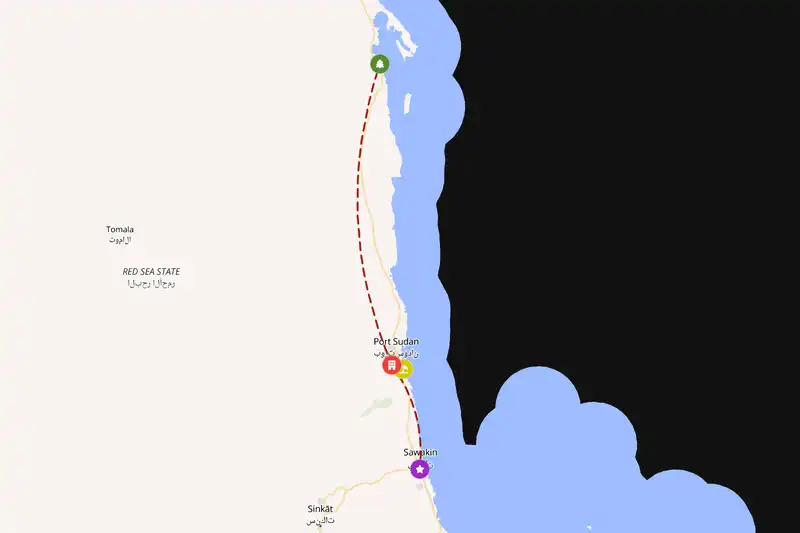
Another long bus day carries you to Port Sudan, which is also your exit point by air. On day 14, charter a boat out to Sanganeb National Park, an offshore coral atoll with a lighthouse and steep reef walls where hammerhead sharks gather in the cooler months. Even snorkelers see dense coral and reef fish within meters of the boat.
Spend your final morning at Suakin, about an hour south, the coral-stone ruins of the old Ottoman port on its small island, before heading back for your flight out.
If a friend asked me for one extra stop on this route, I would send them across the river from Karima to the pyramids of Nuri in the last hour of light, and tell them to bring a headscarf for the wind and enough water to linger until dark.v2.webp)
 Best Backpacking