×
China🇨🇳 | 21 days itinerary

The Perfect 21-Day Route for China

By Johan Kruseman 🇳🇱 | Updated May 8, 2026
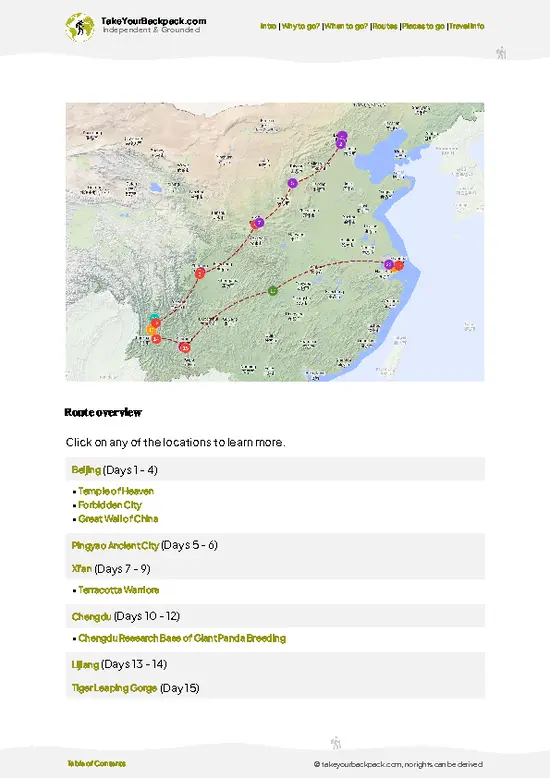
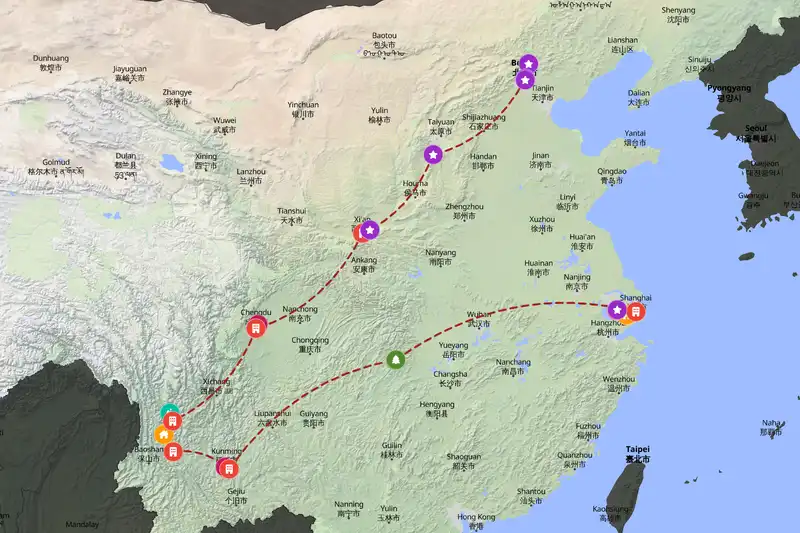
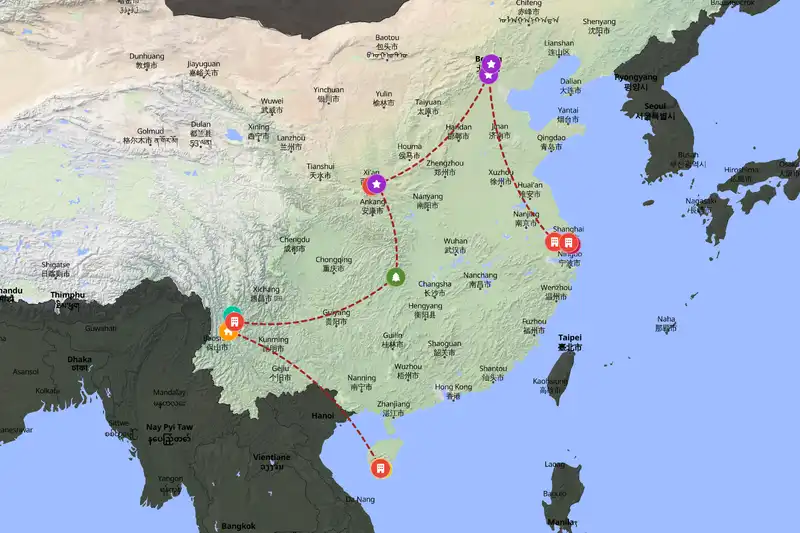
This 21-day route is for travelers who want a strong mix of cities, mountains, and karst landscapes, moving at a medium pace with high-speed trains and a couple of domestic flights to keep the jumps reasonable. You’ll hit the big cultural anchors, then pivot into southwest China for hikes and river time, with enough three-night stops that you’re not living out of your daypack every morning.

Days 1-4: Beijing - Dynasties, Walls, and Museums

Begin in Beijing to ground yourself in the country’s political and cultural core before you start bouncing around. Spend a full day between the Forbidden City and the The Palace Museum, letting the palace complex and its collections explain how power and art intertwined here for centuries. Take another day for the Great Wall of China, choosing a section where you can actually walk a few towers and feel the terrain rather than just ticking a box, and then use a quieter day to explore the National Museum of China for a sweeping narrative from early civilizations … read more 👉
This 21-day route is for travelers who want a strong mix of cities, mountains, and karst landscapes, moving at a medium pace with high-speed trains and a couple of domestic flights to keep the jumps reasonable. You’ll hit the big cultural anchors, then pivot into southwest China for hikes and river time, with enough three-night stops that you’re not living out of your daypack every morning.

Days 1-4: Beijing - Dynasties, Walls, and Museums

Begin in Beijing to ground yourself in the country’s political and cultural core before you start bouncing around. Spend a full day between the Forbidden City and the The Palace Museum, letting the palace complex and its collections explain how power and art intertwined here for centuries. Take another day for the Great Wall of China, choosing a section where you can actually walk a few towers and feel the terrain rather than just ticking a box, and then use a quieter day to explore the National Museum of China for a sweeping narrative from early civilizations to the present. If you have the bandwidth, the Temple of Heaven, Beijing and Summer Palace, Beijing make for excellent half-day bookends before you catch a high-speed train west.

Days 5-7: Xi’an - Terracotta Warriors and Ancient Streets

Roll into Xi’an and give yourself three nights to soak up its role as the eastern end of the Silk Road. Dedicate a full day to the Terracotta Warriors and Horses Museum and the Terracotta Warriors complex, taking time to walk the pits slowly and then dive into the exhibits that explain how they were built and discovered. Balance that with a visit to the Shaanxi History Museum, which ties together trade routes, religions, and dynasties in a way that makes the city’s old walls and markets feel alive. If you’re curious about imperial ambition pushed to the extreme, add a side trip to the Mausoleum of the First Qin Emperor before your evening train south.

Days 8-11: Chengdu & Pandas - Slow City, Big Bowls, and Bamboo

Head to Chengdu by high-speed train or a short flight, shifting from imperial capitals to a city that runs on tea houses and hotpot. Spend a morning at the Chengdu Research Base of Giant Panda Breeding, arriving early to see the pandas at their most active and giving yourself time to wander the different enclosures instead of rushing from pen to pen. Use another day to explore local neighborhoods and parks, then take a day trip into the Sichuan Giant Panda Sanctuaries region to see the broader mountain environment that keeps this ecosystem going. Evenings are for long, spicy dinners and people-watching in teahouses before you head deeper into the mountains.

Days 12-15: Mount Emei & Leshan - Sacred Peaks and Stone Giants

Travel to Emeishan and base yourself there to explore one of China’s most important Buddhist mountains without turning it into a forced march. Spend a full day in Mount Emei National Park, using cable cars and well-marked trails to mix viewpoints, temples, and short hikes instead of trying to summit everything in one go. Take another day trip to nearby Leshan to visit the Mount Emei Scenic Area (Leshan Giant Buddha), where the sheer scale of the carved cliffside Buddha makes the crowds feel tiny. The combination of misty forests, temple bells, and river views gives you a very different spiritual tone than the palaces and museums of the north.

Days 16-18: Guilin & Yangshuo - Karst Peaks and River Time

Fly or take an overnight train to Guilin, then quickly pivot into the Yangshuo region, where limestone peaks and rivers become your main landmarks. Use one day for a classic river cruise or bamboo raft between Guilin and Yangshuo, watching farmers, fishermen, and water buffalo slide past those jagged silhouettes. Another day can be spent exploring the South China Karst landscapes around Yangshuo by bike or scooter, stopping at small villages and viewpoints rather than chasing a checklist of specific sights. This phase is about slowing down, getting outside, and letting the scenery do the heavy lifting.

Days 19-21: Longji Rice Terraces - Terraced Hills and Village Paths

Finish with a quieter, more rural note at the Longji Rice Terraces, reached by road from Guilin. Base yourself in one of the terrace villages and spend your days hiking between viewpoints and hamlets, watching how the light changes across the layered fields as you climb. The walking here is flexible, so you can choose gentle paths or longer loops, but either way you get a close look at how people have shaped these hills over centuries. After a couple of nights, return to Guilin for your onward journey, carrying a mental map that runs from imperial capitals to panda forests to terraced hillsides.

The part of this route that sticks with me most is sipping tea in Chengdu after a panda morning, knowing that a week later I’d be walking alone along a misty path above the Longji terraces with only the sound of water and distant roosters for company.
Loading the map 🌍
film
0
0
0a
Beijing
Pixabay
film
1
1
1a
Forbidden City
Pixabay
film
2
2
2a
Great Wall of China
film
3
3
3a
National Museum of China
film
4
4
4a
Xi’an
film
5
5
5a
Terracotta Warriors
Pixabay
film
6
6
6a
Mount Emei
film
7
7
7a
Mount Emei Scenic Area (Leshan Giant Buddha)
film
8
8
8a
Longji Rice Terraces

✈️ The backpacker research shortcutChina Travel Guide

An offline-friendly backpacking guide with optimized travel routes, ranked highlights, transport advice, and the best areas to stay.
example page 0 from our offline Travel Guide for Chinaexample page 1 from our offline Travel Guide for Chinaexample page 2 from our offline Travel Guide for Chinaexample page 3 from our offline Travel Guide for Chinaexample page 4 from our offline Travel Guide for Chinaexample page 5 from our offline Travel Guide for China
The digital guide (419 pages) contains:
139 highlights, ranked by travel appeal
Optimized 14, 21 & 30-day travel routes
Best neighborhoods to stay
How to get around
Offline-friendly for travel without Wi-Fi
👉 See all 30+ guide features

📅 Plan smarter in minutes, not weeks
Month by month travel advice
Festivals & national holidays
Budget expectations

🗺️ Go to the right places, skip the overrated ones
Honest pros & cons of destinations
Top hikes, parks & viewpoints
Lesser-known places most travelers miss
Clear “worth it vs skip it” guidance

🛏️ Travel smoothly without rookie mistakes
Best areas to stay
Transport systems explained simply
Common scams & safety advice
SIM cards, money & practical tips

🌍 Understand the country, not just visit it
Culture & traditions
52 Essential phrases & customs
Festivals worth planning around
Traveler-friendly historical context
Insights that make places more meaningful

📱 Built for real travel conditions
Fully downloadable PDF
Works completely offline
Optimized for phone use
Useful in remote areas & buses
Everything in one place
Save weeks of stressful planning
Get instant access to the full guide directly. 30-day money-back guarantee.


Sent to your inbox immediately after payment • 100% Secure Checkout
Best Backpacking Travel Advisor 2025 tourism awardBest Backpacking
Travel Advisor
2025
What others say about Take Your Backpack Guides:
⭐⭐⭐⭐⭐
Fantastic, amazing amount of information!
⭐⭐⭐⭐⭐
My goodness this is amazing, it's what I've been looking for hats off too you!
⭐⭐⭐⭐⭐
I think this is absolutely BRILLIANT
⭐⭐⭐⭐
Very complete and informative. It's still missing places, but I gotta to commend you
⭐⭐⭐⭐⭐
This is truly amazing, thank you, can't wait to explore it with my kids!
⭐⭐⭐⭐⭐
Awesome resource, thank you!
⭐⭐⭐⭐⭐
This is amazing! Can't wait to explore the ones I haven't seen
⭐⭐⭐⭐
I love this! Well done, great idea.
⭐⭐⭐⭐⭐
Thanks for taking the time to make this gem!
⭐⭐⭐⭐⭐
This might be the best website I've ever seen.
⭐⭐⭐⭐⭐
Congratulations, and thank you so much for your work; it's incredibly valuable.
⭐⭐⭐⭐
In all seriousness I think you did a great job pointing out the important spots
⭐⭐⭐⭐⭐
10/10 very good
⭐⭐⭐⭐⭐
As someone who's only just starting to visit regularly this is awesome, thank you.
⭐⭐⭐⭐
Thank you very much! I'm going to visit my dad, it's going to be very useful!
⭐⭐⭐⭐⭐
This is really cool! We'll be travelling for the first time and this definitely come in handy.
⭐⭐⭐⭐⭐
You are now our minister of culture, congratulations 👨‍💼
⭐⭐⭐⭐⭐
Just wanted to tell you that this is a pearl! Going to follow your recommendations.
⭐⭐⭐⭐⭐
This is so cool. I'll definitely be using the resource for my travels soon.
⭐⭐⭐⭐⭐
This is very impressive! Good work.
⭐⭐⭐⭐⭐
This is an amazing and informative site. Very well done!

🧭 RouteAlternative Routes

Travel China your way — from a quick highlights trip to a slow-paced adventure.

🙋 FAQBackpacking FAQ

Short version: yes, but it’s not a “wing it and hope” country. It’s very doable if you’re organized and comfortable being out of your comfort zone. The big advantages: trains go almost everywhere, hostels are common in major destinations, and people are generally helpful even if you don’t share a language. The main frictions: language barrier, apps, and rules. English is limited outside major tourist zones, so offline tools matter: download Chinese offline maps (with Chinese characters), have your hostel names and addresses written in Chinese, and keep key phrases saved in your phone. Many bookings and payments inside China lean heavily on local apps and mobile payments; as a budget traveler you can still get by with cash plus a bank card, but you’ll want to pre-book some trains and hostels on international-friendly platforms before you arrive. Visas require planning and a rough itinerary; this is not a last-minute border-hop country. Once you’re in, backpacking feels structured rather than wild: think efficient trains, cheap local eateries, and hostel-to-hostel hops instead of spontaneous hitchhiking. If you’ve done Southeast Asia, expect less English and more rules, but better infrastructure and more variety in landscapes and cities. If you’re willing to prep a bit, China is absolutely backpackable on your own.
For a first backpacking trip, 2–3 weeks is the sweet spot: long enough to see a mix of megacities, old towns, and nature without burning out on train rides. With about 10 days, focus hard: pick 2–3 regions and ignore the rest. For example: Beijing + Xi’an + one nature stop (Zhangjiajie or Guilin/Yangshuo). With 2–3 weeks, you can do a classic north–central–south arc: Beijing → Datong or Pingyao → Xi’an → Chengdu → Guilin/Yangshuo or Zhangjiajie → Hong Kong or Guangzhou. With a month, you can slow down and add a more offbeat region like Yunnan (Dali, Lijiang, Tiger Leaping Gorge), Gansu (Dunhuang, Zhangye), or Inner Mongolia/Xinjiang if logistics and permits work for you. China is huge; treating it like one country is misleading. Think of it as several big trips: north (history and walls), southwest (mountains and minority cultures), northwest (desert and Silk Road), and east coast (cities and business hubs). For budget travelers, more time usually means better value because you can take slower trains, stay longer in each place, and avoid expensive last-minute flights. If you only have a week, it’s still worth going, but commit to one main hub (Beijing or Shanghai) plus one side trip and don’t try to “do China.”
You can travel almost everywhere you care about as a backpacker without ever touching a steering wheel. The backbone is the rail network: high-speed trains for long hops between major cities, and slower, cheaper trains for budget days and overnight journeys. High-speed trains are clean, fast, and easy once you understand the system; second-class seats are usually the best value. Overnight hard-sleeper bunks on regular trains are a budget traveler’s friend: you save a night of accommodation and meet locals in your compartment. Buses fill in the gaps, especially for smaller towns, national parks, and mountain areas. They’re cheap but can be slower and less comfortable; still, they’re often the only way to reach trailheads or rural spots. Inside cities, metros in big places like Beijing, Shanghai, Chengdu, and Xi’an are cheap, signed in English, and intuitive. In smaller cities, you’ll rely on buses, taxis, and ride-hailing apps. To make life easier, always have your destination written in Chinese characters to show drivers, and screenshot your hostel’s location on a map. Domestic flights are useful for huge distances (for example, Beijing to Yunnan or Xinjiang), but they add cost and airport time; for a budget trip, use them sparingly and lean on trains. You do not need to rent a car, and for most travelers it would add stress rather than freedom.
For a first-time backpacker on a budget, think in terms of experiences rather than a checklist of cities. A strong, efficient starter mix looks like this: Beijing for history and scale: the Great Wall (choose a less crowded section like Jinshanling or Gubeikou if possible), the Forbidden City, hutong alleys, and cheap local food. It’s touristy but important context for everything else. Xi’an for the Terracotta Warriors and the old city walls: it’s a compact stop that gives you Silk Road flavor, good street food (Muslim Quarter), and a clear sense of China’s deep timeline. Chengdu for chill city life and pandas: the vibe is slower, food is spicy and cheap, and it’s a good base for side trips to places like Leshan (Giant Buddha) or Emei Shan if you want a temple-and-hiking combo. Guilin and Yangshuo or the Longji rice terraces for landscapes: karst peaks, rivers, and rice terraces give you the postcard side of China, and you can do it on a backpacker budget with hostels and local buses. Yunnan (Dali, Lijiang, Tiger Leaping Gorge) if you have extra time: this is where many backpackers fall in love with China—mountain hikes, old towns, and a mix of cultures. If you’re into more offbeat routes and have longer: Gansu (Zhangye Danxia landforms, Dunhuang desert and caves) for wild colors and Silk Road history; Zhangjiajie for surreal pillar mountains if you don’t mind park fees and crowds; and maybe Hong Kong as a soft landing or exit point with easy flights and a very different city feel. Prioritize places that combine culture, food, and nature so every long train ride feels worth it.
If you’re short on time or cash, skip anything that eats days without giving you a new type of experience. Long, flat industrial cities that are mainly business hubs (for example, many second-tier coastal cities) are easy to cut unless you have a specific reason to be there. You can also safely skip doing both Beijing and Shanghai on a tight trip; pick one big city. Beijing gives you history and the Great Wall; Shanghai gives you a more modern, international city with a flashy skyline. For a backpacker, Beijing usually wins if you can only choose one. Consider skipping multiple similar old towns: if you do Pingyao or Lijiang or Dali, you don’t need a whole string of walled towns that now function mostly as tourist streets. Choose one or two and move on. If you’re not deeply into theme parks or shopping, you can skip big-ticket attractions like Disneyland or luxury malls; they burn money and time without telling you much about the country. Think twice about extremely remote regions (like far western deserts or border areas) on a short trip: they require long travel days, extra permits or checks, and higher costs, which is better suited to a longer, focused journey. Finally, don’t over-stack temples and museums; after a few, they blur together. Pick a couple of well-regarded ones in each region and spend the saved time walking neighborhoods, eating street food, or taking a day hike instead.

🇨🇳 ChinaMore of China

Ready to build a truly unique trip? Predefined routes are perfect for first-time visitors, but there is so much more to discover. Whether you are chasing a city trip, pristine national parks, local food scenes, or quiet beaches, pick a category to design your own path.