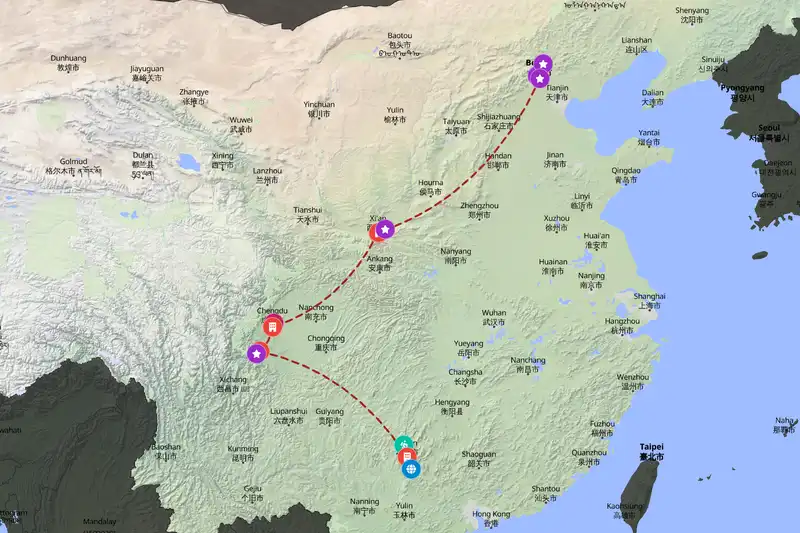
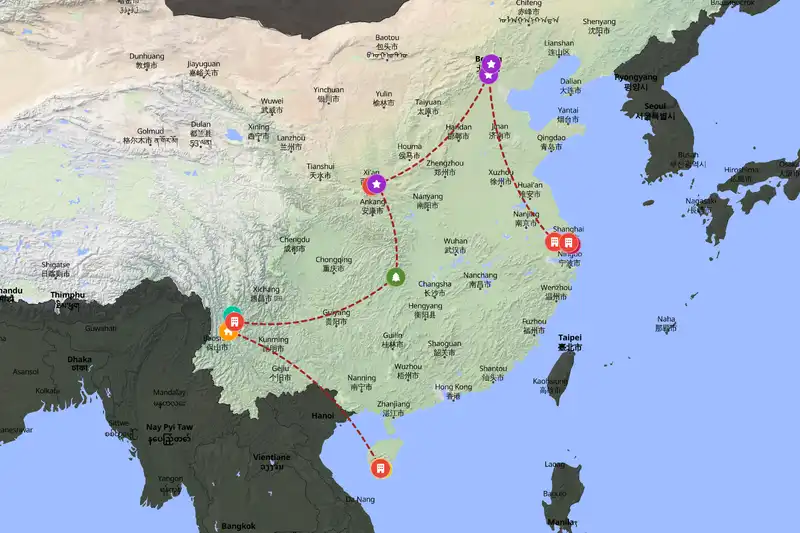
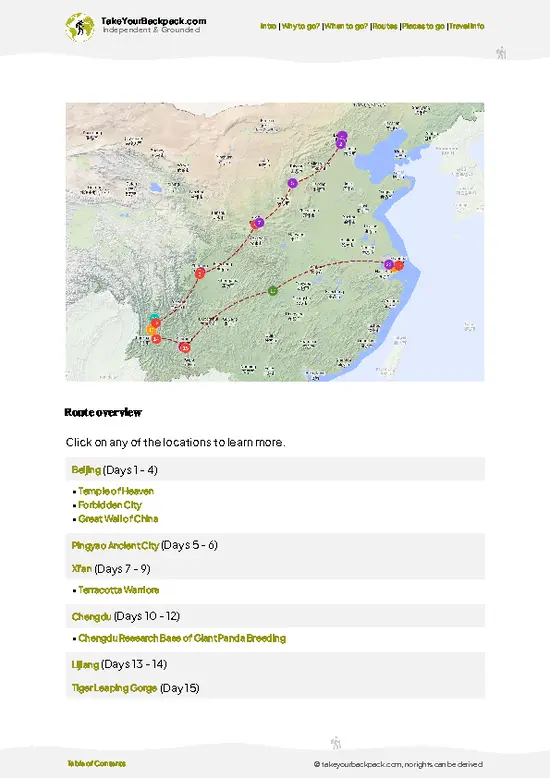
This month-long route across China is for travelers who want the big anchors and also the slow, rural side of the country, with time to sit in a Yunnan market square or trek a gorge without watching the clock. The style is independent and mid-budget, mixing courtyard guesthouses, hostels and a mountain inn, and the pace stays steady, with at least two nights almost everywhere and a spare day built into the Yunnan section. You’ll use high-speed trains in the north, three domestic flights (Chengdu to Lijiang, Kunming to Zhangjiajie, Zhangjiajie to Shanghai), long-distance buses and minibuses in Yunnan, and city metros.
Days 1-5: Beijing
Four nights in
Beijing let you learn the city on foot. Base yourself in the hutong lanes around the Drum Tower, where courtyard hostels run about 70 to 120 yuan (US$10 to 17) for a dorm bed and breakfast is jianbing from a cart. Be at the
Temple of Heaven park before 8 a.m. to watch retirees doing tai chi, ballroom dancing and calligraphy with water on the …
read more 👉This month-long route across China is for travelers who want the big anchors and also the slow, rural side of the country, with time to sit in a Yunnan market square or trek a gorge without watching the clock. The style is independent and mid-budget, mixing courtyard guesthouses, hostels and a mountain inn, and the pace stays steady, with at least two nights almost everywhere and a spare day built into the Yunnan section. You’ll use high-speed trains in the north, three domestic flights (Chengdu to Lijiang, Kunming to Zhangjiajie, Zhangjiajie to Shanghai), long-distance buses and minibuses in Yunnan, and city metros.
Days 1-5: Beijing
Four nights in Beijing let you learn the city on foot. Base yourself in the hutong lanes around the Drum Tower, where courtyard hostels run about 70 to 120 yuan (US$10 to 17) for a dorm bed and breakfast is jianbing from a cart. Be at the Temple of Heaven park before 8 a.m. to watch retirees doing tai chi, ballroom dancing and calligraphy with water on the paving stones. Walk the Forbidden City from south to north, then climb Jingshan Park opposite the north gate for the view back over its yellow roofs. For the Great Wall of China, skip the crowded close-in sections and head 2.5 to 3 hours out to Jinshanling, where a 3 to 4 hour walk along the ridge covers both restored towers and crumbling stretches.Days 5-7: Pingyao
About 4 hours southwest by high-speed train, the Ancient City of Ping Yao is a walled Ming and Qing trading town whose 6-kilometer wall you can circle on top. Pingyao was where China’s first draft banks opened, and the Rishengchang counting house still shows how silver moved across the empire. The combined ticket (around 125 yuan, US$17) covers the wall and most courtyard sites for several days. Sleep in a converted merchant’s house on a heated kang bed, and walk the lanes after dark when the day-trippers have gone.Days 7-10: Xi’an
A roughly 3-hour train brings you to Xi’an. This time, treat the Terracotta Warriors and Horses Museum (120 yuan, US$17) as half of a bigger site. Your ticket also covers the Mausoleum of the First Qin Emperor, a short shuttle ride away, where the burial mound itself has never been opened. Seeing the mound puts the army in context: thousands of clay soldiers were only the outer guard. Spend your other days around the Big Wild Goose Pagoda and the evening fountain show on its north plaza, and leave a morning free to do nothing.Days 10-13: Chengdu
Three to four hours south on the high-speed line, Chengdu is where you should start eating seriously. At the Chengdu Research Base of Giant Panda Breeding (55 yuan, US$8), aim for the nurseries and the adult enclosures before 10 a.m., when keepers bring out bamboo and the animals are still moving. Afterward, slow down at Wenshu Monastery with a vegetarian lunch in its canteen, and book an evening of Sichuan opera for the face-changing act. A cooking class is a good way to learn mapo tofu properly, Sichuan peppercorn and all.Days 13-17: Lijiang and Tiger Leaping Gorge
Fly about 1 hour to Lijiang, at roughly 2,400 meters, and use two nights to adjust to the altitude. The old town is crowded by midday, so walk it at dawn and spend an afternoon in the quieter Naxi village of Baisha just north. Then take a 2-hour bus to Qiaotou for Tiger Leaping Gorge (entry around 45 yuan). The high trail climbs the zigzag “28 Bends” and contours above the Jinsha River, with Jade Dragon Snow Mountain across the gorge. Overnight at one of the guesthouses around Halfway, finish at Tina’s the next morning, and ride a minibus back to Lijiang for one recovery night.Days 17-19: Shaxi
Two buses (Lijiang to Jianchuan in 2 to 2.5 hours, then 30 to 45 minutes by minibus) bring you to Shaxi Ancient Town, a former caravan stop on the Tea Horse Road. The Sideng market square, with its old stage and Xingjiao Temple, is the heart of town. If you can, time your stay for the Friday market, when Bai and Yi farmers come down from the hills. Two nights here are for walking rice paddies and reading in a courtyard café.Days 19-22: Dali
A 2 to 3 hour ride south lands you in Dali, the trip’s easiest stop. Its old town has backpacker bars and good coffee, and the Cangshan range rises right behind it. Rent an e-bike for a day along the shore of Erhai Lake to the Bai village of Xizhou, and stop for a baba flatbread from a street griddle. Three nights here give you a real rest before the second half.Days 22-23: Kunming
The high-speed train to Kunming takes about 2 hours. Use the afternoon for the Yunnan Nationalities Museum by Dianchi Lake, which lays out the costumes and crafts of the province’s many ethnic minorities. It makes good sense of the villages you’ve just passed through. Eat a bowl of crossing-the-bridge noodles and sleep near the airport side of town.Days 23-26: Wulingyuan
Fly about 2 hours to Zhangjiajie and continue 45 to 60 minutes to Wulingyuan, the gateway town for the Zhangjiajie National Forest Park. The park’s sandstone pillars rise straight out of the forest by the thousand. The multi-day ticket (around 225 yuan, US$31, in high season) is the reason for three nights: spend one day on the Yuanjiajie plateau via the Bailong cliff elevator, one on Tianzi Mountain, and one walking the Golden Whip Stream at the bottom, where the crowds thin out.Days 26-30: Shanghai
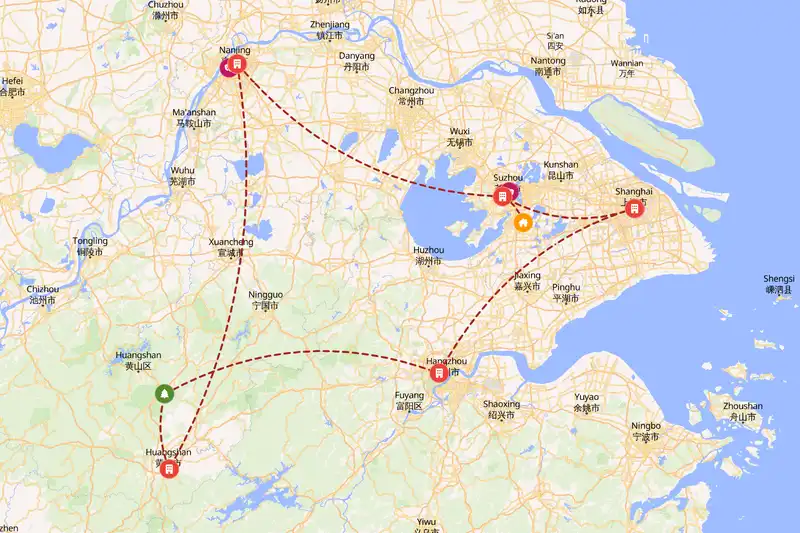
A 2 to 2.5 hour flight ends the trip in Shanghai. Four nights let you treat it as a hub rather than a checklist. Take metro Line 17 about an hour west to Zhujiajiao, a canal town where you can hire a rowboat under its five-arched Fangsheng Bridge. Give another day to Suzhou, 30 minutes away by train, for the Classical Gardens of Suzhou; two gardens before lunch is the right dose. Keep your last evenings for Shanghai itself, with xiaolongbao in the former French Concession and the Bund lit up after dark, before flying home on day 30.
The one place on this route I’d send a friend is Shibaoshan, the temple-dotted mountain between Jianchuan and Shaxi: hire a driver from Shaxi for half a day and save most of your time for the Nanzhao-era carvings in the Shizhong Temple grottoes.v2.webp)

 Best Backpacking