How many cities to visit: Plan on
four to six cities for a trip of three to four weeks, and three or four for two weeks. This is not caution for its own sake. Every city change costs a half day once you add station transfers, security lines, ticket checks and check-in, and Chinese cities are large enough that a single one holds days of worthwhile wandering. An experienced traveler picks fewer places and uses the saved time for neighborhoods, markets and day trips that make a city feel specific.
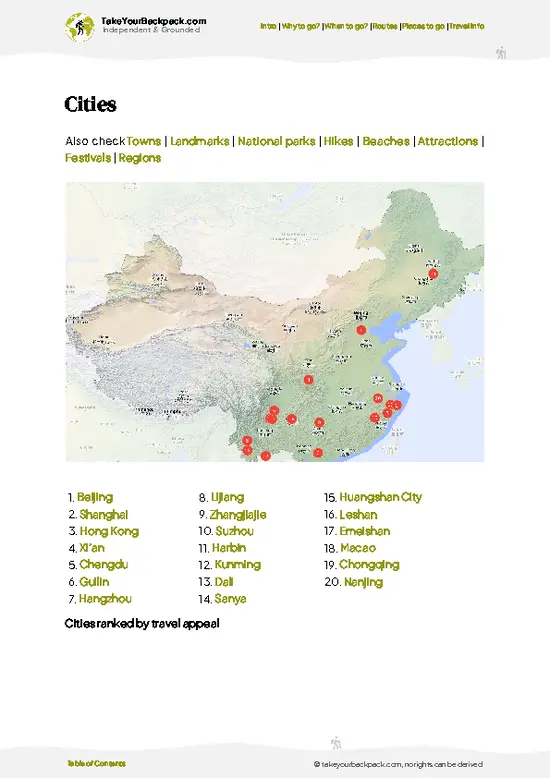
Choosing between kinds of cities: China’s cities fall into broad types, and each suits a different style.
Eastern megacities reward people who like efficiency, nightlife, museums and food variety, and they are the easiest first stop because of English signage on metros, plentiful hostels and fast connections. …
read more 👉 How many cities to visit: Plan on four to six cities for a trip of three to four weeks, and three or four for two weeks. This is not caution for its own sake. Every city change costs a half day once you add station transfers, security lines, ticket checks and check-in, and Chinese cities are large enough that a single one holds days of worthwhile wandering. An experienced traveler picks fewer places and uses the saved time for neighborhoods, markets and day trips that make a city feel specific.
Choosing between kinds of cities: China’s cities fall into broad types, and each suits a different style. Eastern megacities reward people who like efficiency, nightlife, museums and food variety, and they are the easiest first stop because of English signage on metros, plentiful hostels and fast connections. Historic capitals and walled cities suit travelers who want architecture, layered history and street food. Interior provincial capitals are best for those chasing regional cuisine, tea houses and local life at lower cost. Highland and border cities in the southwest and west suit people who want landscape access, ethnic diversity and slower days, but they demand more patience with transport and language. First-timers should anchor the trip in one megacity and one historic or interior city. Repeat visitors can lean toward the less developed regions.
What it costs: A realistic backpacker budget is US$35 to 60 a day (about 250 to 430 yuan) in major eastern cities, and US$25 to 40 in interior and southwestern ones. Dorm beds run roughly US$8 to 20, private budget rooms US$25 to 50. Meals from street stalls and local canteens cost US$2 to 5, while a sit-down restaurant meal is US$8 to 15. Metro rides cost US$0.30 to 1, and high-speed trains typically run about US$8 to 15 per hour of travel in second class. Major attractions charge US$5 to 15, with premium sites such as imperial palaces and famous mountains reaching US$20 to 40 including cable cars. Budget US$10 to 25 for entry per city if you visit two or three paid sights. Guided tours cost US$30 to 80 a day for groups, while private guides run US$80 to 150. Many sights are manageable alone with an audio guide or translation app. Prices rise sharply in holiday weeks, so the cheaper, smarter approach is to travel outside them.
Payments and money handling: Cash still exists but is declining, which is why foreigners get stuck. Shops, taxis and even street vendors expect Alipay or WeChat Pay. Both apps now allow linking Visa, Mastercard and other international cards, with small transaction fees of about 3 percent, and there are per-transaction limits. Set this up before you arrive, carry a backup of 500 to 1,000 yuan in cash, and keep a card for hotels. ATMs at major banks, such as Bank of China, usually accept foreign cards.
Safety: Cities in China have low violent crime and are safe to walk at night by global standards, with extensive camera coverage and visible policing. The usual risks are petty. Watch for pickpockets in crowded stations, scams involving tea house invitations or “art students” in tourist districts, and unlicensed taxi drivers who refuse the meter. Use ride-hailing apps such as Didi, which now supports foreign accounts, or the official taxi line.
Documents, connectivity and rules: Carry your passport at all times. Hotels register you with the police, trains require it for boarding, and some attractions scan it on entry. Foreigners may be asked to show it during spot checks. Reservations for popular museums and sites often open a few days ahead and sell out, and many need a passport number. Buy an eSIM or roaming plan before arrival so that blocked services work without extra steps, and download offline maps and a translation app. Air quality can be poor in northern cities in winter, so check the AQI and carry a few N95 masks.
Cultural considerations: Public behavior is more relaxed than many expect, but a few norms matter. Politics, Tibet, Taiwan and Xinjiang are sensitive topics, so keep them out of casual conversation with strangers. Photography near government buildings and military sites is prohibited. Queuing is looser than in Western countries, and a firm but calm approach works better than irritation. At meals, sharing dishes is standard, and stabbing chopsticks upright into rice is considered bad luck. Squat toilets are common outside hotels and malls, and carrying tissue is wise because paper is often not provided. Tipping is not expected. Learning a few phrases, such as nihao, xiexie and duoshao qian, gets warmer responses than expected, and many people are glad to help with apps if you show patience.
v2.webp)





 Best Backpacking
.jpg) Hi, I’m Johan (Netherlands 🇳🇱), the creator of TakeYourBackpack. Over the past 3 decades, I’ve backpacked through 90+ countries across six continents, gaining extensive experience with independent travel, long-term trips, and overland routes.
Hi, I’m Johan (Netherlands 🇳🇱), the creator of TakeYourBackpack. Over the past 3 decades, I’ve backpacked through 90+ countries across six continents, gaining extensive experience with independent travel, long-term trips, and overland routes.