×
Democratic Republic of the Congo🇨🇩 | 21 days itinerary

A Complete 21-Day Plan for DR Congo

By Johan Kruseman 🇳🇱 | Updated April 12, 2026
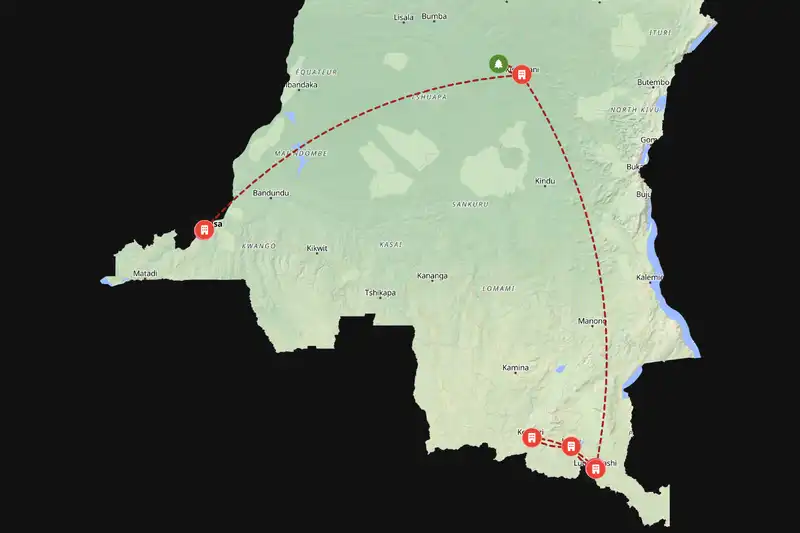
This 21-day route is for travelers who want to go beyond the headline parks and really feel the scale of the DRC, combining big cities, river country, highland lakes, and multiple national parks at a measured, exploratory pace. You’ll stitch the journey together with domestic flights between major hubs like Kinshasa, Lubumbashi, and Goma, plus 4x4s, boats, and the occasional long road day, but never so many back-to-back that the trip turns into a transport marathon.

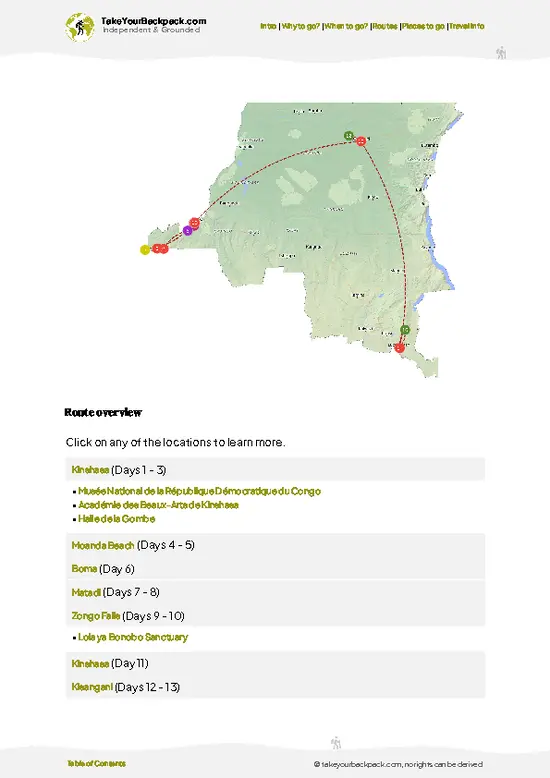
Days 1-4: Kinshasa Deep Dive & Zongo Falls

Begin in Kinshasa, giving yourself three full days to get under the skin of the capital instead of just skimming the surface. Start at the Musée National de la République Démocratique du Congo to anchor everything you’ll see later in history and culture, then spend time at the Académie des Beaux-Arts de Kinshasa watching artists work and seeing how contemporary Congolese art responds to the country’s realities. Add evenings or afternoons at the Halle de la Gombe / Institut Français de read more 👉
This 21-day route is for travelers who want to go beyond the headline parks and really feel the scale of the DRC, combining big cities, river country, highland lakes, and multiple national parks at a measured, exploratory pace. You’ll stitch the journey together with domestic flights between major hubs like Kinshasa, Lubumbashi, and Goma, plus 4x4s, boats, and the occasional long road day, but never so many back-to-back that the trip turns into a transport marathon.

Days 1-4: Kinshasa Deep Dive & Zongo Falls

Begin in Kinshasa, giving yourself three full days to get under the skin of the capital instead of just skimming the surface. Start at the Musée National de la République Démocratique du Congo to anchor everything you’ll see later in history and culture, then spend time at the Académie des Beaux-Arts de Kinshasa watching artists work and seeing how contemporary Congolese art responds to the country’s realities. Add evenings or afternoons at the Halle de la Gombe / Institut Français de Kinshasa and Centre Culturel Boboto if there are concerts, films, or talks on, and balance it with a visit to the Jardin Zoologique de Kinshasa and the Cathédrale Notre-Dame du Congo for a sense of how locals use public and spiritual spaces. Then take a two-day road escape to Zongo Falls, spending a night near the roaring cascade so you can enjoy the falls without rushing, and returning via the Bombo Lumene Game Reserve for a quick taste of savanna and river landscapes.

Days 5-8: Lubumbashi & Copperbelt Highlands

Fly to Lubumbashi, the Copperbelt hub with a very different feel from Kinshasa. Use your first day to walk the city center, then dive into the region’s mining and social history at the Musée National de Lubumbashi, which gives context to the landscapes you’ll see next. Visit the Jardin Zoologique de Lubumbashi and the Cathédrale Saints Pierre et Paul de Lubumbashi for a sense of local life, then take a day trip or overnight out toward Kundelungu National Park, where you can pair the plateau scenery with a hike on the Kundelungu Plateau Trail. If you want to go deeper into the Copperbelt story, add a stop at the Musée de la Gécamines or a side run to Likasi or Kolwezi, but keep at least one day relatively light so you’re not stacking long drives on top of each other.

Days 9-13: Eastern Lakes, Bukavu & Kahuzi-Biega

From Lubumbashi, connect by air and road toward Lake Tanganyika and the eastern corridor, routing via Kalemie or another hub as schedules allow, then onward to Uvira on the northern shore. Use this stretch to feel the shift from Copperbelt plateau to lake and highland country, with a relaxed day along Lake Tanganyika itself to swim, walk the shore, and reset. Continue by road or boat along the lakes and hills to Bukavu, where you base yourself for several days. Spend a full day in Kahuzi-Biega National Park tracking eastern lowland gorillas and walking through dense, moody forest, then another day exploring Bukavu’s streets, the Centre Culturel de Bukavu, and the Cathédrale Notre-Dame de la Paix de Bukavu. If you want a quieter interlude, take a half-day out to Ile de la Lwiro on the lake for a slower, more contemplative side of the region.

Days 14-17: Goma, Virunga & Nyiragongo

Travel by boat along Lake Kivu to Goma, watching the hills and islands slide by as you move from Bukavu’s steep streets to Goma’s lava-rock frontier vibe. Give yourself an afternoon to wander the lakeside and browse the Marché d’Art de Goma, then head into Virunga National Park for a multi-day immersion. One day is dedicated to gorilla tracking and time at the Virunga National Park Senkwekwe Gorilla Orphanage Centre, where you see the long-term conservation work that underpins those magical one-hour encounters. With your legs and lungs tuned, tackle the overnight ascent of Nyiragongo Volcano, sleeping on the crater rim and descending the next day back to Goma. Keep at least one relatively easy day in Goma afterward to rest, process, and enjoy simple pleasures like lakeside meals instead of immediately jumping on another long transfer.

Days 18-21: Idjwi Island & Idling into Departure

For your final phase, slow the pace right down with time on Idjwi Island, reached by boat from Goma. Spend your days walking through banana groves and villages, watching fishermen on Lake Kivu, and letting the noise of cities and the intensity of gorilla and volcano days fade into the background. If you want one last market fix, you can route via Bukavu or back through Goma’s Marché d’Art de Goma before your flight out, but the emphasis here is on reflection and recovery rather than more checklists. You finish the three weeks with a sense of how river, plateau, lake, and volcano all fit together into one huge, complex country instead of just a string of isolated highlights.

For an extra-deep future adventure once you’ve handled this loop, imagine a side expedition to the remote village of Ango in the far northeast, where forest tracks and small communities sit far beyond the usual tourist conversation.
Loading the map 🌍
film
0
0
0a
Kinshasa
film
1
1
1a
Musée National de la République Démocratique du Congo
film
2
2
2a
Jardin Zoologique de Kinshasa
film
3
3
3a
Zongo Falls
film
4
4
4a
Bombo Lumene Game Reserve
film
5
5
5a
Musée National de Lubumbashi
film
6
6
6a
Cathédrale Saints Pierre et Paul de Lubumbashi
film
7
7
7a
Virunga

✈️ The backpacker research shortcutDR Congo Travel Guide

An offline-friendly backpacking guide with optimized travel routes, ranked highlights, transport advice, and the best areas to stay.
example page 0 from our offline Travel Guide for Democratic Republic of the Congoexample page 1 from our offline Travel Guide for Democratic Republic of the Congoexample page 2 from our offline Travel Guide for Democratic Republic of the Congoexample page 3 from our offline Travel Guide for Democratic Republic of the Congoexample page 4 from our offline Travel Guide for Democratic Republic of the Congoexample page 5 from our offline Travel Guide for Democratic Republic of the Congo
The digital guide (323 pages) contains:
96 highlights, ranked by travel appeal
Optimized 7, 14 & 21-day travel routes
Best neighborhoods to stay
How to get around
Offline-friendly for travel without Wi-Fi
👉 See all 30+ guide features

📅 Plan smarter in minutes, not weeks
Month by month travel advice
Festivals & national holidays
Budget expectations

🗺️ Go to the right places, skip the overrated ones
Honest pros & cons of destinations
Top hikes, parks & viewpoints
Lesser-known places most travelers miss
Clear “worth it vs skip it” guidance

🛏️ Travel smoothly without rookie mistakes
Best areas to stay
Transport systems explained simply
Common scams & safety advice
SIM cards, money & practical tips

🌍 Understand the country, not just visit it
Culture & traditions
52 Essential phrases & customs
Festivals worth planning around
Traveler-friendly historical context
Insights that make places more meaningful

📱 Built for real travel conditions
Fully downloadable PDF
Works completely offline
Optimized for phone use
Useful in remote areas & buses
Everything in one place
Save weeks of stressful planning
Get instant access to the full guide directly. 30-day money-back guarantee.


Sent to your inbox immediately after payment • 100% Secure Checkout
Best Backpacking Travel Advisor 2025 tourism awardBest Backpacking
Travel Advisor
2025
What others say about Take Your Backpack Guides:
⭐⭐⭐⭐⭐
Fantastic, amazing amount of information!
⭐⭐⭐⭐⭐
My goodness this is amazing, it's what I've been looking for hats off too you!
⭐⭐⭐⭐⭐
I think this is absolutely BRILLIANT
⭐⭐⭐⭐
Very complete and informative. It's still missing places, but I gotta to commend you
⭐⭐⭐⭐⭐
This is truly amazing, thank you, can't wait to explore it with my kids!
⭐⭐⭐⭐⭐
Awesome resource, thank you!
⭐⭐⭐⭐⭐
This is amazing! Can't wait to explore the ones I haven't seen
⭐⭐⭐⭐
I love this! Well done, great idea.
⭐⭐⭐⭐⭐
Thanks for taking the time to make this gem!
⭐⭐⭐⭐⭐
This might be the best website I've ever seen.
⭐⭐⭐⭐⭐
Congratulations, and thank you so much for your work; it's incredibly valuable.
⭐⭐⭐⭐
In all seriousness I think you did a great job pointing out the important spots
⭐⭐⭐⭐⭐
10/10 very good
⭐⭐⭐⭐⭐
As someone who's only just starting to visit regularly this is awesome, thank you.
⭐⭐⭐⭐
Thank you very much! I'm going to visit my dad, it's going to be very useful!
⭐⭐⭐⭐⭐
This is really cool! We'll be travelling for the first time and this definitely come in handy.
⭐⭐⭐⭐⭐
You are now our minister of culture, congratulations 👨‍💼
⭐⭐⭐⭐⭐
Just wanted to tell you that this is a pearl! Going to follow your recommendations.
⭐⭐⭐⭐⭐
This is so cool. I'll definitely be using the resource for my travels soon.
⭐⭐⭐⭐⭐
This is very impressive! Good work.
⭐⭐⭐⭐⭐
This is an amazing and informative site. Very well done!

🧭 RouteGot More or Less Time?

Travel DR Congo your way — from a quick highlights trip to a slow-paced adventure.

🙋 FAQCommon Questions

Short answer: no, DRC is not an easy independent backpacking country, but it’s doable if you already have experience in West/Central Africa and you’re comfortable with chaos, bureaucracy, and rough conditions.

The main challenges are: visas (often need to be arranged in advance with invitation letters), security (situations can change quickly, especially in the east), and logistics (poor roads, limited public transport, and almost no backpacker infrastructure). English is not widely spoken; French and sometimes Swahili are your real tools.

For a first big trip, DRC is too heavy. For a budget traveler who has already handled places like Nigeria, Angola, or rural Ethiopia, it becomes a serious but manageable project. You’ll rely more on local contacts, guesthouse owners, and fixers than in most countries. In some regions, especially around conflict-affected areas, independent movement is limited or simply not smart; you’ll need to join organized trips or hire local guides.

If you keep your scope tight (for example: Kinshasa + one or two regions like Kongo Central or Goma/Lake Kivu) and accept that things will go wrong, you can travel independently without spending luxury money. The key is to move slowly, stay flexible, and never treat schedules as guaranteed.
For a serious backpacking trip that justifies the visa cost and effort, 2–3 weeks is the realistic minimum. Less than 10 days and you’ll spend half your time just dealing with admin and transport.

Rough timing benchmarks:
- 7–10 days: Kinshasa plus one side trip (e.g., Zongo Falls or Kongo Central). This is a “toe in the water” trip, not a full DRC experience.
- 2 weeks: Kinshasa + Kongo Central region or Kinshasa + Goma/Lake Kivu area (if you’re flying internally). Enough to get a feel for big-city DRC and one contrasting region.
- 3 weeks: Kinshasa, Kongo Central, and the Goma/Lake Kivu area, possibly with a national park visit if your budget and security conditions allow.

Because transport is slow and unpredictable, it’s better to plan fewer regions and go deeper. Trying to “see the whole country” is impossible on a backpacker timeline. Build in at least one buffer day per week for delays, canceled boats, or admin surprises.
You can technically get around without your own car, but it’s not like hopping buses in Southeast Asia. Think: crowded minibuses, shared taxis, river boats, and occasional domestic flights, all with variable safety standards.

Inside cities like Kinshasa, Goma, and Lubumbashi, you’ll mostly use shared taxis and moto-taxis. They’re cheap but chaotic; agree on the price before you get in and avoid motos at night if you can.

Between cities, options are:
- Buses and minibuses: Used by locals, cheap, but slow and often overloaded. Road conditions can be brutal, especially in the rainy season.
- Shared 4x4s: On some routes, you can pay for a seat in a private vehicle. More expensive than buses but often safer and faster.
- Boats: On the Congo River and some lakes, boats and barges are a classic way to move, but they’re slow and can be very basic. Good for patient travelers with time, not for tight schedules.
- Domestic flights: Not very budget-friendly but sometimes the only practical way to cross big distances. If you’re short on time and want to see both Kinshasa and Goma, flying is usually worth the splurge.

Renting your own car is expensive and comes with its own risks (police checks, breakdowns, security). For most backpackers, a mix of public transport, shared vehicles, and the occasional flight is the most realistic approach.
For a budget-conscious backpacker, the must-visits are the places that give you strong DRC character without requiring a private expedition budget.

Top picks:

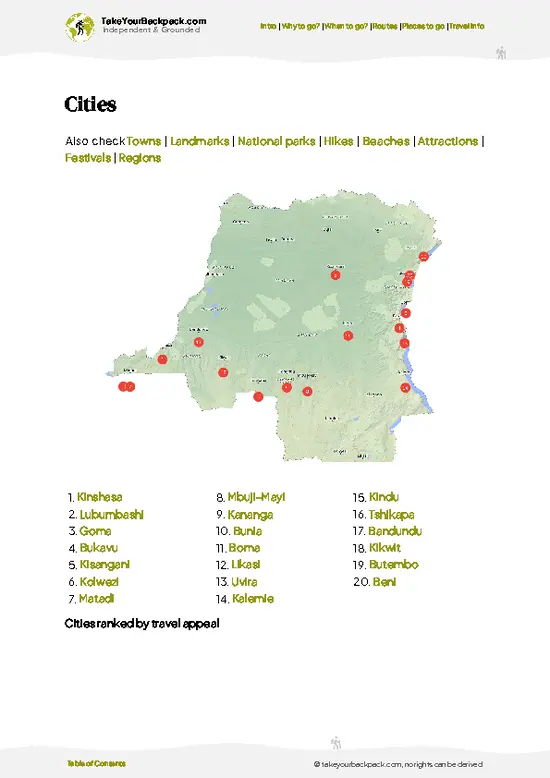
1. Kinshasa
Chaotic, loud, and absolutely full-on. This is where you feel the scale and energy of the country. Walk the markets, check out the street art, listen to Congolese rumba in bars, and watch the river from the banks. It’s not a pretty city break; it’s a sensory overload that explains a lot about modern DRC.

2. Kongo Central (Bas-Congo)
Close enough to Kinshasa to be reachable on a backpacker budget, with greener landscapes and a slower pace. Zongo Falls is the classic trip: big waterfall, forest, and a chance to escape the city heat. The region also has small towns and rural life that are easier to access than the deep interior.

3. Goma & Lake Kivu
If you can get there safely and afford the flight, Goma is one of the most interesting cities in Central Africa: lava-rock streets, lake views, and a frontier-town feel. Lake Kivu offers laid-back lakeside stays, boat rides, and a breather from the intensity of the cities. It’s also a useful base for exploring nearby hills and villages.

4. Virunga National Park (if open and safe, and if your budget allows)
This is the big-ticket nature experience: mountain gorillas, volcano treks, and serious biodiversity. It’s not cheap, even for backpackers, but compared to neighboring countries, gorilla permits here have historically been better value. Only worth it if security conditions are acceptable and you’re ready to spend more than your usual daily budget.

5. Everyday street life
Markets, roadside food stalls, riverfronts, and bus stations are where DRC really gets under your skin. Even if you don’t tick off many “sights,” spending time just watching how the country moves is a must-do experience in itself.
If you’re short on time or money, skip anything that eats days in transit without giving you a unique payoff.

1. Over-ambitious cross-country routes
Trying to cross huge chunks of DRC by road or river on a tight schedule is a trap. Multi-day river journeys and long-haul bus routes can be fascinating but are slow, uncomfortable, and prone to delays. If you only have 2 weeks, pick one or two regions and ignore the rest.

2. Remote interior towns just for the map tick
Unless you have a specific reason (research, family, volunteering), going deep into the interior just to say you’ve been there usually means huge effort for limited reward. Infrastructure is minimal, and you’ll spend most of your time dealing with logistics rather than actually enjoying the place.

3. Expensive, heavily packaged tours that duplicate cheaper experiences
Some city tours or short excursions are priced for NGO staff and business travelers, not backpackers. You can often recreate the experience by using local taxis, walking, and hiring a local guide on the spot for a fraction of the cost.

4. Trying to see both far west and far east on a purely overland budget
If you can’t afford at least one domestic flight, don’t try to combine Kinshasa with Goma/Lake Kivu in a short trip. Pick one side and explore it properly instead of spending your whole trip in transit.

5. High-end lodges if you’re not doing a specific activity
Some lodges around parks and lakes are priced for luxury travelers. If you’re not actually doing the park activities (gorilla tracking, volcano treks, etc.), staying there just for the room is a poor use of a backpacker budget. Opt for simpler guesthouses and spend your money on the experiences instead.

🇨🇩 DR CongoWhere to Go Next

Ready to build a truly unique trip? Predefined routes are perfect for first-time visitors, but there is so much more to discover. Whether you are chasing a city trip, pristine national parks, local food scenes, or quiet beaches, pick a category to design your own path.