Yes, Tunisia is one of the easier countries in North Africa to backpack on your own, thanks to its dense louage network and its short distances between the main sights.
Shared louages link almost every town from stations at the edge of each city, and they leave when full, so there’s no need to book. Trains cover the coast, and Tunis to
Sousse takes 2 to 2.5 hours. Hostels are rare, but guesthouses and small hotels cost about 60 to 120 TND (US$20 to 40) for a double. Plan on 85 to 155 TND (€25 to 45) a day. French opens more doors than English, though a few words of Tunisian Arabic go a long way.
Ten to fourteen days is the right amount for a first trip to Tunisia. That gives you time for the capital, the Sahel coast and the Sahara without a run of exhausting travel days.
With 5 days, stay in
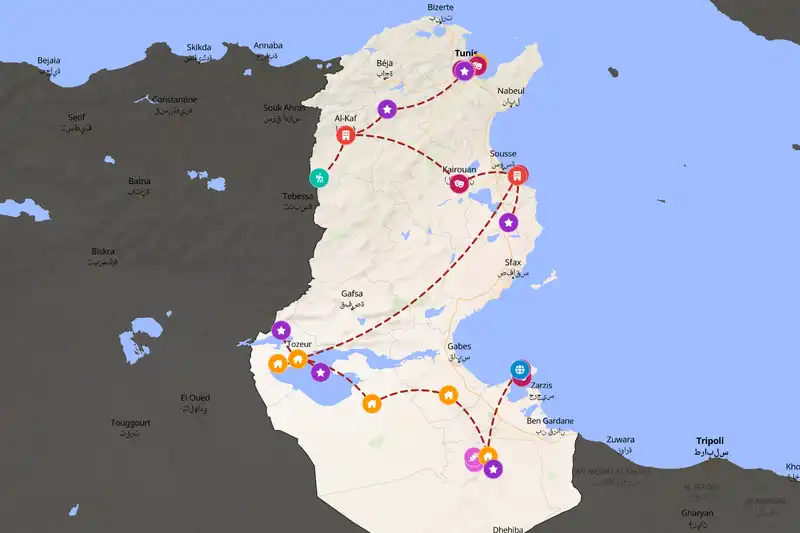
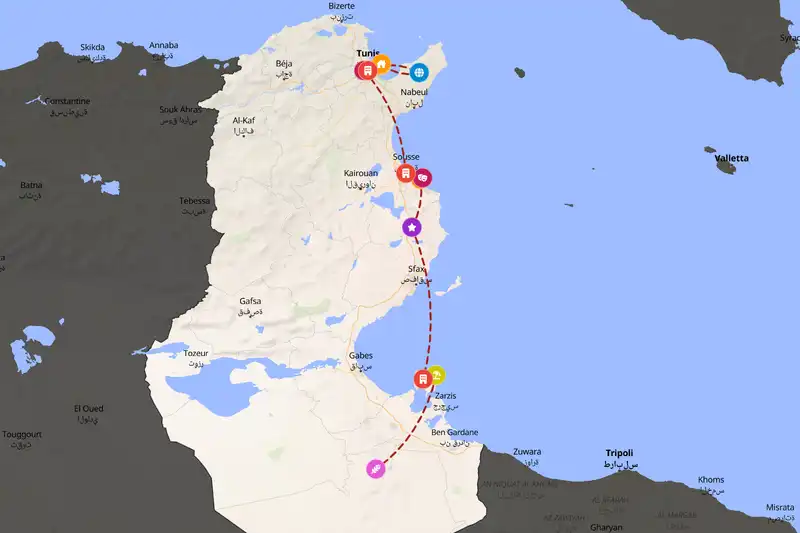
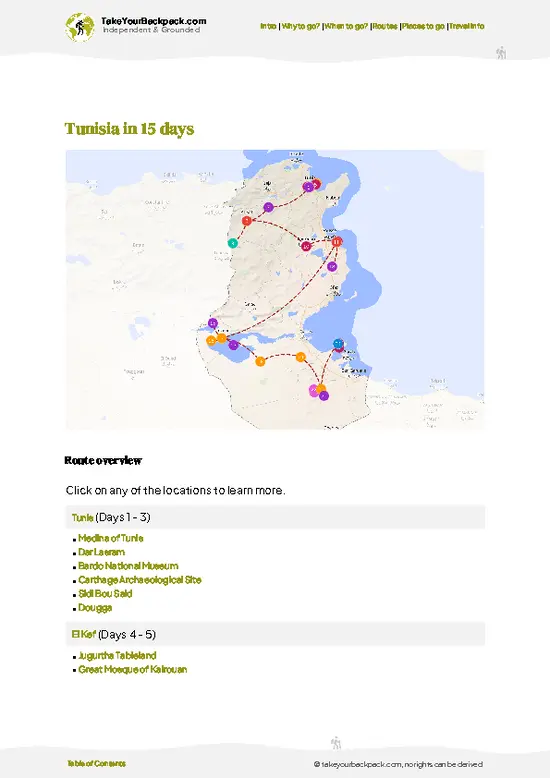
Tunis and do day trips to Carthage, Sidi Bou Said and Dougga. With 10 days, add the coast from Hammamet to Mahdia, with Kairouan and El Jem as side trips. With 15 days, you can do a full loop through El Kef, Tozeur, Douz, Tataouine and Djerba. The south eats time: Tunis to Tozeur is 7 to 8 hours by louage, so allow at least 5 days for the desert and the ksour.
Yes, you can travel almost all of Tunisia without a car by using louages, trains and long-distance SNTRI buses, which together reach every town on a typical route.
Tunis to Sousse costs about 10 to 15 TND (US$3 to 5) by train or louage. Tunis to Djerba is roughly 8 hours by bus, or about an hour by domestic flight. Around Tunis, the TGM light rail reaches Carthage and Sidi Bou Said in about 35 minutes for around 1 TND. The one gap is the ksour around
Tataouine (Chenini, Douiret and Ksar Ouled Soltane), where hiring a taxi for the day costs about 100 to 200 TND (US$32 to 65). For the mountain oases near
Tozeur, join a shared 4x4 tour.
The places in Tunisia that belong on almost every itinerary are the Medina of Tunis, Carthage with Sidi Bou Said, Kairouan, El Jem, Dougga and the desert around Douz and Tozeur.
Give
Tunis 2 to 3 days to cover the souks, the Bardo mosaics and the TGM coast.
Kairouan and
El Jem each take half a day and are about an hour by louage from Sousse.
Dougga makes a full day trip from Tunis, about 2 hours each way. In the south, plan 2 nights in
Tozeur for Chebika and Nefta, and 1 night in
Douz for the dunes. If you have the time,
Chenini near Tataouine and the island of
Djerba complete the picture.
If you’re short on time in Tunisia, skip the resort strips: Port El Kantaoui north of Sousse and the hotel zone of Hammamet Yasmine offer little you can’t find at a beach at home.
Use Sousse’s ribat and medina rather than also making a trip to Monastir, since both towns are only 30 minutes apart and cover similar ground. Gafsa and Sfax work as transit points and aren’t worth an overnight stay on a tight schedule. You don’t need a separate trip to
Chott el Jerid either, because the louage from Tozeur to Douz crosses it on the causeway. And unless you have at least 10 days, keep to the north and the Sahel, since the south needs 4 to 5 days to be worth the ride.
Yes, our itinerary-planner does exactly that. Set your trip length in days, give your interests and travel style, optionally give start- and end location and/or some mandatory stops you would like to include and the itinerary planner creates your personalized routes for Tunisia in seconds. Try it out!
Try the itinerary plannerv2.webp)
 Best Backpacking