×
Tunisia🇹🇳 | 15 days itinerary

The Perfect 15-Day Route for Tunisia

By Johan Kruseman 🇳🇱 | Updated May 9, 2026
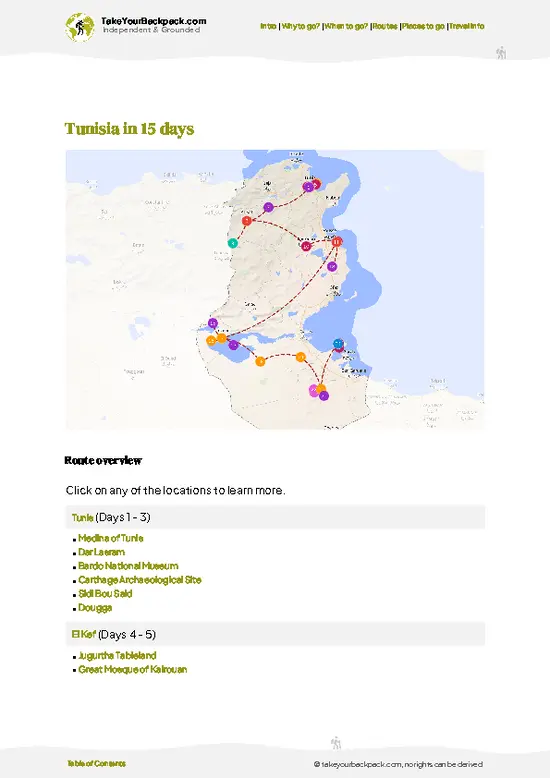
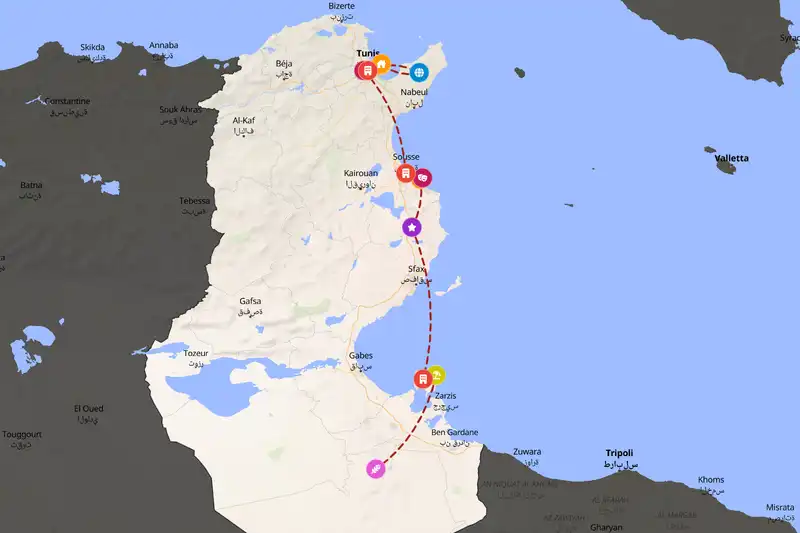
This 15-day itinerary is for travelers who want to really dig into Tunisia: ancient cities, desert treks, mountain plateaus, and enough coast time that you remember this is also a beach country. The pace is steady but exploratory, using a mix of trains, louages, and a couple of targeted private transfers so you can reach more remote spots like Jugurtha Tableland and the Sahara without stacking exhausting travel days back-to-back.

Days 1-3: Tunis, Medina of Tunis, Bardo & Carthage

Start with three nights in Tunis to anchor the whole trip. Spend your first day in the Medina of Tunis, letting yourself drift between the Ez-Zitouna Mosque area and quieter backstreets where workshops still hammer copper and carve wood, then duck into the Dar Ben Abdallah Museum of Traditional Arts and Traditions to see how these crafts fit into everyday life. On day two, give the Bardo National Museum the time it deserves, then wander through Dar Lasram for another angle on old-town architecture before an … read more 👉
This 15-day itinerary is for travelers who want to really dig into Tunisia: ancient cities, desert treks, mountain plateaus, and enough coast time that you remember this is also a beach country. The pace is steady but exploratory, using a mix of trains, louages, and a couple of targeted private transfers so you can reach more remote spots like Jugurtha Tableland and the Sahara without stacking exhausting travel days back-to-back.

Days 1-3: Tunis, Medina of Tunis, Bardo & Carthage

Start with three nights in Tunis to anchor the whole trip. Spend your first day in the Medina of Tunis, letting yourself drift between the Ez-Zitouna Mosque area and quieter backstreets where workshops still hammer copper and carve wood, then duck into the Dar Ben Abdallah Museum of Traditional Arts and Traditions to see how these crafts fit into everyday life. On day two, give the Bardo National Museum the time it deserves, then wander through Dar Lasram for another angle on old-town architecture before an evening on Avenue Habib Bourguiba. Day three is for the coast: ride the TGM to the Carthage Archaeological Site and Carthage National Museum, then continue to Sidi Bou Said for the Sidi Bou Said Coastal Walk, finishing with coffee above the bay before heading back to Tunis.

Days 4-6: Cap Bon, Hammamet & Hammamet Beach

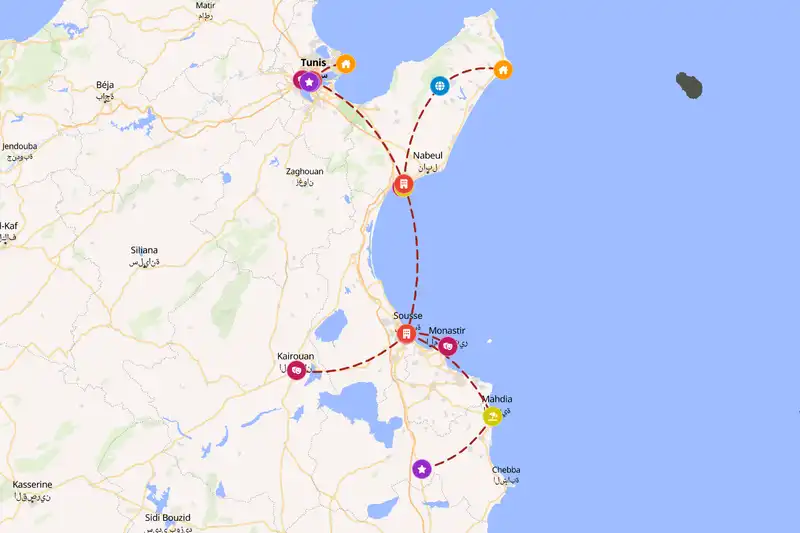
Shift your base to the Cap Bon region, where sea breezes and citrus groves change the mood completely. Settle into Hammamet for two nights, using your first afternoon to explore the old town and climb the Kasbah of Hammamet for views over the bay. The next day is all about Hammamet Beach, where you can swim, try water sports, or just sprawl with a book and let your legs recover from city walking. On day six, keep things flexible: you can linger in Hammamet, take a short side trip along Cap Bon, or simply enjoy a slow morning before transferring south, avoiding any sense of rush.

Days 7-9: Sousse, Monastir, Amphitheatre of El Jem & Mahdia Beach

Continue by train to Sousse and give yourself three nights to work the central coast properly. Use your first day to explore the medina and cool off on Sousse Beach, then visit the Sousse Archaeological Museum, where mosaics and artifacts are displayed inside a fortress-like kasbah. On day eight, hop down to Monastir to climb the towers and walk the courtyards of the Ribat of Monastir, then loop back via the Amphitheatre of El Jem, whose massive stone arcs make it one of the most impressive Roman sites anywhere in North Africa. Day nine is your coastal exhale: head to Mahdia Beach for softer sands and a more laid-back feel than Sousse, giving you a full day to swim and wander the old town before returning to your base.

Days 10-12: Kairouan, Sbeitla Region & Jugurtha Tableland

Turn inland to Kairouan for a night, where the Kairouan Great Mosque and Medina Monuments anchor a quieter, more contemplative city; the rhythm here is slower, with carpet workshops and old cisterns adding texture to your walks. From there, continue toward the northwest, using a base in the broader region to reach the Jugurtha Tableland, a flat-topped mountain fortress that rises abruptly from the plains and rewards the climb with huge views and a sense of standing on a natural citadel. If time and logistics allow, you can weave in a visit to the Ruins of Sufetula for another Roman city experience that sees far fewer visitors than El Jem, giving you a more solitary feel among the columns and arches.

Days 13-15: Tozeur, Chebika Oasis & Chott el Jerid

Finish with a desert arc by heading to Tozeur for three nights, spacing this longer transfer so it doesn’t sit right after another big travel day. Use one full day to explore the Chebika Oasis, where palm groves, rocky paths, and small waterfalls give you a taste of desert hiking without requiring expedition-level fitness. Another day, cross the Chott el Jerid, watching the salt flats shift color and shimmer with mirages, stopping for photos and short walks where the crust crunches under your boots before looping back to Tozeur for a final evening among the date palms. On your last morning, you can simply wander the old brick quarters of Tozeur or sit under the shade of the palms, letting two weeks of ruins, beaches, and high plateaus sink in before you head home.
To round things off with a quiet flourish, consider a twilight stroll through the little oasis hamlet of Mides’ lesser-known neighbor Tamerza’s back lanes, where crumbling stone houses and canyon views give you a last, almost secret-feeling glimpse of desert life.
Loading the map 🌍
film
0
0
0a
Medina of Tunis
film
1
1
1a
Ez-Zitouna Mosque
film
2
2
2a
Carthage
film
3
3
3a
Sidi Bou Said
film
4
4
4a
Ruins of Sufetula
film
5
5
5a
Tozeur
film
6
6
6a
Chebika Oasis

✈️ The backpacker research shortcutTunisia Travel Guide

An offline-friendly backpacking guide with optimized travel routes, ranked highlights, transport advice, and the best areas to stay.
example page 0 from our offline Travel Guide for Tunisiaexample page 1 from our offline Travel Guide for Tunisiaexample page 2 from our offline Travel Guide for Tunisiaexample page 3 from our offline Travel Guide for Tunisiaexample page 4 from our offline Travel Guide for Tunisiaexample page 5 from our offline Travel Guide for Tunisia
The digital guide (319 pages) contains:
97 highlights, ranked by travel appeal
Optimized 5, 10 & 15-day travel routes
Best neighborhoods to stay
How to get around
Offline-friendly for travel without Wi-Fi
👉 See all 30+ guide features

📅 Plan smarter in minutes, not weeks
Month by month travel advice
Festivals & national holidays
Budget expectations

🗺️ Go to the right places, skip the overrated ones
Honest pros & cons of destinations
Top hikes, parks & viewpoints
Lesser-known places most travelers miss
Clear “worth it vs skip it” guidance

🛏️ Travel smoothly without rookie mistakes
Best areas to stay
Transport systems explained simply
Common scams & safety advice
SIM cards, money & practical tips

🌍 Understand the country, not just visit it
Culture & traditions
52 Essential phrases & customs
Festivals worth planning around
Traveler-friendly historical context
Insights that make places more meaningful

📱 Built for real travel conditions
Fully downloadable PDF
Works completely offline
Optimized for phone use
Useful in remote areas & buses
Everything in one place
Save weeks of stressful planning
Get instant access to the full guide directly. 30-day money-back guarantee.


Sent to your inbox immediately after payment • 100% Secure Checkout
Best Backpacking Travel Advisor 2025 tourism awardBest Backpacking
Travel Advisor
2025
What others say about Take Your Backpack Guides:
⭐⭐⭐⭐⭐
Fantastic, amazing amount of information!
⭐⭐⭐⭐⭐
My goodness this is amazing, it's what I've been looking for hats off too you!
⭐⭐⭐⭐⭐
I think this is absolutely BRILLIANT
⭐⭐⭐⭐
Very complete and informative. It's still missing places, but I gotta to commend you
⭐⭐⭐⭐⭐
This is truly amazing, thank you, can't wait to explore it with my kids!
⭐⭐⭐⭐⭐
Awesome resource, thank you!
⭐⭐⭐⭐⭐
This is amazing! Can't wait to explore the ones I haven't seen
⭐⭐⭐⭐
I love this! Well done, great idea.
⭐⭐⭐⭐⭐
Thanks for taking the time to make this gem!
⭐⭐⭐⭐⭐
This might be the best website I've ever seen.
⭐⭐⭐⭐⭐
Congratulations, and thank you so much for your work; it's incredibly valuable.
⭐⭐⭐⭐
In all seriousness I think you did a great job pointing out the important spots
⭐⭐⭐⭐⭐
10/10 very good
⭐⭐⭐⭐⭐
As someone who's only just starting to visit regularly this is awesome, thank you.
⭐⭐⭐⭐
Thank you very much! I'm going to visit my dad, it's going to be very useful!
⭐⭐⭐⭐⭐
This is really cool! We'll be travelling for the first time and this definitely come in handy.
⭐⭐⭐⭐⭐
You are now our minister of culture, congratulations 👨‍💼
⭐⭐⭐⭐⭐
Just wanted to tell you that this is a pearl! Going to follow your recommendations.
⭐⭐⭐⭐⭐
This is so cool. I'll definitely be using the resource for my travels soon.
⭐⭐⭐⭐⭐
This is very impressive! Good work.
⭐⭐⭐⭐⭐
This is an amazing and informative site. Very well done!

🧭 RouteAlternative Routes

Travel Tunisia your way — from a quick highlights trip to a slow-paced adventure.

🙋 FAQBackpacking FAQ

Yes, Tunisia is very doable as an independent backpacker, especially if you’ve handled places like Morocco, Egypt, or Turkey. It’s cheaper and generally calmer than Morocco, with fewer touts and less chaos, but you still get that North African energy. French helps a lot, but you can get by with basic French phrases, some English, and Google Translate for menus and signs. Arabic is a bonus, not a requirement. Hostels exist in Tunis, Sousse, and a few other hubs, but they’re not everywhere, so you’ll often use cheap guesthouses or small hotels instead of classic dorm hostels. Booking ahead for weekends and holidays is smart, especially in coastal towns. Safety-wise, normal city awareness is enough: keep valuables close on buses and in medinas, avoid flashing tech, and don’t wander dark, empty streets late at night in unfamiliar neighborhoods. As a solo woman, Tunisia is more relaxed than some neighbors, but expect occasional comments; firm, neutral responses and sticking to busier areas at night go a long way. ATMs are common in cities and bigger towns, but carry some cash for smaller places and desert areas. Data is cheap: buy a local SIM at the airport or in town and you’ll be set for maps and translations. Overall, Tunisia is a great first North Africa country for independent travel: compact, affordable, and just adventurous enough without being exhausting.
For a tight backpacking trip that still feels worthwhile, 7–10 days is the minimum sweet spot. That gives you Tunis and Carthage, one or two coastal bases, and a quick taste of the south. If you want to actually breathe, 2 weeks is ideal for most budget travelers. With 14 days you can: spend 2–3 days in Tunis (medina, Bardo Museum if open, Carthage, Sidi Bou Said), 2–3 days on the Sahel coast (Sousse or Monastir plus Kairouan as a day trip), 3–4 days in the south (Tozeur or Douz, desert overnight, maybe Matmata), and still have a buffer day or two for slow buses and lazy beach time. If you’re the type who likes to linger in cafes and talk to people, 3 weeks lets you add Djerba, more desert time, and maybe a second inland town without rushing. Under 5 days, Tunisia becomes a city break with a side dish of ruins; you’ll basically do Tunis, Carthage, and one extra stop and spend a big chunk of time in transit. Over a month, you can really dig into smaller towns, but most backpackers feel they’ve hit the main arc in 2–3 weeks and then move on to Algeria, Sicily, or elsewhere.
You can absolutely get around Tunisia without a car, and most backpackers do. The backbone of budget travel here is louages: shared minibuses or station wagons that run fixed routes and leave when full. They’re cheap, fast, and reach many towns that trains and big buses skip. You usually pay a set price, throw your backpack in the back, and squeeze in; it’s not luxury, but it’s efficient. Trains connect key coastal and northern cities like Tunis, Sousse, Monastir, and sometimes further, and they’re comfortable and inexpensive, though not always frequent. For inland and southern routes, long-distance buses and louages are your main tools. Expect some waiting around at stations, especially in smaller towns or late in the day, so start early when you have a long hop. Inside cities, you’ll use a mix of walking, cheap taxis, and sometimes light rail or metro in Tunis. Always insist on the meter in taxis or agree a price before getting in; if the driver refuses, just walk away and flag another. Hitchhiking exists but isn’t necessary given how cheap transport is. The only time a rental car really helps is if you want to string together remote desert spots on your own schedule or chase obscure Roman ruins; for a classic backpacking route, public transport plus the occasional taxi is enough and keeps costs low.
For a first-time backpacker in Tunisia, a few places really earn their spot on the itinerary. Tunis and its medina are essential: the old city is dense, lived-in, and full of cheap food, tea houses, and crumbling doorways that look like movie sets. Pair it with Carthage for ruins with sea views and Sidi Bou Said for white-and-blue alleyways and cliffside cafes; it’s touristy but still worth it for the atmosphere and photos. On the coast, Sousse makes a great base: a compact medina, easy beach access, and cheap trains and louages to Monastir and Kairouan. Kairouan itself is a must if you care about history and architecture: the Great Mosque, old cisterns, and quiet backstreets feel very different from the coast and give you a more traditional inland vibe. In the south, Tozeur is the standout: palm oases, brick architecture, and access to desert landscapes and canyon villages like Chebika and Tamerza. If you want a simple desert experience, Douz is the classic jumping-off point for camel treks and overnight camps in the dunes. Djerba is worth it if you have time for a slower, island pace: whitewashed villages, beaches, and a mix of Berber, Arab, and Jewish heritage. If you’re into Roman history, El Jem’s amphitheater is one of the most impressive in the world and easy to combine with Sousse or Sfax. Those spots together give you a strong mix of medinas, ruins, coast, and desert without blowing your budget.
If you’re short on time, skip anything that’s just a weaker version of something better you’re already seeing. You can skip generic resort strips like the hotel zones in Hammamet or the more isolated package-tour beaches; they’re fine for all-inclusive holidays but add little for a backpacker who wants character and street life. If you’re already doing El Jem, you can skip smaller or more ruined Roman sites unless you’re a hardcore archaeology fan; the big amphitheater scratches that itch well. If your schedule is tight, you can also skip Matmata and the Star Wars cave houses; they’re interesting but often feel staged and require a detour that eats a lot of time. Many inland small towns are pleasant but not essential unless you have a specific reason to go, so don’t feel guilty about focusing on a few hubs instead of trying to ‘collect’ places. If you only have a week, prioritize Tunis + Carthage + Sidi Bou Said, one coastal base (Sousse or Monastir) with a day trip to Kairouan, and either Tozeur or Douz for a taste of the south. In that case, skip Djerba; it’s better when you have time to slow down. Also skip trying to cram both deep desert and multiple islands into a short trip; long transfers will eat your days, and you’ll spend more time in louage stations than actually exploring.

🇹🇳 TunisiaMore of Tunisia

Ready to build a truly unique trip? Predefined routes are perfect for first-time visitors, but there is so much more to discover. Whether you are chasing a city trip, pristine national parks, local food scenes, or quiet beaches, pick a category to design your own path.