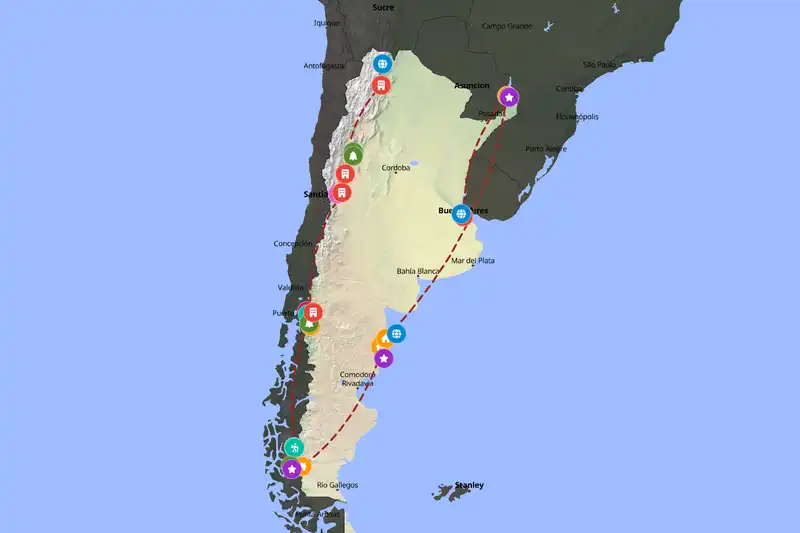
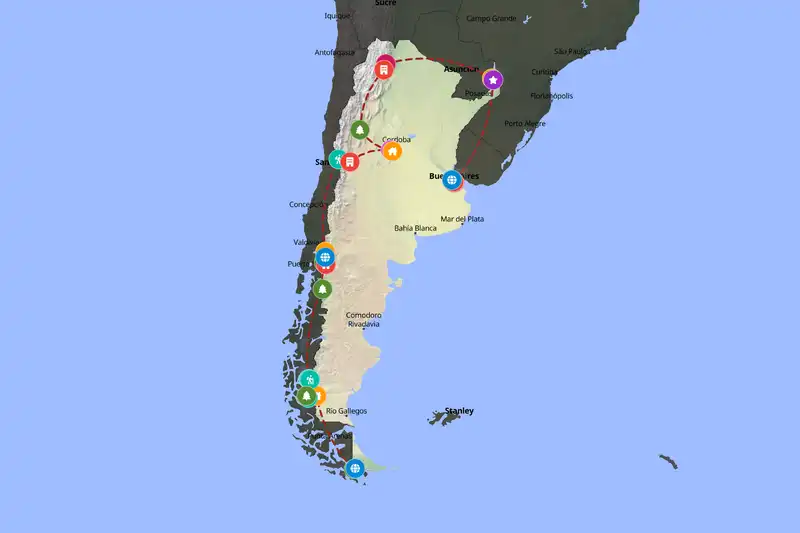
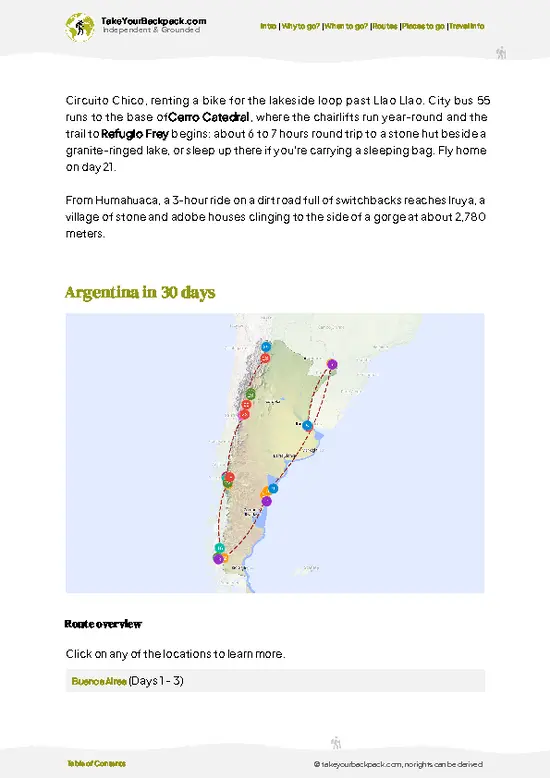
Three weeks is enough to see Argentina’s biggest contrasts without living in airports: the capital, subtropical waterfalls, the high desert north, wine country and the Andean lakes. This route suits first-time visitors who want variety at a moderate pace, with two to four nights per stop. It relies on four or five domestic flights, a couple of scenic regional bus rides in the northwest and city buses in Bariloche, plus one or two day tours for the high-altitude sights.
Days 1-3: Buenos Aires
Three nights in
Buenos Aires lets you see the city at its own late pace. Book the guided tour of
Teatro Colón, an opera house that opened in 1908 and whose horseshoe auditorium is ranked among the best for acoustics in the world, and grab cheap standing-room tickets if a performance is on. Walk the lanes of the
Cementerio de la Recoleta in the morning light, then cross town to La Boca for
La Bombonera, the Boca Juniors stadium where the stands are so steep they seem to lean over the pitch. A match day …
read more 👉Three weeks is enough to see Argentina’s biggest contrasts without living in airports: the capital, subtropical waterfalls, the high desert north, wine country and the Andean lakes. This route suits first-time visitors who want variety at a moderate pace, with two to four nights per stop. It relies on four or five domestic flights, a couple of scenic regional bus rides in the northwest and city buses in Bariloche, plus one or two day tours for the high-altitude sights.
Days 1-3: Buenos Aires
Three nights in Buenos Aires lets you see the city at its own late pace. Book the guided tour of Teatro Colón, an opera house that opened in 1908 and whose horseshoe auditorium is ranked among the best for acoustics in the world, and grab cheap standing-room tickets if a performance is on. Walk the lanes of the Cementerio de la Recoleta in the morning light, then cross town to La Boca for La Bombonera, the Boca Juniors stadium where the stands are so steep they seem to lean over the pitch. A match day there is louder than any concert. Go with an organized group rather than on your own.Days 4-6: Puerto Iguazú, Iguazu Falls and Iguazu National Park
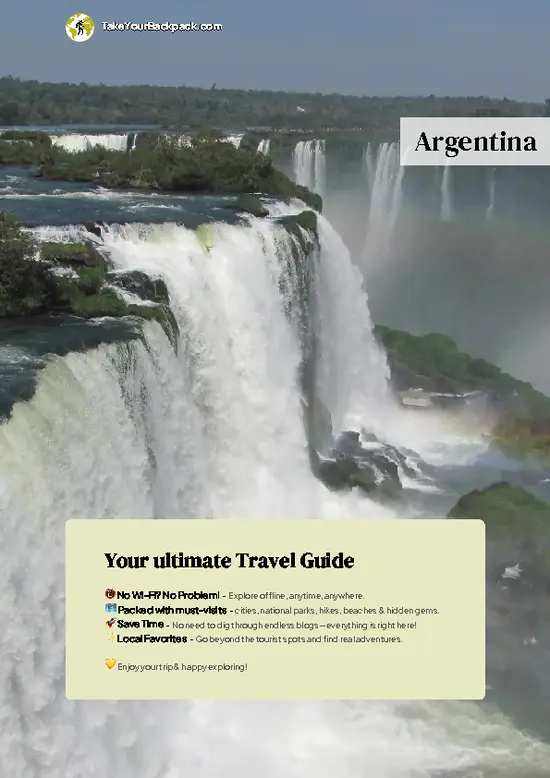
A flight of under two hours swaps the city for humid jungle in Puerto Iguazú. Give Iguazu National Park one full day for the upper and lower trails and the walkway to the Garganta del Diablo, where nearly half of Iguazu Falls drops into one horseshoe. The third day is flexible: cross to the Brazilian side for the panoramic view of the whole system, or walk the quieter Sendero Macuco to a swimming hole beneath a smaller waterfall.Days 7-8: Salta
Fly to Salta (usually via Buenos Aires), a colonial city at 1,150 meters with pink and white churches and cool evenings. Ride the cable car up Cerro San Bernardo at sunset, then head to a peña on Calle Balcarce for folk music, empanadas salteñas and locro.Days 9-10: Cafayate
The 4-hour bus south through the Quebrada de las Conchas is the best scenery you can get for the price of a bus ticket, with red rock amphitheaters right outside the window. Cafayate is a small wine town built around Torrontés, a crisp white grape that suits the 1,700-meter altitude, and the bodegas are close enough to reach by rented bicycle.Days 11-12: Purmamarca, Las Salinas Grandes and Serranía de Hornocal
Take a long but straightforward transfer back through Salta and north to Purmamarca, where the Cerro de los Siete Colores glows behind the adobe village at dawn. A shared tour climbs the Cuesta de Lipán, topping out above 4,100 meters, to Las Salinas Grandes, a white salt flat that crunches underfoot. Another tour goes north past Humahuaca to Serranía de Hornocal, a mountain range striped in more than a dozen colors, viewed from a lookout at about 4,350 meters. Walk slowly and drink coca tea.Days 13-16: Mendoza, Mendoza wine region and Valle de Uco
Fly from Jujuy to Mendoza via Buenos Aires and give yourself a lazy first evening on the terraces of Avenida Arístides Villanueva. Rent a bike in Maipú to explore the closer bodegas of the Mendoza wine region, and book a separate day for Valle de Uco, about 90 minutes south, where vineyards at 1,000 to 1,500 meters face a wall of snowy Andes and lunches stretch to five courses. Four nights includes a free day to recover from the tastings.Days 17-21: San Carlos de Bariloche, Cerro Catedral and Refugio Frey
Fly to San Carlos de Bariloche (direct in some seasons, otherwise via Buenos Aires) on the edge of Nahuel Huapi National Park. Take city bus 20 along the Circuito Chico, renting a bike for the lakeside loop past Llao Llao. City bus 55 runs to the base of Cerro Catedral, where the chairlifts run year-round and the trail to Refugio Frey begins: about 6 to 7 hours round trip to a stone hut beside a granite-ringed lake, or sleep up there if you’re carrying a sleeping bag. Fly home on day 21.
From Humahuaca, a 3-hour ride on a dirt road full of switchbacks reaches Iruya, a village of stone and adobe houses clinging to the side of a gorge at about 2,780 meters.
 Best Backpacking