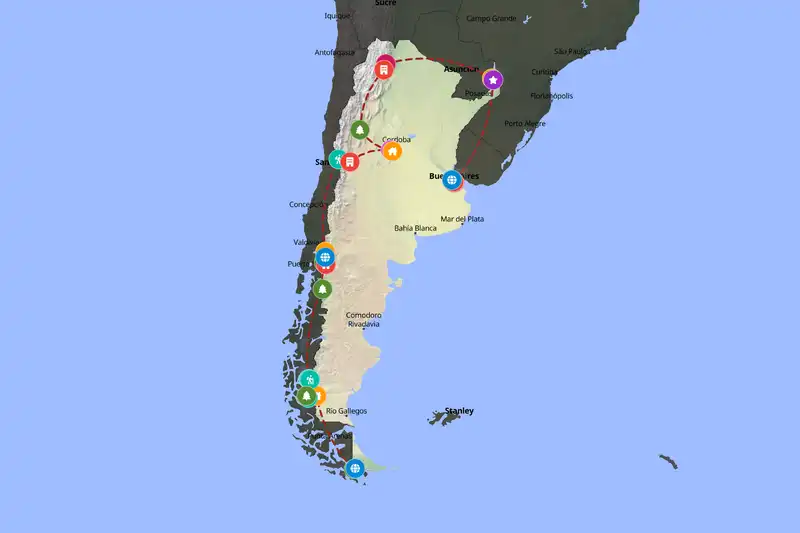
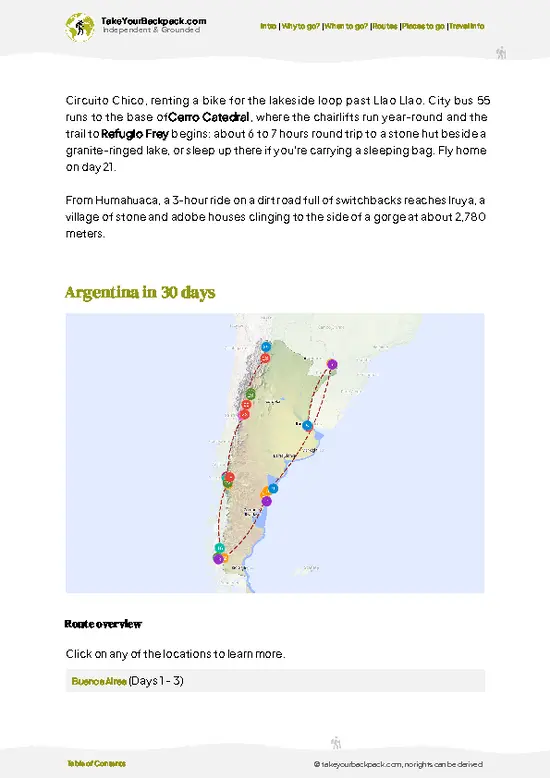
This month-long route suits travelers who want Argentina’s full range: whale coast, ice fields, Andean lakes, dinosaur deserts and the colored north, with time to actually walk around once you arrive. The pace is relaxed, with two or three nights almost everywhere and four nights where weather or trails require it. Expect about eight domestic flights (several connecting through Buenos Aires), a handful of regional buses, the commuter train to Tigre and a few organized day tours to parks that public transport doesn’t reach.
Days 1-3: Buenos Aires and the Tigre Delta
Start your first visit to
Buenos Aires with its architecture.
Palacio Barolo, a 1923 office tower laid out according to Dante’s Divine Comedy, runs guided tours that end inside the lighthouse dome with views over Avenida de Mayo.
El Ateneo Grand Splendid is a 1919 theater turned bookshop, and you can order coffee on the old stage. The free
Museo Nacional de Bellas Artes fills a slow afternoon with Argentine painters you won’t …
read more 👉This month-long route suits travelers who want Argentina’s full range: whale coast, ice fields, Andean lakes, dinosaur deserts and the colored north, with time to actually walk around once you arrive. The pace is relaxed, with two or three nights almost everywhere and four nights where weather or trails require it. Expect about eight domestic flights (several connecting through Buenos Aires), a handful of regional buses, the commuter train to Tigre and a few organized day tours to parks that public transport doesn’t reach.
Days 1-3: Buenos Aires and the Tigre Delta
Start your first visit to Buenos Aires with its architecture. Palacio Barolo, a 1923 office tower laid out according to Dante’s Divine Comedy, runs guided tours that end inside the lighthouse dome with views over Avenida de Mayo. El Ateneo Grand Splendid is a 1919 theater turned bookshop, and you can order coffee on the old stage. The free Museo Nacional de Bellas Artes fills a slow afternoon with Argentine painters you won’t see anywhere else. On day three, ride the Mitre line train from Retiro to Tigre (about an hour) and board a lancha colectiva, the river bus that delivers groceries and schoolkids, into the brown channels of the Tigre Delta, where stilt houses sit among willows.Days 4-5: Puerto Iguazú and Iguazu Falls
Fly about 1 hour 50 minutes to Puerto Iguazú and settle in on the first evening. Be at the gate of Iguazu National Park when it opens on day five and take the jungle train straight to the Garganta del Diablo walkway before the tour groups arrive. Then work back along the upper and lower circuits, where coatis raid backpacks and the spray from Iguazu Falls soaks you from 50 meters away. One full day covers the Argentine side properly.Days 6-8: Puerto Madryn, Península Valdés and Punta Tombo
This is the long travel day: fly to Trelew (usually connecting in Buenos Aires) and take the hour-long shuttle to Puerto Madryn. Spend one full day on Península Valdés, where southern right whales calve in the gulfs from roughly June to December, elephant seals haul out on the beaches, and orcas hunt sea lion pups at Punta Norte in March and April. The second day goes south to Punta Tombo, the largest Magellanic penguin colony in South America (occupied September to April), and most tours stop on the way back in Gaiman for a Welsh tea of scones and black cake, a leftover from the 1865 settlers.Days 9-11: El Calafate, Perito Moreno Glacier and Los Glaciares National Park
Fly to El Calafate, the service town for the southern ice field. Give one day to the walkways at Perito Moreno Glacier and stay late into the afternoon, when the face breaks most often. Use the second day for a boat trip deeper into Los Glaciares National Park to the Upsala and Spegazzini glaciers, where icebergs the size of houses drift through milky water.Days 12-15: El Chaltén, Laguna de los Tres and Laguna Torre
The 3-hour bus north brings you to El Chaltén, a village of fewer than 2,000 residents that exists for hikers. Do the shorter Laguna Torre trail first (about 18 km round trip, mostly gentle) to warm up your legs and check the clouds over Cerro Torre. Save the first clear forecast for Laguna de los Tres, a 20 to 22 km day whose last kilometer climbs about 400 meters of loose rock to the glacier lake below Fitz Roy. The spare days soak up the wind, which regularly shuts the high viewpoints.Days 16-19: San Carlos de Bariloche, Puerto Blest and Cerro Tronador
Return to El Calafate by bus and catch the roughly two-hour direct flight to San Carlos de Bariloche (via Buenos Aires when it isn’t running). Skip the chocolate-shop strip and head out on the water: the full-day boat to Puerto Blest crosses Lago Nahuel Huapi into dripping Valdivian rainforest close to the Chilean border. On another day, take a tour or the seasonal shuttle to Pampa Linda at the base of Cerro Tronador, an extinct volcano over 3,400 meters high whose hanging glaciers rumble as they shed ice, and walk to the soot-gray Ventisquero Negro.Days 20-21: El Bolsón and Río Azul-Lago Escondido
A 2-hour bus south leads to El Bolsón, a valley town of hop fields, berry farms and craft beer, with a big artisans’ market several days a week. The trails of the Área natural protegida Río Azul-Lago Escondido start just outside town and climb past turquoise river pools to mountain refugios, including the Cajón del Azul gorge, a solid 5 to 6 hour round trip.Days 22-24: Mendoza and Potrerillos
Head back to Bariloche and fly to Mendoza, a city of wide sidewalks and irrigation channels running beside the plane trees. Do one winery afternoon, then use a full day for Potrerillos, about an hour west into the Andes, where the reservoir and the Río Mendoza offer rafting, horseback rides and cool air after the dry heat of the city.Days 25-26: San Juan, Ischigualasto and Talampaya
A 2.5-hour bus brings you north to San Juan, the base for a long day tour (often 13 to 15 hours) covering two neighboring desert parks. Ischigualasto Provincial Park, the “Valle de la Luna”, holds some of the oldest dinosaur fossils ever found among wind-carved shapes like the Submarino. Next door, Talampaya National Park is a red sandstone canyon whose walls rise about 150 meters above petroglyphs and nesting condors.Days 27-30: Salta and the Quebrada de Humahuaca
The final long hop goes to Salta, usually by flight via Buenos Aires. Spend the first evening in a peña with folk guitar and tamales, then take a day tour north through Quebrada de Humahuaca, a UNESCO-listed valley of striped mountains, adobe chapels and llama herds that passes Purmamarca on the way to Humahuaca. Keep the last day free for the colonial center before flying out on day 30.
For a final detour from Salta, take the Cuesta del Obispo road about 160 km west to Cachi, a whitewashed adobe town at 2,280 meters beneath the snowy Nevado de Cachi.

 Best Backpacking