×
Chile🇨🇱 | 21 days itinerary

The Perfect 21-Day Route for Chile

By Johan Kruseman 🇳🇱 | Updated October 20, 2026
This three-week route runs the length of Chile, from the salt flats and canyons of the Atacama to the granite towers of Torres del Paine. It suits travelers with time and curiosity who want cities, desert, volcanoes, an island with its own food and building traditions, and one proper multi-day trek at the end. The pace is moderate: you move every two or three days, with no back-to-back long travel days. You’ll use domestic flights (Santiago to Calama, Calama to Temuco via Santiago, Puerto Montt to Punta Arenas), long-distance buses, the short car-and-bus ferry across the Chacao Channel to Chiloé, a boat to the penguin colony, and the park shuttle and catamaran inside Torres del Paine.

Days 1-2: Santiago

Spend your first two days in Santiago eating and wandering, which is the best way to shake off a long flight. Start at the Central Market of Santiago, a 19th-century iron hall full of fish stalls and seafood counters, then cross the Mapocho River to the Vega Central Market, where locals buy … read more 👉
This three-week route runs the length of Chile, from the salt flats and canyons of the Atacama to the granite towers of Torres del Paine. It suits travelers with time and curiosity who want cities, desert, volcanoes, an island with its own food and building traditions, and one proper multi-day trek at the end. The pace is moderate: you move every two or three days, with no back-to-back long travel days. You’ll use domestic flights (Santiago to Calama, Calama to Temuco via Santiago, Puerto Montt to Punta Arenas), long-distance buses, the short car-and-bus ferry across the Chacao Channel to Chiloé, a boat to the penguin colony, and the park shuttle and catamaran inside Torres del Paine.

Days 1-2: Santiago

Spend your first two days in Santiago eating and wandering, which is the best way to shake off a long flight. Start at the Central Market of Santiago, a 19th-century iron hall full of fish stalls and seafood counters, then cross the Mapocho River to the Vega Central Market, where locals buy avocados, cheese and empanadas and a filling set lunch runs CLP 4,000 to 6,000 (US$4 to 7). A few blocks back, the Chilean Museum of Pre-Columbian Art holds Andean textiles and ceramics from across the continent in a compact building you can cover in two hours.

On day two, take the metro north to the Cementerio General de Santiago in Recoleta. It reads like a history book in marble: grand family mausoleums, the tomb of Salvador Allende, and a memorial wall to people killed under the dictatorship. Quiet, shaded, and almost free of tourists on weekday mornings.

Days 3-4: Valparaíso

The bus to Valparaiso takes 1.5 to 2 hours. Here, focus on the hills as a walker’s puzzle: ride the old funicular elevators up, then lose yourself on stairways that drop between corrugated-iron houses painted every color available at the hardware store. The Valparaíso Street Art and Open-Air Museum on Cerro Bellavista is a loop of large murals worked into the slope, and the graffiti across Cerro Alegre and Cerro Concepción changes month to month. Tip-based walking tours leave from Plaza Sotomayor most mornings and are the fastest way to understand which walls matter and why the port declined after the Panama Canal opened.

Days 5-7: San Pedro de Atacama

This is your first long travel day: back to Santiago airport, a 2-hour flight to Calama, then 1.5 hours by shuttle to San Pedro de Atacama, sitting at about 2,400 meters. Go easy on day one, drink water, and let the altitude settle. The Atacama Desert around town is best explored with a mix of rented bikes and small-group tours that leave before dawn.

Save an evening for the Valle de la Luna Viewpoints and Lookouts. Rather than joining the crowded sunset bus inside the reserve, ride or walk up to the ridge lookouts outside it, where the salt-crusted ridges turn orange and then purple while the Licancabur volcano goes dark on the horizon. After that, book a stargazing session: the sky here is some of the driest and darkest on Earth.

Days 8-10: Pucón and the Lake District

Fly from Calama to Temuco (connecting in Santiago), then take the 1.5 to 2 hour bus to Pucon. You arrive in the Lake District proper: black-sand lake beaches, wood-smoked cafés, and the snow cone of Villarrica volcano looming over town. The Villarrica Volcano Ascent is a full-day guided climb with crampons and ice axe, usually CLP 100,000 to 150,000 (US$105 to 160), and it’s closed whenever volcanic activity rises, so keep two possible days open.

Your other full day goes to Huerquehue National Park, about 45 minutes away by local bus. The Los Lagos trail climbs steeply through monkey puzzle trees to a string of small lakes, 6 to 7 hours return, and on a clear day you look straight across at Villarrica.

Days 11-12: Valdivia

A 3-hour bus brings you to Valdivia, a university city built around rivers, which gives the trip a slower, softer two days. Sea lions loiter by the riverside fish market waiting for scraps, the local brewing tradition comes from 19th-century German settlers, and boats run down the river to the Spanish colonial forts at Niebla and Corral. The city was rebuilt after the 1960 earthquake, the strongest ever recorded, and you can still see sunken land along the riverbanks.

Days 13-15: Chiloé

Expect 6 to 7 hours by bus to Chiloé (Castro), including the half-hour ferry across the Chacao Channel. Castro’s palafitos, houses on stilts over the tidal flats, make a fine base, and the yellow-and-lavender San Francisco church on the main square is the first stop on the Chiloe Churches Route. Sixteen of these wooden churches are UNESCO-listed. Take local buses and small ferries out to Dalcahue and the island of Quinchao to see more, built with shingles and wooden pegs.

On day 15, ride 1.5 hours north to Ancud, where boats from nearby Puñihuil take you close to Humboldt and Magellanic penguins between roughly September and March. Try curanto, a pile of shellfish, meat and potato dumplings steamed over hot stones, before heading back to Castro.

Days 16-17: Punta Arenas and Puerto Natales

Head to Puerto Montt airport (3.5 to 4 hours by bus) and fly 2 hours to Punta Arenas. The next morning, a half-day boat trip runs out to Isla Magdalena National Park, a treeless island covered in Magellanic penguin burrows, from roughly October to March. In the afternoon, catch the 3-hour bus to Puerto Natales, where you pick up rental gear and gas canisters and confirm campsite bookings.

Days 18-21: Torres del Paine and the W Trek

The final phase is a four-day, three-night W Trek in Torres del Paine National Park. Hiking it from west to east, you start with the catamaran across Lago Pehoé and the walk to the blue walls of Grey Glacier, then climb into the Valle del Francés, where hanging glaciers crack and rumble above you. You finish with the steep last hour of moraine to the base of the towers before taking the bus back to Natales for a hot shower and a plate of Patagonian lamb. Book campsites or refugios months ahead, because rangers check reservations at every site.

If a friend of mine had a spare day on Chiloé, I’d send them to Cucao on the Pacific side to walk out to the Muelle de las Almas, a wooden pier that ends in midair above the cliffs, and I’d tell them to bring a real rain shell because the trail is fully exposed to the ocean wind.
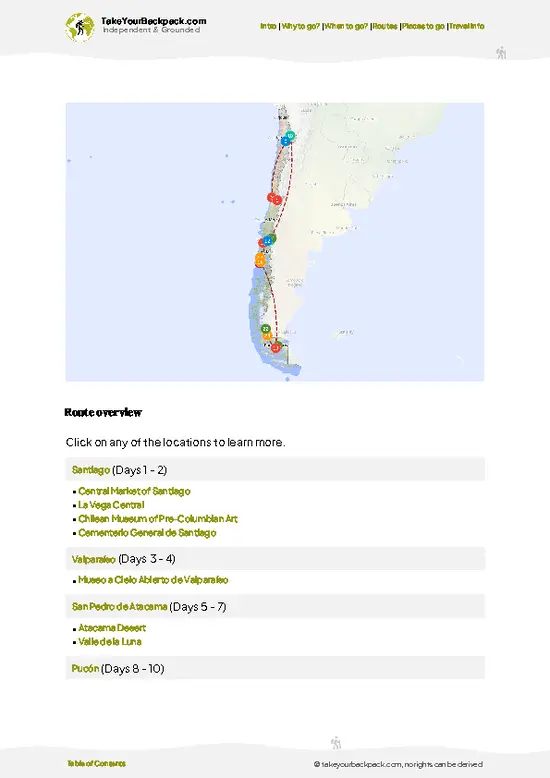
Loading the map 🌍

🛏️ Where to stay?21 Days of Adventure

👉 Click on any of the locations to learn more.
 
Santiago(Days 1 - 2)
 
Valparaíso(Days 3 - 4)
 
San Pedro de Atacama(Days 5 - 7)
 
Pucón(Days 8 - 10)
 
Valdivia(Days 11 - 12)
 
Castro(Days 13 - 15)
 
Punta Arenas(Day 16)
 
Puerto Natales(Day 17)
 
W Trek(Days 18 - 20)
 
Puerto Natales(Day 21)

⚠️ This itinerary is intended as inspiration, not a fixed travel plan. Suggested routes and travel times may not always be feasible due to transport availability, seasonal conditions or other local factors. Always verify all travel logistics before booking.

✈️ The backpacker research shortcutChile Travel Guide

An offline-friendly backpacking guide with optimized travel routes, ranked highlights, transport advice, and the best areas to stay.
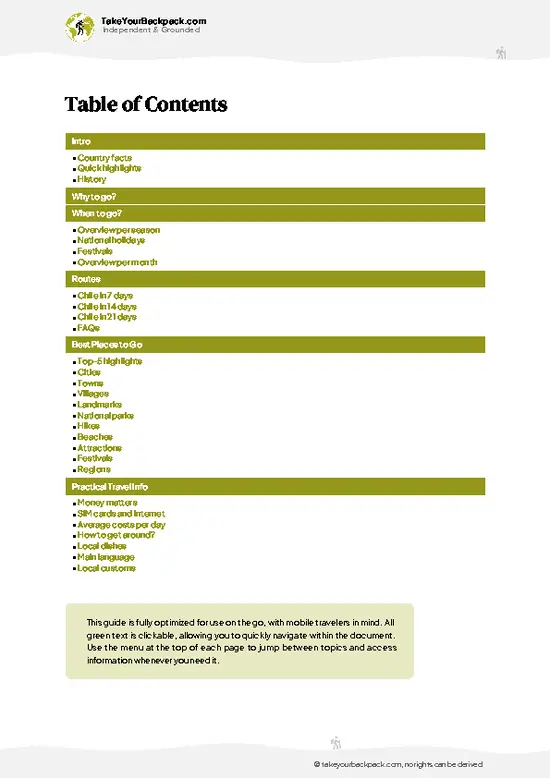
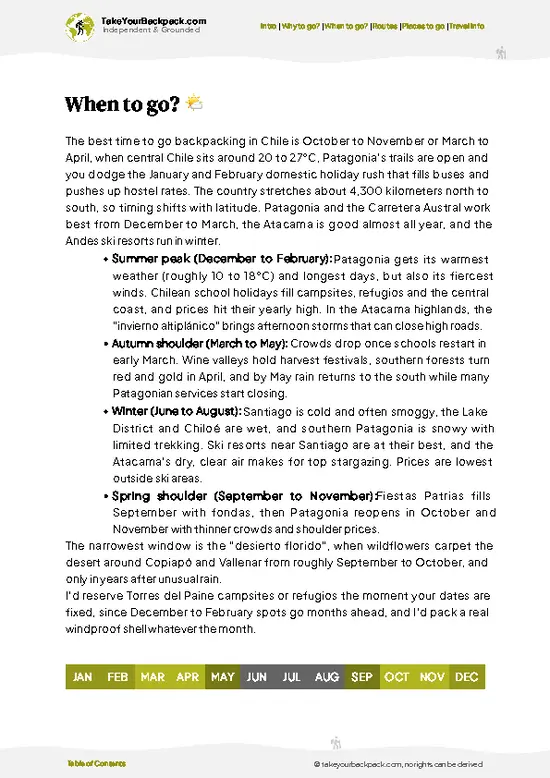
example page 0 from our offline Travel Guide for Chile
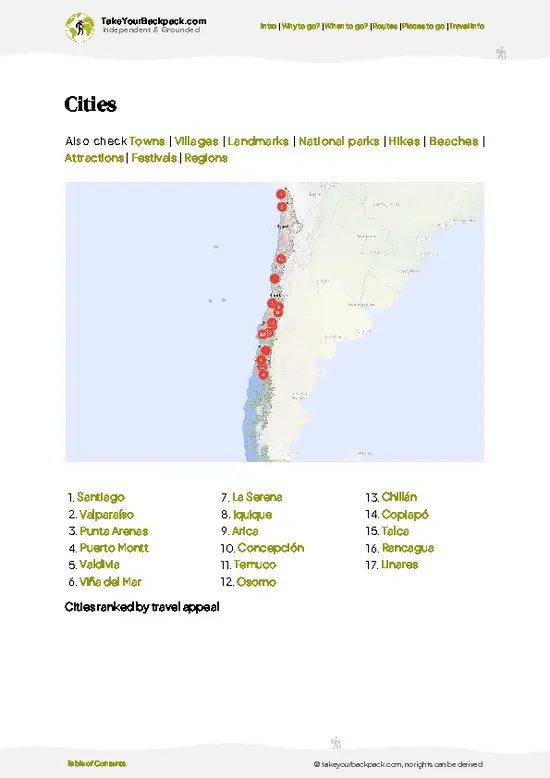
example page 1 from our offline Travel Guide for Chile
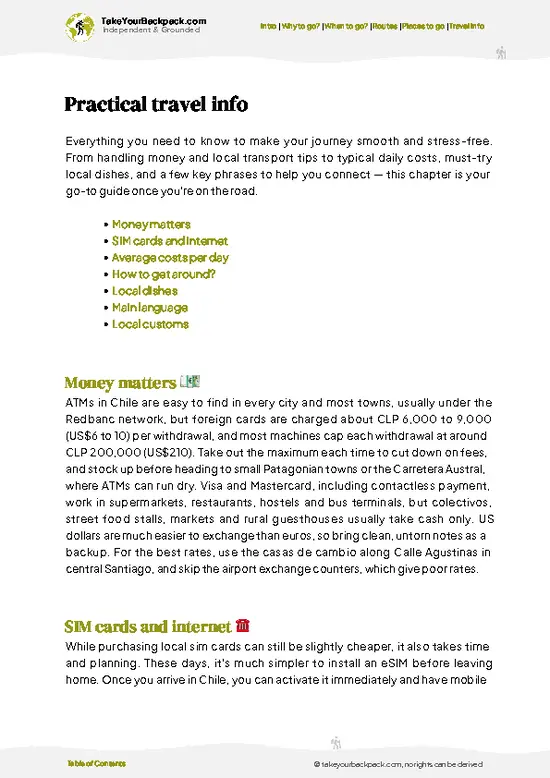
example page 2 from our offline Travel Guide for Chile
example page 3 from our offline Travel Guide for Chile
example page 4 from our offline Travel Guide for Chile
example page 5 from our offline Travel Guide for Chile
example page 6 from our offline Travel Guide for Chile
example page 7 from our offline Travel Guide for Chile
The digital guide (333 pages) contains:
✅ 107 highlights, ranked by travel appeal
✅ Optimized 7, 14 & 21-day travel routes
✅ Cities, national parks, landmarks, beaches
✅ How to get around
✅ Offline-friendly for travel without Wi-Fi
👉 Click to see all 30+ guide features

📅 Plan smarter in minutes, not weeks
✅ Month by month travel advice
✅ Festivals & national holidays
✅ Budget expectations

🗺️ Go to the right places, skip the overrated ones
✅ Honest pros & cons of destinations
✅ Top hikes, parks & viewpoints
✅ Lesser-known places most travelers miss
✅ Clear “worth it vs skip it” guidance

🛏️ Travel smoothly without rookie mistakes
✅ Best areas to stay
✅ Transport systems explained simply
✅ Common scams & safety advice
✅ SIM cards, money & practical tips

🌍 Understand the country, not just visit it
✅ Culture & traditions
✅ 52 Essential phrases & customs
✅ Festivals worth planning around
✅ Traveler-friendly historical context
✅ Insights that make places more meaningful

📱 Built for real travel conditions
✅ Fully downloadable PDF
✅ Works completely offline
✅ Optimized for phone use
✅ Useful in remote areas & buses
✅ Everything in one place
Stop searching, start planning
Get instant access to your full guide. 30‑day money-back guarantee.
+ Add another guide for just

By proceeding you agree to our terms.
Sent to your inbox immediately after payment • 100% Secure Checkout
Best Backpacking Travel Advisor 2025 tourism awardBest Backpacking
Travel Advisor
2025
What others say about Take Your Backpack Guides:
⭐⭐⭐⭐⭐
Fantastic, amazing amount of information!
⭐⭐⭐⭐⭐
My goodness this is amazing, it's what I've been looking for hats off too you!
⭐⭐⭐⭐⭐
I think this is absolutely BRILLIANT
⭐⭐⭐⭐
Very complete and informative. It's still missing places, but I gotta to commend you
⭐⭐⭐⭐⭐
This is truly amazing, thank you, can't wait to explore it with my kids!
⭐⭐⭐⭐⭐
Awesome resource, thank you!
⭐⭐⭐⭐⭐
This is amazing! Can't wait to explore the ones I haven't seen
⭐⭐⭐⭐
I love this! Well done, great idea.
⭐⭐⭐⭐⭐
Thanks for taking the time to make this gem!
⭐⭐⭐⭐⭐
This might be the best website I've ever seen.
⭐⭐⭐⭐⭐
Congratulations, and thank you so much for your work; it's incredibly valuable.
⭐⭐⭐⭐
In all seriousness I think you did a great job pointing out the important spots
⭐⭐⭐⭐⭐
10/10 very good
⭐⭐⭐⭐⭐
As someone who's only just starting to visit regularly this is awesome, thank you.
⭐⭐⭐⭐
Thank you very much! I'm going to visit my dad, it's going to be very useful!
⭐⭐⭐⭐⭐
This is really cool! We'll be travelling for the first time and this definitely come in handy.
⭐⭐⭐⭐⭐
You are now our minister of culture, congratulations 👨‍💼
⭐⭐⭐⭐⭐
Just wanted to tell you that this is a pearl! Going to follow your recommendations.
⭐⭐⭐⭐⭐
This is so cool. I'll definitely be using the resource for my travels soon.
⭐⭐⭐⭐⭐
This is very impressive! Good work.
⭐⭐⭐⭐⭐
This is an amazing and informative site. Very well done!

🧭 RouteMore Ways to Explore

Travel Chile your way — from a quick highlights trip to a slow-paced adventure. Or build your custom route based on your own interests, time and travel style.
👉 Build your own Chile route

🙋 FAQGood to Know

Yes, Chile is one of the easiest countries in South America to backpack on your own, with punctual long-distance buses, hostels in every traveler town and safe tap water in most cities.

Dorm beds run CLP 15,000 to 25,000 (US$16 to 26) in Santiago and up to CLP 35,000 (US$37) in Puerto Natales. Overnight buses like Santiago to Pucón take 10 to 11 hours with reclining seats. The hard parts are cost (plan on US$45 to 80 a day) and Torres del Paine campsites, which need booking months ahead. Chilean Spanish is fast and full of slang, but basic Spanish covers buses and hostels. In San Pedro de Atacama, drink bottled water.
Two weeks is the realistic minimum to see more than one region of Chile, and three weeks lets you go from the Atacama to Patagonia without rushing.

The country is about 4,300 kilometers long, so distance shapes everything. With 7 days, pick one region, such as the 4 to 5 day W Trek with nights in Puerto Natales. In 14 days you can combine Santiago, Valparaíso, 4 nights in San Pedro de Atacama and the Lake District around Puerto Varas. In 21 days you can add Chiloé and Torres del Paine. Santiago to Punta Arenas is a 3.5-hour flight, and reaching San Pedro takes about 5 hours door to door.
Yes, you can cover nearly the whole classic backpacker route in Chile without a car, using intercity buses plus two or three domestic flights.

Santiago to Valparaíso takes 1.5 to 2 hours and costs CLP 4,000 to 8,000 (US$4 to 9). Pucón to Valdivia takes about 3 hours, and Puerto Montt to Castro on Chiloé takes 3.5 to 4 hours including the ferry. Fly for the long jumps to Calama and Punta Arenas, which often cost US$40 to 120 one way if booked ahead with low-cost carriers. A car only becomes really useful on the Carretera Austral, where buses to places like Puyuhuapi and Patagonia National Park run just a few times a week.
The must-visits in Chile are Torres del Paine, San Pedro de Atacama, Valparaíso and the Lake District, with Santiago as the gateway.

Give Torres del Paine 4 to 5 days for the W Trek, and San Pedro de Atacama 3 to 4 nights to adjust to 2,400 meters and catch sunset at the Valle de la Luna. Valparaíso needs 2 nights for its murals and hillside funiculars, and it’s only 1.5 to 2 hours by bus from Santiago, where the Museum of Memory and Human Rights is free. In the Lake District, Pucón or Puerto Varas each deserve 3 nights. Easter Island is worth it if your budget allows, but it’s a 5-hour flight each way and needs 3 to 4 days.
If time is short in Chile, skip the central valley cities like Rancagua, Talca and Concepción, which are pleasant places to live but offer little to someone on a tight schedule.

The far north is another easy cut. Arica and Iquique are about 2.5 hours by air from Santiago and need 2 days each to justify the trip. Viña del Mar works as a 15 to 20 minute side trip from Valparaíso rather than a base. Easter Island needs its own 5-hour flight and 3 to 4 days, so leave it out of a one-week trip. The Carretera Austral deserves 10 days or more by itself, so save it for a second visit.
Yes, our itinerary-planner does exactly that. Set your trip length in days, give your interests and travel style, optionally give start- and end location and/or some mandatory stops you would like to include and the itinerary planner creates your personalized routes for Chile in seconds. Try it out!


Try the itinerary planner

🇨🇱 ChileDiscover the Country

Ready to build a truly unique trip? Predefined routes are perfect for first-time visitors, but there is so much more to discover. Whether you are chasing a city trip, pristine national parks, local food scenes, or quiet beaches, pick a category to design your own path.