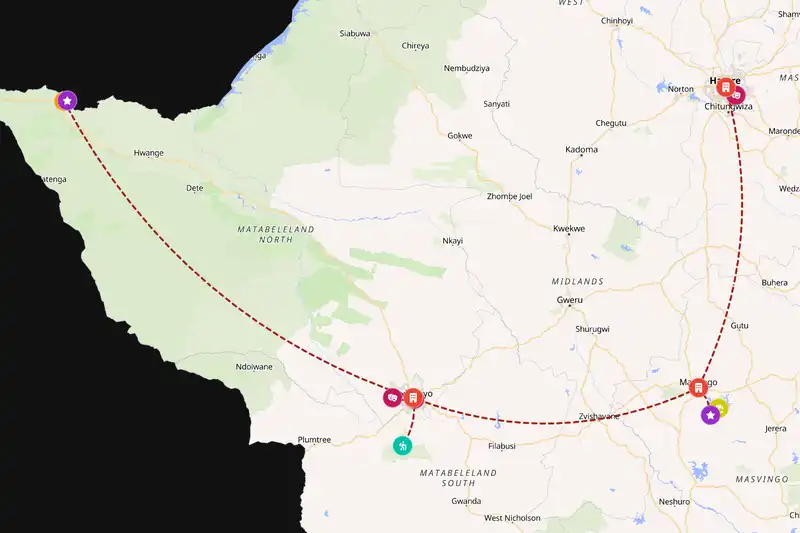
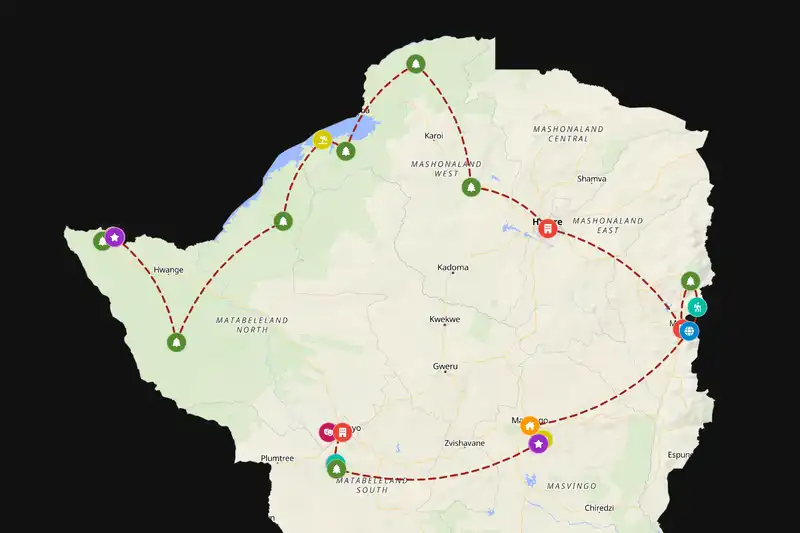
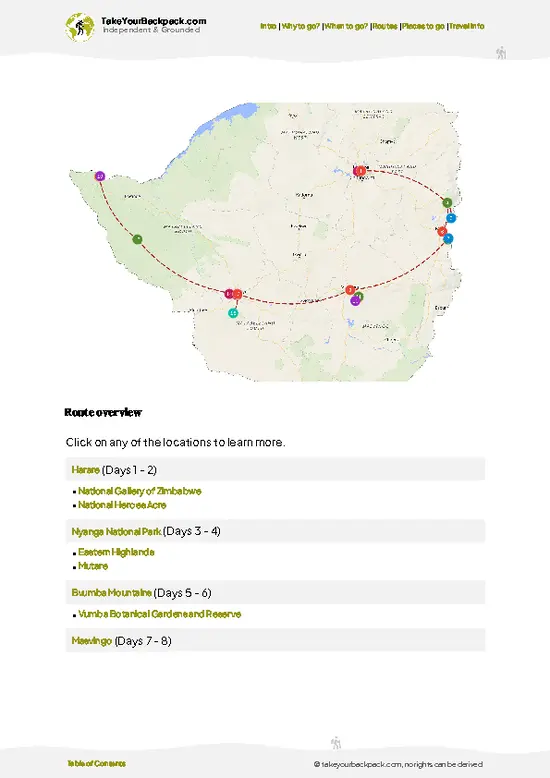
This 15-day loop through Zimbabwe is for travelers with two weeks who want the whole country in one arc: the capital, the cool Eastern Highlands, the stone cities of the old Shona and Torwa states, the granite of Matobo, a proper safari and the falls to finish. The pace is relaxed, with two-night stops nearly everywhere and no two long travel days in a row. You’ll rely on long-distance buses between cities, kombis (minibuses) and taxis for short hops, hired drivers for the national park days, and a shuttle transfer into Hwange.
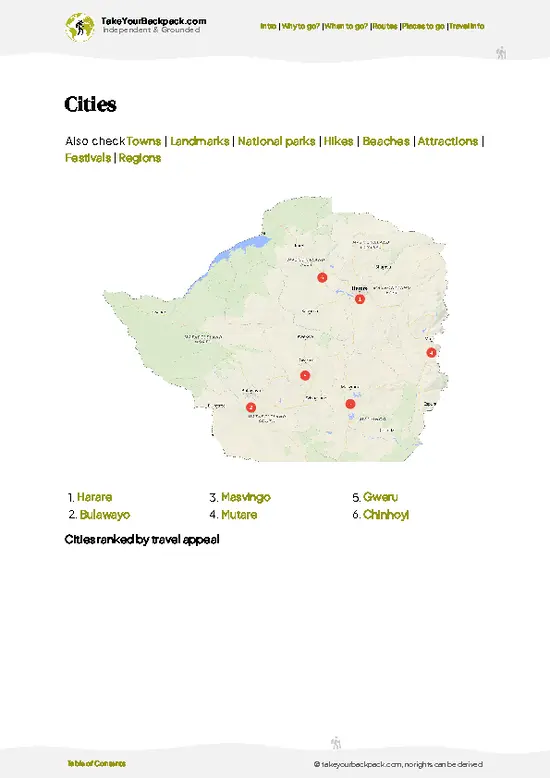
Days 1-2: Harare
Start in
Harare and give the city a full day before heading east. The
National Gallery of Zimbabwe is the best introduction to Shona stone sculpture you’ll find anywhere, with serpentine and springstone pieces in the sculpture garden that make the souvenir stalls elsewhere look tired. In the afternoon, take a taxi about 7 kilometers west to
National Heroes Acre, the hilltop memorial built with North Korean help after independence; visits run with …
read more 👉This 15-day loop through Zimbabwe is for travelers with two weeks who want the whole country in one arc: the capital, the cool Eastern Highlands, the stone cities of the old Shona and Torwa states, the granite of Matobo, a proper safari and the falls to finish. The pace is relaxed, with two-night stops nearly everywhere and no two long travel days in a row. You’ll rely on long-distance buses between cities, kombis (minibuses) and taxis for short hops, hired drivers for the national park days, and a shuttle transfer into Hwange.
Days 1-2: Harare
Start in Harare and give the city a full day before heading east. The National Gallery of Zimbabwe is the best introduction to Shona stone sculpture you’ll find anywhere, with serpentine and springstone pieces in the sculpture garden that make the souvenir stalls elsewhere look tired. In the afternoon, take a taxi about 7 kilometers west to National Heroes Acre, the hilltop memorial built with North Korean help after independence; visits run with a guide, bring your passport, and ask before photographing. It’s a niche stop, but it explains a lot about how the country tells its own story.Days 3-4: Nyanga National Park
A 3 to 4 hour bus ride takes you up into Nyanga National Park, where the air drops to sweater temperatures and the landscape turns to pine, heath and trout streams. Day 4 is for the big Eastern Highlands hike: Mount Nyangani, at 2,592 meters the highest point in Zimbabwe, is a 4 to 5 hour return walk from the base car park. Start early, sign in with the rangers, and turn back if the cloud comes down, because the summit plateau is flat and featureless in mist. If your legs need a rest, Mtarazi Falls and the World’s View escarpment are gentler outings.Days 5-6: Mutare and the Bvumba Mountains
Drop south 1.5 to 2 hours to Mutare, a tidy border city ringed by hills, and stop just long enough for lunch and an ATM run before taking a taxi about 25 kilometers up to the Bvumba Mountains. Two nights here is the slow middle of the trip. Spend day 6 at Vumba Botanical Gardens and Reserve, where terraced lawns give way to wet montane forest with samango monkeys in the canopy and serious birding for anyone carrying binoculars. Evenings are cold enough for a fireplace, even in summer.Days 7-8: Masvingo, Great Zimbabwe and Lake Mutirikwi
The 4 to 5 hour run west to Masvingo crosses the Save River at Birchenough Bridge and drops you into dry, granite-studded lowveld. Sleep near the ruins rather than in town. Give a full morning to Great Zimbabwe, focusing on the Great Enclosure, the largest ancient stone structure in sub-Saharan Africa, built without mortar, and its conical tower; a site guide is worth the fee for the stories behind the walls. In the afternoon, head to Kyle Recreational Park on the shore of Lake Mutirikwi, where you can see giraffe, zebra and antelope on foot or horseback, then end the day at Mutirikwi Beach watching the sun go down over the water (look, don’t swim, because of crocodiles and bilharzia).Days 9-10: Bulawayo, Khami and Matobo
A 4 hour bus brings you to Bulawayo, Zimbabwe’s second city, with streets laid out wide enough to turn an ox wagon. Arrive by midday and take a taxi 22 kilometers west to Khami Ruins National Monument, the terraced stone capital of the Torwa state, which you’ll likely share with a handful of other visitors at most. Day 10 belongs to Matobo National Park, 35 kilometers south, with a hired car and driver. Prioritize the Matobo Hills rock art sites, especially Nswatugi Cave, whose painted giraffes and antelope are among the finest in southern Africa, then climb World’s View for the panorama of balanced granite domes.Days 11-12: Hwange National Park
Use the morning of day 11 for the Bulawayo Railway Museum, where old steam locomotives and Cecil Rhodes’s private carriage sit in the yard, then travel 4 to 5 hours northwest to Hwange National Park. This is Zimbabwe’s largest park at roughly 14,600 square kilometers, and its pumped waterholes pull in huge elephant herds, especially from August to October. Spend day 12 on an early and a late game drive from Main Camp, with a lazy midday at the camp’s hide.Days 13-15: Victoria Falls
The final leg is an easy 2 to 2.5 hour transfer to Victoria Falls town. Walk the Mosi-oa-Tunya / Victoria Falls Rainforest Viewing Area on day 14 and see Victoria Falls from every angle, from Devil’s Cataract to Danger Point. Save the late afternoon for the Victoria Falls Bridge, reached with a gate pass from the Zimbabwe border post; standing over the gorge with the spray drifting past is a fitting end to two weeks on the road. Day 15 is for a slow breakfast and the short ride to the airport.
I’d stop at Tony’s Coffee Shop in the Bvumba for a slab of its famously rich cake on a cold afternoon; go hungry, bring US dollar cash, and don’t plan dinner afterward.v2.webp)
 Best Backpacking