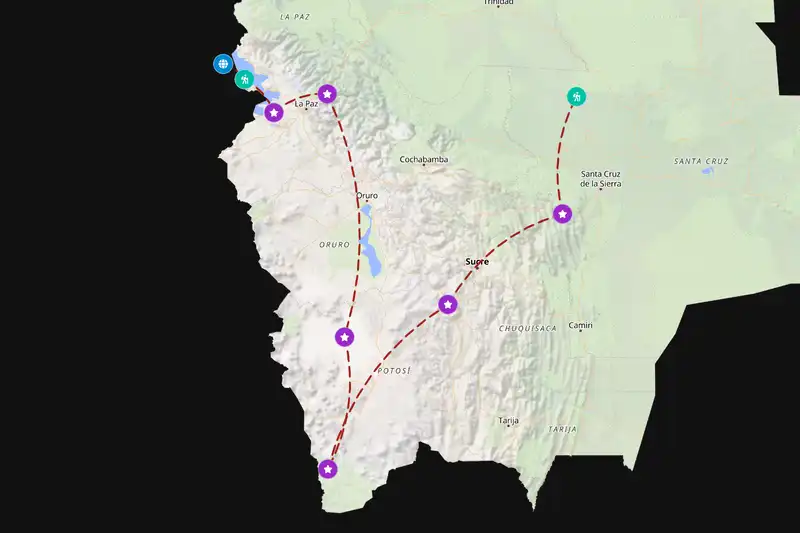
Three weeks in Bolivia is for travelers who want the whole altitude story, starting in the warm lowlands and climbing in stages to the salt flats, the capital’s canyon and the high lake. The pace is relaxed, with one demanding transfer day in the middle. You will use shared taxis, long-distance buses, two short domestic flights, a 4x4 tour vehicle, a mountain bike if you ride the Yungas Road, and boats on Lake Titicaca. Starting low at 400 meters and finishing high is the smartest acclimatization plan the country allows.
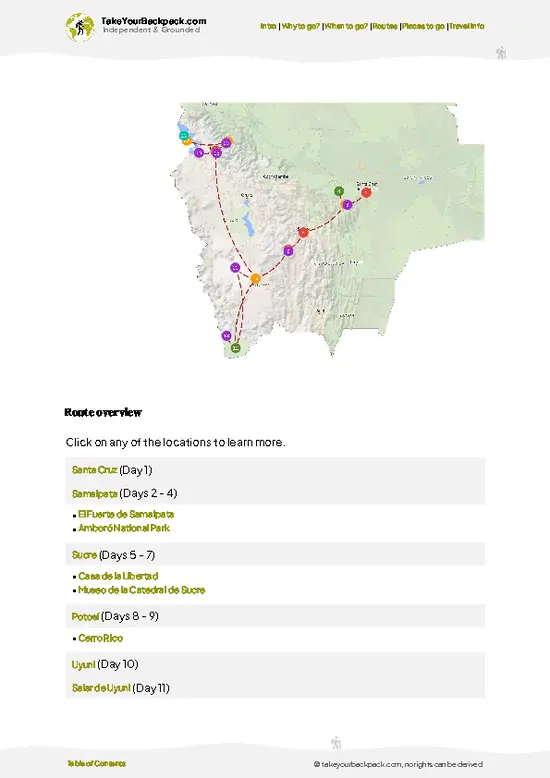
Days 1-4: Santa Cruz and Samaipata
Fly into
Santa Cruz and give yourself one night in the humid, palm-lined center around Plaza 24 de Septiembre, where the cathedral roof walk gives you a first look over terracotta rooftops. Next morning, a shared taxi from the Avenida Grigotá stand gets you to
Samaipata in 2.5 to 3 hours for Bs 30 to 40 (US$2.50 to 3.50).
At 1,650 meters, Samaipata is a whitewashed village of cafés, bakeries and expat-run guesthouses, and three nights here …
read more 👉Three weeks in Bolivia is for travelers who want the whole altitude story, starting in the warm lowlands and climbing in stages to the salt flats, the capital’s canyon and the high lake. The pace is relaxed, with one demanding transfer day in the middle. You will use shared taxis, long-distance buses, two short domestic flights, a 4x4 tour vehicle, a mountain bike if you ride the Yungas Road, and boats on Lake Titicaca. Starting low at 400 meters and finishing high is the smartest acclimatization plan the country allows.
Days 1-4: Santa Cruz and Samaipata
Fly into Santa Cruz and give yourself one night in the humid, palm-lined center around Plaza 24 de Septiembre, where the cathedral roof walk gives you a first look over terracotta rooftops. Next morning, a shared taxi from the Avenida Grigotá stand gets you to Samaipata in 2.5 to 3 hours for Bs 30 to 40 (US$2.50 to 3.50).
At 1,650 meters, Samaipata is a whitewashed village of cafés, bakeries and expat-run guesthouses, and three nights here never feel like too many. Walk or taxi up to El Fuerte de Samaipata, a UNESCO-listed sandstone ridge carved with channels, niches and feline figures by pre-Inca peoples and later used by the Inca. The next day, join a guided trip into Amboró National Park for the giant tree ferns, which grow taller than a two-story house in the cloud forest above the village. Guides charge roughly Bs 250 to 400 (US$21 to 33) per person for a day.Days 5-9: Sucre and Potosi
The direct road from Samaipata to Sucre takes 10 to 12 rough hours, so go back to Santa Cruz and take the 45-minute flight instead. Sucre earns three nights. Its white colonial core at 2,800 meters is the gentlest altitude step you will get, and the city is built for slow wandering between courtyard cafés and the Mercado Central’s juice stalls. Casa de la Libertad holds the hall where independence was signed in 1825, and the Museo de la Catedral de Sucre next to the cathedral shows the silver and gold church treasures that Potosí’s mines paid for.
From Sucre, buses reach Potosi in about 3 hours. At roughly 4,090 meters, it is one of the highest cities on Earth, so use the first afternoon for nothing more strenuous than the steep streets. On day two, take a cooperative mine tour into Cerro Rico with a former miner as your guide (Bs 100 to 200, US$8 to 17). The tunnels are tight, hot and dusty, and they explain the city better than any exhibit. Skip it if you are claustrophobic.Days 10-13: Uyuni and the Lípez
A 4-hour bus brings you from Potosí to Uyuni, a windswept grid of tour agencies and pizza joints. Sleep one night, compare operators in the morning, and leave on a 3-day shared 4x4 tour, typically Bs 1,000 to 1,700 (US$85 to 140) before park fees. Day one crosses the Salar de Uyuni, around 10,000 square kilometers of hexagonal salt crust, with a night in a salt-brick lodge. Day two climbs into the Eduardo Avaroa Andean Fauna National Reserve (Bs 150 entry), past high lagoons and wind-carved rock to Laguna Colorada, whose algae turn the water rust red and feed thousands of flamingos. Pack a real sleeping bag; the refugio there drops well below freezing. Day three brings geysers at dawn, a hot spring soak and the long drive back. Spend that night in Uyuni instead of jumping on a bus.Days 14-16: La Paz
Fly from Uyuni to La Paz in about an hour. Having come up through Potosí, the altitude barely bothers you now, so make use of three full nights. Ride the Mi Teleférico cable car lines (Bs 3 to 5 per ride) for the view down into the canyon, then spend a morning at the Museo Nacional de Arte, housed in an 18th-century palace on Plaza Murillo. The Museo Tambo Quirquincho is a quieter colonial inn turned municipal museum, good for an hour. Take a minibus south to Valle de la Luna for its eroded clay spires, then give a full day to Tiwanaku, about 1.5 to 2 hours west, where the Gate of the Sun and the sunken temple with its carved stone heads explain the culture that dominated this altiplano long before the Inca. Entry runs Bs 100 (US$8).Days 17-18: Yungas Road and Coroico
Riders should book the mountain bike descent of the Yungas Road, the former main route to the lowlands, now mostly traffic-free, dropping around 3,500 vertical meters from La Cumbre into the jungle. A tour costs Bs 600 to 900 (US$50 to 75). Instead of returning with the group van, stay two nights in Coroico, a hillside town at about 1,750 meters with coffee and citrus farms and swimming pools that feel wonderful after the altiplano cold.Days 19-21: Lake Titicaca
Day 19 is your second long transfer: a minibus back to La Paz (about 3 hours), then a bus to Copacabana (3.5 to 4 hours, Bs 25 to 40), including the barge crossing at the Strait of Tiquina. Climb Cerro Calvario for sunset over the lake. Next morning, catch the boat to Isla del Sol and sleep in Yumani, where the Inca stairway and terraced paths of the Isla del Sol Archaeological and Sacred Sites lead up to a ridge with views of the Cordillera Real. On day 21, boat and bus back to La Paz for your flight out.
If I were sending a friend down this route, I’d tell them to stop at the Las Cuevas waterfalls on the road between Santa Cruz and Samaipata and bring a swimsuit, because the three pools are a good place to cool off before the climb into the Andes.v2.webp)

 Best Backpacking